On this page

Vatican II Explained

The Second Vatican Council met in Rome from 1962 to 1965. This page covers what happened there, what its sixteen documents say, how the Mass developed from the Last Supper to today, and how the Church asks Catholics to read the Council.

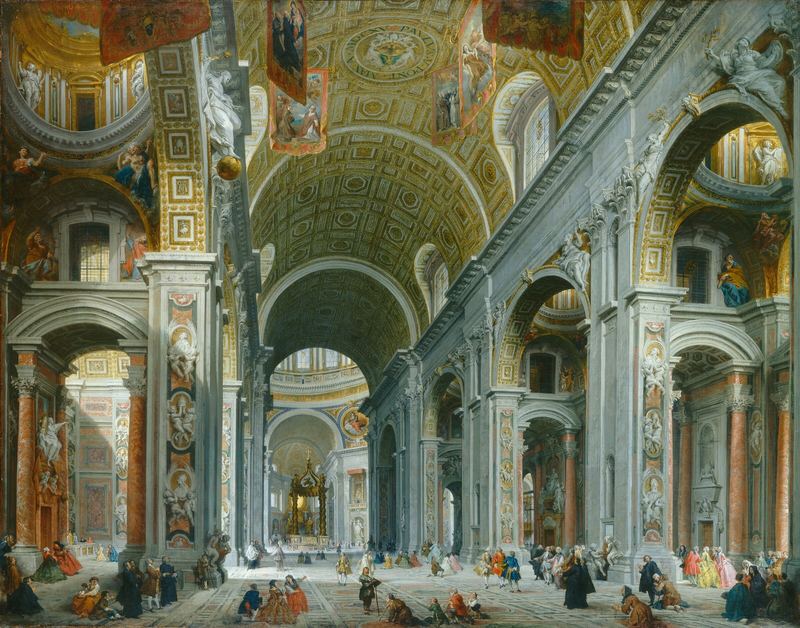
Giovanni Paolo Pannini · Interior of Saint Peter’s, Rome

What happened in Rome

How it started

On January 25, 1959, three months after his election, Pope John XXIII told a small group of cardinals at the Basilica of St. Paul Outside the Walls that he meant to call an ecumenical council. He later wrote that they answered with a “devout silence”. He was 77, and most people expected a short, quiet pontificate.

An ecumenical council is a gathering of the world’s bishops in union with the Pope. The Church counts twenty-one of them, from Nicaea in 325 to Vatican II. The one before, the First Vatican Council (1869-1870), defined papal infallibility and was then cut short when Italian troops took Rome.

The Council opened on October 11, 1962. In his opening speech, John XXIII said he disagreed with the “prophets of gloom, who are always forecasting disaster”, and described the Council’s purpose:

The substance of the ancient doctrine of the deposit of faith is one thing, and the way in which it is presented is another.

Pope St. John XXIII, opening address, 1962

He did not plan to define new dogmas or issue condemnations. The aim was to teach the same faith in a way people of the time could understand. John died on June 3, 1963, after the first session. Pope Paul VI, elected on June 21, carried the Council through three more autumn sessions and closed it on December 8, 1965.

Who took part

Nearly 2,500 bishops voted, more than at any earlier council; the First Vatican Council had about 700. They sat on tiered benches built along the nave of St. Peter’s, and the debates were held in Latin.

For the first time, Orthodox, Anglican and Protestant churches sent official observers. From 1964 lay auditors were admitted too, women among them. Theologians served as advisers to the bishops; one of them, a young German priest named Joseph Ratzinger, would become Pope Benedict XVI.

Five popes took part in the Council. John XXIII called it, Paul VI attended as a cardinal and then led it, and three future popes attended as bishops or advisers: Albino Luciani (John Paul I), Karol Wojtyła (John Paul II), who helped draft Gaudium et Spes, and Ratzinger. Among the bishops was also Archbishop Marcel Lefebvre, who would later found the Society of St. Pius X.

Some facts

  • The Moonlight Speech. On the evening the Council opened, a crowd with torches filled St. Peter’s Square. John XXIII came to his window and spoke without notes: “When you go home, you will find your children. Give your children a caress and tell them: this is the Pope’s caress.”
  • Bar Jonah and Bar Abbas. Two coffee bars were set up inside St. Peter’s for the bishops. The bishops nicknamed them after Simon Peter, “son of Jonah” (Matthew 16:17), and after Barabbas.
  • Paul VI’s tiara. On November 13, 1964, during the Council, Paul VI laid his papal tiara on the altar of St. Peter’s as a gift for the poor. It was bought by American Catholics and is kept today at the Basilica of the National Shrine of the Immaculate Conception in Washington.
  • The votes. The Constitution on the Liturgy passed by 2,147 votes to 4, and the Constitution on the Church by 2,151 to 5.
  • Rome and Constantinople. On December 7, 1965, the day before the Council closed, Paul VI in Rome and Patriarch Athenagoras in Istanbul lifted the excommunications of 1054 at the same hour.
  • No new dogma. The Council defined no new dogma. In January 1966 Paul VI explained that its teaching still carries the authority of the Church’s supreme ordinary magisterium, which all the faithful are to accept “docilely and sincerely”.

The sixteen documents

Everything the Council taught is in sixteen documents, about 103,000 words in all. The four constitutions are the main texts; the decrees and declarations apply them to particular parts of the Church’s life. All are free to read at vatican.va.

DocumentKind, yearIn one line
Sacrosanctum ConciliumConstitution, 1963The liturgy is “the summit” of the Church’s life; the faithful should take a full, conscious and active part in it.
Lumen GentiumDogmatic constitution, 1964What the Church is: the People of God, built on the apostles under Peter, with every member called to holiness.
Dei VerbumDogmatic constitution, 1965God speaks through Scripture and Tradition, faithfully taught by the Church; the Bible should be open to every believer.
Gaudium et SpesPastoral constitution, 1965The Church in the modern world: human dignity, marriage and family, work, culture, war and peace.
Inter MirificaDecree, 1963The press, radio, film and television, and the duty to use them well.
Orientalium EcclesiarumDecree, 1964The Eastern Catholic Churches keep their own rites, laws and heritage.
Unitatis RedintegratioDecree, 1964Working and praying for the unity of all Christians.
Christus DominusDecree, 1965The bishop’s work in his diocese; national bishops’ conferences.
Perfectae CaritatisDecree, 1965Renewing religious life by returning to each order’s founding spirit.
Optatam TotiusDecree, 1965How priests are to be trained.
Apostolicam ActuositatemDecree, 1965The mission of lay people in the Church and the world.
Ad GentesDecree, 1965The Church is missionary by her nature.
Presbyterorum OrdinisDecree, 1965The life and ministry of priests, including celibacy.
Gravissimum EducationisDeclaration, 1965Christian education and the rights of parents.
Nostra AetateDeclaration, 1965How the Church looks at other religions, with special words for Jews and Muslims.
Dignitatis HumanaeDeclaration, 1965No state may force anyone to believe, or stop anyone from worshiping.

Common misunderstandings

Many claims about Vatican II describe what was done after it, not what it wrote. The most common ones are below, checked against the documents.

Did the Council abolish Latin?

No. “The use of the Latin language is to be preserved in the Latin rites” (Sacrosanctum Concilium 36). It allowed the mother tongue a wider place, especially in the readings and some prayers, and asked that the faithful still be able to “say or sing together in Latin” their parts of the Mass (54). Gregorian chant, it said, should be given “pride of place” (116), and the pipe organ “held in high esteem” (120). The Council did not ask for Latin and chant to disappear from parishes, as they did within a few years.

Did it turn the altars around?

No Council document mentions the direction the priest faces. A 1964 instruction recommended building new altars free of the wall so that Mass could be said facing the people, and the current Missal calls that desirable wherever possible. Celebrating toward the east, with priest and people facing the same way, is still permitted, and the Missal’s own rubrics still tell the priest to turn toward the people at certain moments.

Did it make the Pope one bishop among many?

No. The Council taught that the bishops form a college with the Pope, but the college “has no authority unless it is understood together with the Roman Pontiff” and acts “never without this head”, while the Pope has “full, supreme and universal power over the Church. And he is always free to exercise this power” (Lumen Gentium 22). It restated the First Vatican Council’s teaching on papal infallibility in full (25). In 1964 Paul VI had a note of explanation added to make this clear.

Did it say my conscience can overrule the Church?

No. The Council calls conscience man’s “most secret core and sanctuary” (Gaudium et Spes 16), but says that in forming their consciences, Christians “ought carefully to attend to the sacred and certain doctrine of the Church” (Dignitatis Humanae 14). Its teaching on religious freedom is about the state, not about Catholics and the Church, and it “leaves untouched traditional Catholic doctrine on the moral duty of men and societies toward the true religion and toward the one Church of Christ” (1). As the Catechism puts it, “conscience must be informed”, and its education “is indispensable” (CCC 1783).

Did it say all religions are equally true?

No. Nostra Aetate says the Church “rejects nothing that is true and holy” in other religions, and speaks with esteem of Muslims, who “adore the one God”, and of the Jewish people, from whom Christ came (3-4). It also says the Church “ever must proclaim Christ ‘the way, the truth, and the life’” (2). Lumen Gentium teaches that the one Church of Christ “subsists in” the Catholic Church (8), and Ad Gentes that the Church is missionary by her very nature (2). See also Answering Islam and A Call to Our Jewish Friends.

Did it end celibacy or change the teaching on marriage?

No. The Council praised priestly celibacy and “again approves and confirms” the law of the Latin Church (Presbyterorum Ordinis 16). It called married love a gift to be lived in fidelity and openness to life (Gaudium et Spes 48-51) and left the question of birth regulation to the Pope, who answered in Humanae Vitae (1968).

Did it change doctrine?

No. The Council itself says the Church’s teaching office “is not above the word of God, but serves it, teaching only what has been handed on” (Dei Verbum 10). What changed was the way the faith was presented, as John XXIII had said in his opening speech, and much of the Church’s discipline and worship.

The Mass from the Last Supper to today

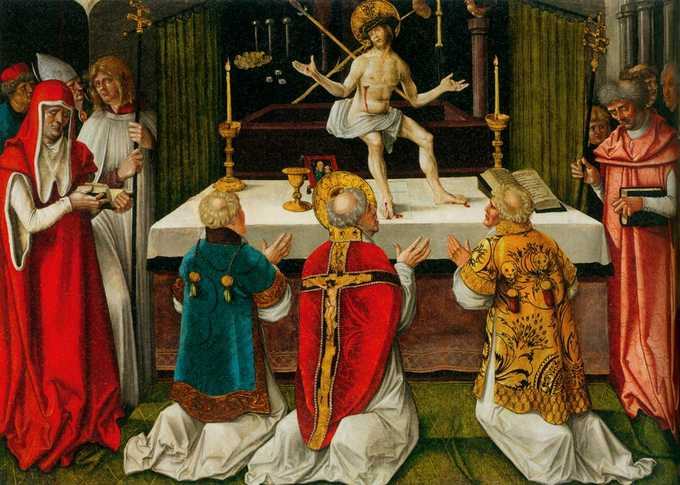
Hans Baldung Grien · The Mass of Saint Gregory

The changes of 1969 are easier to understand against the longer history. The Mass has always been the same sacrifice of Christ, but its outward form has changed many times.

The first Christians (about 30-100)

On the night before He died, Jesus took bread and said, “This is my body which is given for you. Do this in remembrance of me” (Luke 22:19-20). After Pentecost the first believers “devoted themselves to the apostles’ teaching and fellowship, to the breaking of bread and the prayers” (Acts 2:42), and met “on the first day of the week” to break bread (Acts 20:7).

Around the year 55, St. Paul wrote down what he had “received from the Lord” about the Last Supper (1 Corinthians 11:23-29), the oldest written account we have. The Didache, a church manual from the late first century, already says: “Every Lord’s day gather yourselves together, and break bread, and give thanksgiving after having confessed your transgressions, that your sacrifice may be pure.”

A Sunday in Rome, about 155

St. Justin Martyr, writing to the Roman emperor to explain what Christians do, left us the first full description of the Mass:

On the day called Sunday, all who live in cities or in the country gather together to one place, and the memoirs of the apostles or the writings of the prophets are read, as long as time permits; then, when the reader has ceased, the president verbally instructs, and exhorts to the imitation of these good things. Then we all rise together and pray, and, as we before said, when our prayer is ended, bread and wine and water are brought, and the president in like manner offers prayers and thanksgivings, according to his ability, and the people assent, saying Amen.

St. Justin Martyr, First Apology 67

Readings, a homily, the prayer of the faithful, the offering of bread and wine, the Eucharistic Prayer, the people’s Amen, Communion: both forms of the Mass today follow this same order.

Fixed prayers (200-400)

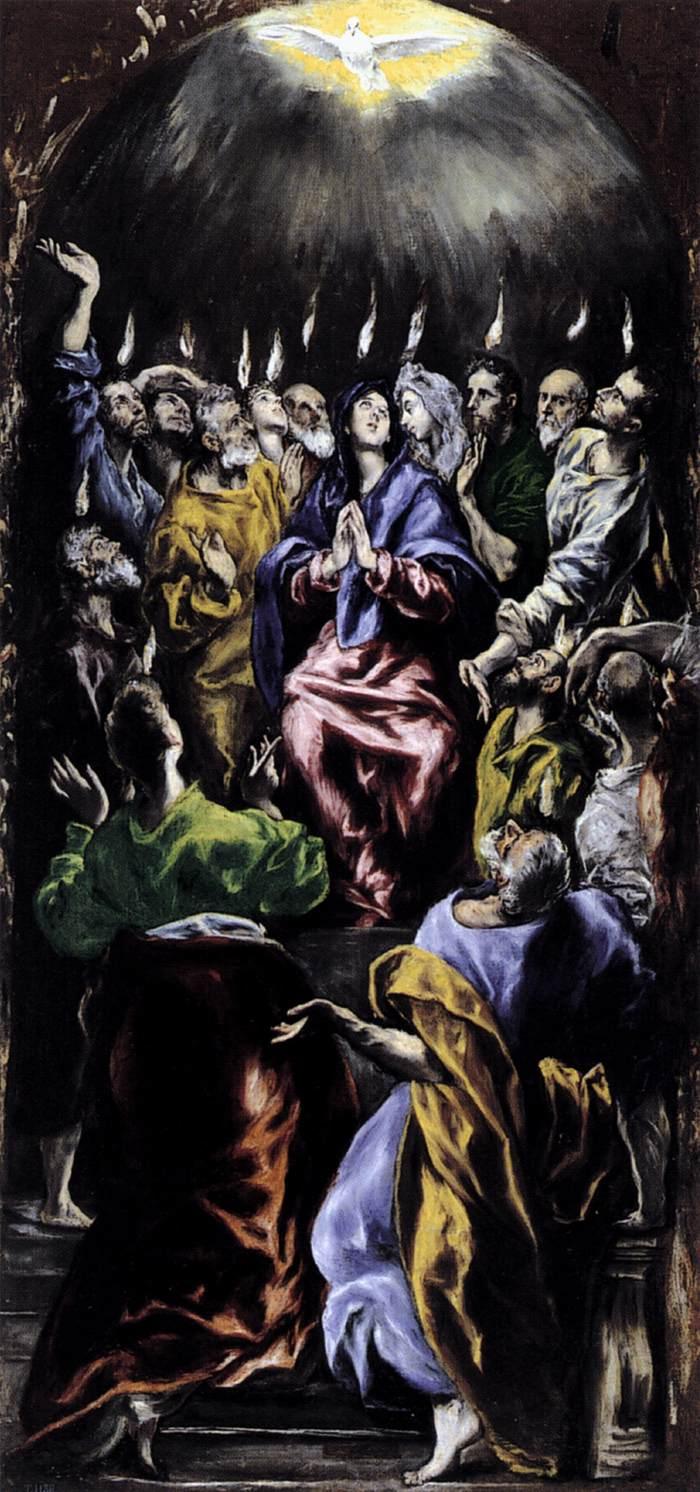
El Greco · Pentecost

A Roman church order from the early third century, traditionally credited to St. Hippolytus, gives a full Eucharistic Prayer with the dialogue still heard today: “Lift up your hearts.” “We lift them up to the Lord.” Today’s Eucharistic Prayer II is modeled on it. Bishops still prayed in their own words, but within a set shape.

After Emperor Constantine ended the persecutions in 313, the Mass moved from homes into great basilicas. Processions, candles, incense and vestments (at first simply the formal clothes of a Roman gentleman) became part of worship.

When Latin was the people’s language

Rome’s first Christians worshiped in Greek, the common language of the empire. In the second half of the fourth century, as fewer Romans spoke Greek, the Church of Rome switched to Latin, the language of the street. Around 390, St. Ambrose of Milan quoted the heart of the Roman Canon, the Eucharistic Prayer still in the Missal today, in words that are almost the same as ours.

So the Latin Mass itself came from a change to the people’s language, just like the reform of the 1960s. In the East, meanwhile, the Church prayed in Greek, Syriac, Coptic, Armenian and later Slavonic, and the Eastern Catholic Churches still keep their own ancient liturgies.

Gregory the Great and the Middle Ages

Pope St. Gregory the Great (590-604) set the Our Father right after the Eucharistic Prayer, where it still is, and added a line to the Canon: “order our days in your peace.” Gregorian chant is named after him.

Charlemagne spread the Roman Mass across his empire, where it absorbed northern customs and more private prayers for the priest. The Creed was added to the Mass in Rome only in 1014, at the request of Emperor Henry II. Around 1200, priests in Paris began lifting the Host high after the consecration so the people could see it, and bells were rung. The Eucharistic miracle of Bolsena (1263) is linked by tradition to the feast of Corpus Christi, which Pope Urban IV extended to the whole Church in 1264.

In the same period the people took less part. The quiet “Low Mass” became common, most people received Communion rarely (the Fourth Lateran Council in 1215 had to require it at least once a year), and many prayed the Rosary or other devotions while the priest prayed at the altar.

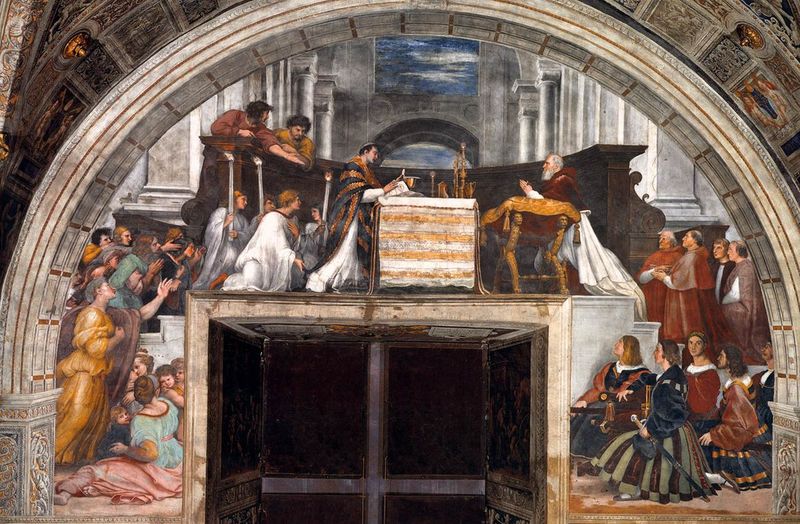
Raphael · The Mass at Bolsena

Trent and one Missal (1570)

The Protestant Reformers rejected the Mass as a sacrifice. The Council of Trent answered by restating the Church’s faith, and in 1570 Pope St. Pius V issued one Roman Missal for the whole Latin Church. The printing press made such uniformity possible for the first time. Rites at least 200 years old, such as those of Milan, Toledo and the Dominicans, were allowed to continue.

This Missal, revised several times (1604, 1634, 1884, 1920, 1962), was used for four centuries. It is what people mean by “the Tridentine Mass”, and its 1962 edition is the one used for the traditional Latin Mass today.

Renewal before the Council (1903-1962)

Liturgical reform started before Vatican II. In 1903 Pope St. Pius X wrote that the faithful should find the true Christian spirit in their “active participation” in the liturgy, the first time a pope used the phrase. He also urged frequent Communion and, in 1910, opened it to young children. Monasteries such as Solesmes led a revival of Gregorian chant.

Pius XII’s encyclical Mediator Dei (1947) endorsed the liturgical movement while warning against its excesses. He restored the Easter Vigil to the night (1951-1955), shortened the Communion fast, and allowed evening Masses. In 1962 John XXIII added St. Joseph to the list of saints in the Roman Canon, the first change to that list in many centuries.

The reform (1963-1970)

Sacrosanctum Concilium asked for a revision of the rites so that they would be clearer and the people could take part more fully. It also warned: “there must be no innovations unless the good of the Church genuinely and certainly requires them; and care must be taken that any new forms adopted should in some way grow organically from forms already existing” (23).

The changes came within a few years. In 1964 and 1965 parts of the Mass were allowed in the vernacular; by 1967 the whole Mass could be. In 1968 three new Eucharistic Prayers were approved. On April 3, 1969, Paul VI promulgated the new Roman Missal, and the new Order of Mass came into use on the First Sunday of Advent that year. Two cardinals, Ottaviani and Bacci, sent the Pope a critical study of it. Paul VI defended the reform. He said the Church was giving up something valuable, the language of the Christian centuries, because the people’s understanding of their prayer was worth more.

Since then

  • 1971: English writers and artists, Agatha Christie among them, petitioned Paul VI to keep the old Mass. He allowed its occasional use in England and Wales, a permission still known as the “Agatha Christie indult”.
  • 1984 and 1988: John Paul II allowed the 1962 Missal more widely with the bishop’s permission, and after Archbishop Lefebvre ordained bishops without papal approval in 1988, he asked bishops to be generous to Catholics attached to it.
  • 2002 and 2011: A third edition of the Roman Missal, and a new English translation closer to the Latin (“And with your spirit”).
  • 2007: Benedict XVI’s Summorum Pontificum let every priest celebrate the 1962 Missal, describing the two Missals as “a twofold use of one and the same rite”.
  • 2021 and 2022: Pope Francis’s Traditionis Custodes made the Missal of Paul VI and John Paul II the one expression of the Roman Rite’s law of prayer and placed the older Missal under each bishop’s regulation. In Desiderio Desideravi he called the whole Church to rediscover the beauty of the liturgy and to be formed by it.

The 1962 and 1970 Missals compared

This table compares the two Missals as their rubrics describe them. Some differences people notice, like altar rails or music, come from local custom, not from either Missal.

1962 MissalMissal of Paul VI (1970)
LanguageLatin throughout; the readings are often repeated in the vernacular before the homily.Usually the people’s language; Latin remains the Missal’s official language and may always be used.
DirectionPriest and people face the same way, usually toward the apse (ad orientem).Usually facing the people; facing east is still permitted.
BeginningPrayers at the foot of the altar, with Psalm 43: “I will go in to the altar of God”, said by priest and server.A greeting, then the Penitential Act said by everyone.
ReadingsA one-year cycle, usually an Epistle and a Gospel.A three-year Sunday cycle: usually an Old Testament reading, a Psalm, a New Testament reading and the Gospel; a two-year weekday cycle.
Prayer of the FaithfulNot part of the Roman Mass for many centuries.Restored, as in Justin’s day.
OffertoryPrayers of offering: “Receive, O holy Father, this spotless host”.Shorter prayers modeled on Jewish table blessings: “Blessed are you, Lord God of all creation”.
Eucharistic PrayerThe Roman Canon only, said quietly.The Roman Canon (Eucharistic Prayer I) or one of several others, said aloud.
Sign of peacePassed among the clergy at a solemn Mass.May be offered among the people.
CommunionKneeling, on the tongue, under the form of bread.Kneeling or standing; on the tongue, or in the hand where bishops allow it; sometimes under both kinds.
Who answersThe server answers for the people; at a sung Mass, the choir sings.The whole congregation answers and sings.
Lay rolesServers; lay readers are rare.Lay readers, and extraordinary ministers of Holy Communion when needed.
EndingThe blessing, then the Last Gospel (John 1:1-14).The blessing and the dismissal.

What stayed the same

In both Missals the Mass is the one sacrifice of Calvary made present; Christ is truly present, body, blood, soul and divinity; the ordained priest acts in the person of Christ; the Word comes first and the Eucharist follows; and the Roman Canon is still in the Missal, word for word. To follow the newer Mass step by step, see The Holy Mass and Celebrating the Mass.

A witness from 1971

The years after the Council

In 1971 the English Catholic writer John Eppstein, a convert who had worked in international affairs, published Has the Catholic Church Gone Mad? Eppstein accepted the Council, and he wrote while the changes were happening.

He did not blame the documents. He found in them “a deep spirituality, great scholarship, an abounding charity”. His concern was what happened next: a stream of priests and nuns leaving their vows, seminaries thrown into turmoil, open defiance of Humanae Vitae, a Dutch catechism that a commission of cardinals ordered amended, translations of the Mass settled by majority vote, and a press campaign for a new “Conciliar Church” cut loose from the Pope.

He argued that much of the crisis came from what commentators and the press claimed in the Council’s name, not from its documents. He showed, for example, how one sentence about freedom from state coercion was being used to justify Catholics rejecting the Church’s own teaching, a reading the Council itself rejects (Dignitatis Humanae 14). Paul VI himself said in 1972 that “from some fissure the smoke of Satan has entered the temple of God”.

He also pointed out that the confusion was mostly in the rich West. In Africa, he wrote, the young Church was solid and sane, and its bishops wanted seminary discipline kept. His book ends with this line:

The first and most important mark of the Church of Christ is holiness.

John Eppstein, Has the Catholic Church Gone Mad? (1971)

Some of Eppstein’s political views, such as his defense of colonial rule in Africa, are not ours, and his book quotes Archbishop Lefebvre, who later broke communion with Rome. We quote him for what he saw in those years, not as a guide on every question.

Reform in continuity

In 2005 Pope Benedict XVI, who had attended the Council as a theologian, described two ways of reading it. One, a “hermeneutic of discontinuity and rupture”, treated the Council as a break with the Church before it, so that its “spirit” mattered more than its words. The other, the “hermeneutic of reform”, reads the Council as “renewal in the continuity of the one subject-Church”. He said the second is the right one, and the one that has borne fruit (Address to the Roman Curia, December 22, 2005).

St. John Paul II called the Council “a sure compass by which to take our bearings in the century now beginning”. In 1985 the world’s bishops met to look back on the Council, and asked for a catechism for the whole Church. The Catechism of the Catholic Church (1992) draws on the Council on almost every page, and reads it alongside Scripture, the Fathers and every earlier council.

In practice this means:

  1. Read the textsRead the documents, not summaries of them. Most are short, and all are online.
  2. Read them with the whole TraditionThe Council quotes Scripture, the Fathers, Trent and the First Vatican Council constantly. It is meant to be read with them.
  3. Tell the texts from what followedThe documents, the “spirit” claimed for them and the way they were carried out are three different things.
  4. Do what it actually askedRead the Bible. Pray the liturgy with understanding. Keep Latin and chant alive. Seek holiness in ordinary life. Bring the Gospel to everyone.

Conclusion

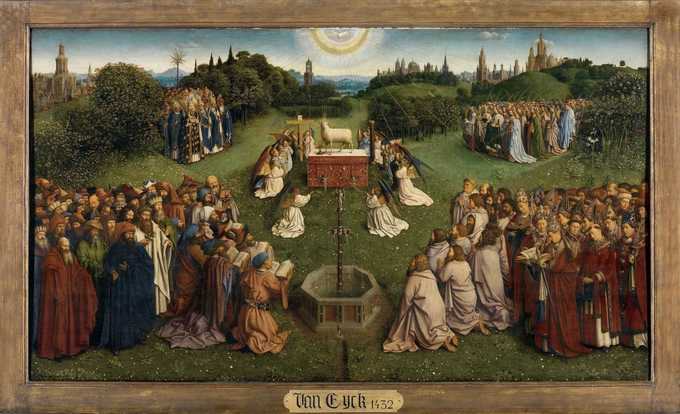
Hubert and Jan van Eyck · The Adoration of the Lamb

Can a faithful Catholic accept the Second Vatican Council? Yes, and Catholics are required to. It was a lawful ecumenical council, called and confirmed by two popes and received by every pope since. Its teaching belongs to the Church’s magisterium. A Catholic may not set it aside, any more than Trent or Nicaea.

But some things went wrong. The years after the Council brought real losses: empty seminaries and convents, catechesis that taught little, beauty stripped from churches, and changes that many Catholics felt were done to them rather than with them. Many Catholics who were hurt by these changes do not reject the Council. They want what it actually asked for.

Many good things also came from the Council. Catholics read the Bible far more than before. Lay people know they are called to holiness, not only priests and nuns. Friendship has grown with the Orthodox and with the Jewish people. The Council’s defense of religious freedom gave the Church a voice against communist states, and a Polish bishop who helped write its texts later, as Pope John Paul II, helped bring communism down in his own country.

Catholics still disagree about altars, music and Latin. But every Mass, in either Missal, is the same sacrifice of Christ. Catholics who like the older form and those who like the newer one have the same faith and the same Pope, and both must obey their bishops. The Council asked for a reverent Mass, with silence, Scripture, chant and a good homily, that people can understand. A parish that does this gives both groups most of what they want.

Many parishes are not there yet. Getting there takes prayer, humility and reverence more than arguments. Before the Council, John XXIII prayed that God would renew His wonders “in this our day, as by a new Pentecost”. After the first Pentecost, the believers were “of one heart and soul” (Acts 4:32). We pray for that same unity today.
Sources and further reading

The Council’s documents

Popes and Church documents

The early Church

  • The Didache, 14
  • St. Justin Martyr, First Apology 65-67
  • The Apostolic Tradition, attributed to St. Hippolytus of Rome
  • St. Ambrose, De Sacramentis IV

Books

  • John Eppstein, Has the Catholic Church Gone Mad? (Arlington House, 1971; Internet Archive)
  • Adrian Fortescue, The Mass: A Study of the Roman Liturgy (1912)
  • Josef A. Jungmann, The Mass of the Roman Rite