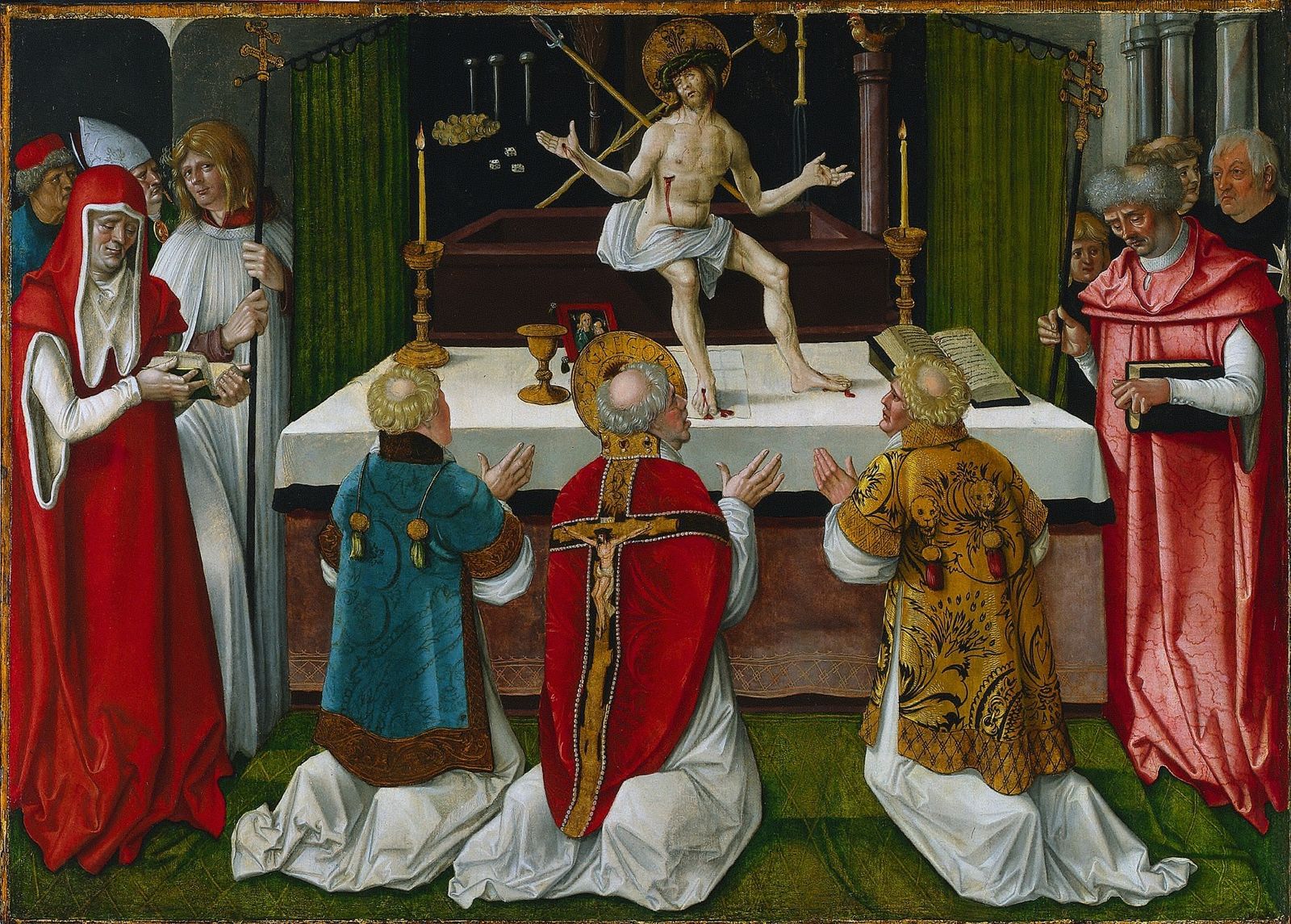
Emblem: The stigmata
Bearer of Christ’s Wounds · 1887-1968
Saint Pio of Pietrelcina
Hans Baldung · The Mass of Saint Gregory
Francesco Forgione was born to a poor farming family in the Italian village of Pietrelcina. Even as a child, it is said, he was unusually devout and had unusual spiritual experiences. At sixteen he joined the Capuchin Franciscans and took the name Pio. His health was always poor, and while training for the priesthood he often fell ill and had to be sent home.
The Stigmata
In 1918, at his friary in San Giovanni Rotondo, while he was praying after Mass, marks like the five wounds of Christ appeared on his hands, his feet and his side. They bled for fifty years and never closed until his death. It is the longest-lasting and most closely examined case of the stigmata in the Church’s history, and the doctors who examined him again and again could find no medical explanation. At first the Vatican was cautious and even restricted for a time his contact with the public and his saying Mass in public, but in the end the restrictions were lifted.
A Lifetime in the Confessional
More than any miracle, what Padre Pio left behind were the countless hours he spent hearing confessions. On some days he heard them for more than twelve hours, and people from all over the world waited for weeks for the chance to speak to him. Extraordinary stories grew up around him: that he could read people’s hearts, that he could be in two places at once (bilocation). He himself was always humble about such things. In 1956 he opened a modern hospital, the "Home for the Relief of Suffering," a very practical fruit of his life of prayer.
Padre Pio died in 1968, at eighty-one, and it is said that by then the wounds had completely disappeared. More than a hundred thousand people came to his funeral. Pope John Paul II canonized him in 2002, and today San Giovanni Rotondo is one of the most visited Catholic shrines in the world. His feast day is September 23.