Emblem: The rosary
Servant of the Poor · 1910-1997
Saint Teresa of Calcutta (Mother Teresa)
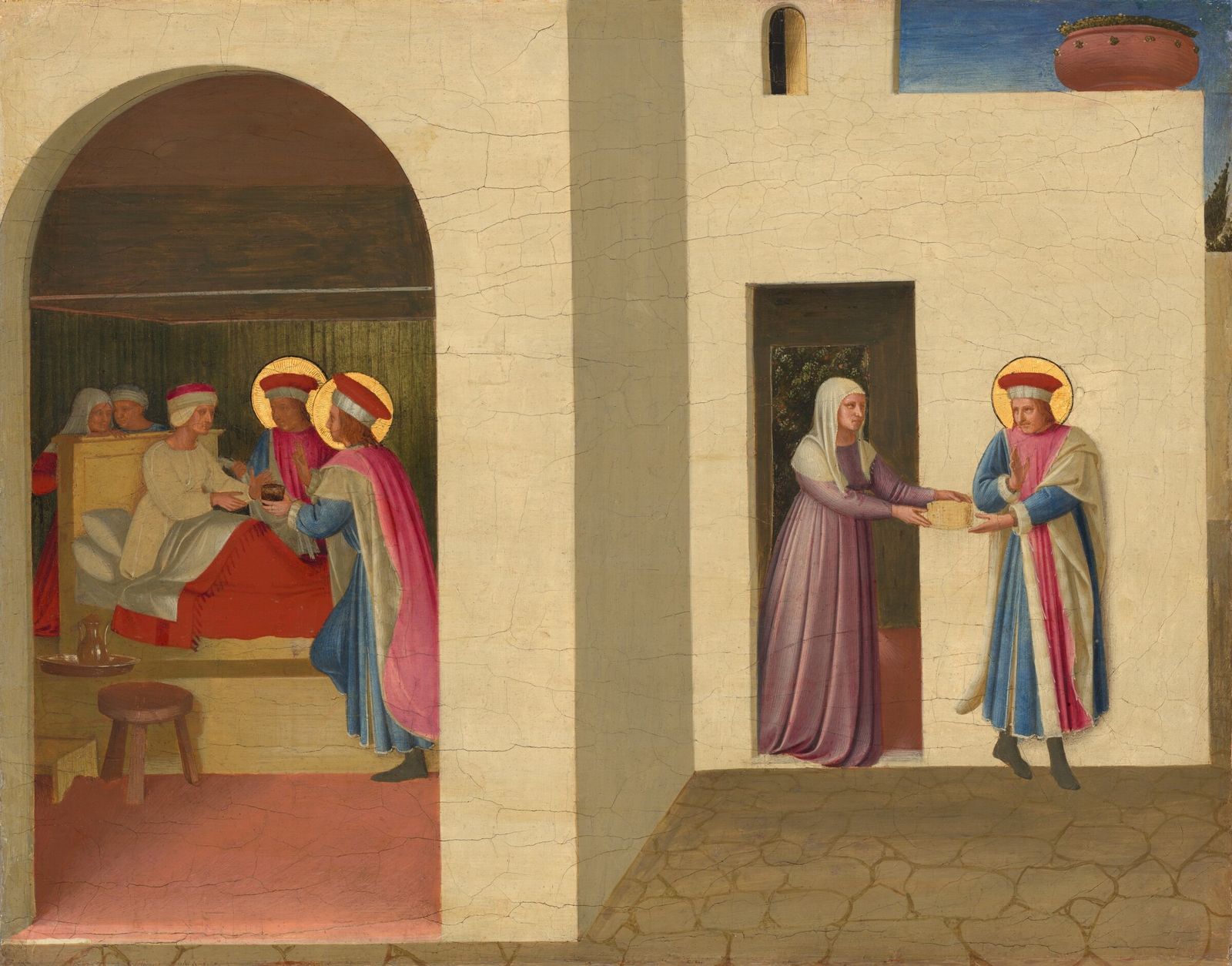
Fra Angelico · The Healing of Palladia by Saints Cosmas and Damian
Anjezë Gonxhe Bojaxhiu was born to an Albanian family in what is now North Macedonia. At eighteen she joined the Sisters of Loreto in Ireland, who soon sent her to India. There she taught geography at a girls’ school in Calcutta and later became its principal. It was a fairly comfortable, orderly life.
"A Call Within a Call"
In 1946, on a train to Darjeeling, she felt what she later called "a call within a call": God wanted her to leave the school and live among the poorest and most abandoned people on the streets. It meant stepping well outside the life her order had planned for her. After two years of asking for permission, in 1948 she left her school, put on a white sari with a blue border and went out into the streets of Calcutta.
Missionaries of Charity
First she opened a simple school for children from the slums. Then she began taking in the dying whom nobody else would care for, and opened a home where they could spend their last days with dignity and love. In 1950, with the Vatican’s approval, she founded the Missionaries of Charity. The order grew astonishingly fast. Today it has hundreds of houses around the world, where thousands of sisters and brothers serve the poorest, the sickest and the most forgotten: lepers, people with AIDS, street children and the elderly.
Mother Teresa received the Nobel Peace Prize in 1979 and asked that the money for the traditional banquet be given to the poor instead. Small and wrinkled, she became one of the most recognized faces in the world. Yet her private letters, published after her death, showed that for many years she had lived through an inner "dark night," a deep spiritual dryness in which God seemed far away, which makes her all the more human. She died in 1997, at eighty-seven, and Pope Francis canonized her in 2016. Her feast day is September 5.