Emblem: The crown of twelve stars
Mother of God · 1st century AD
The Blessed Virgin Mary
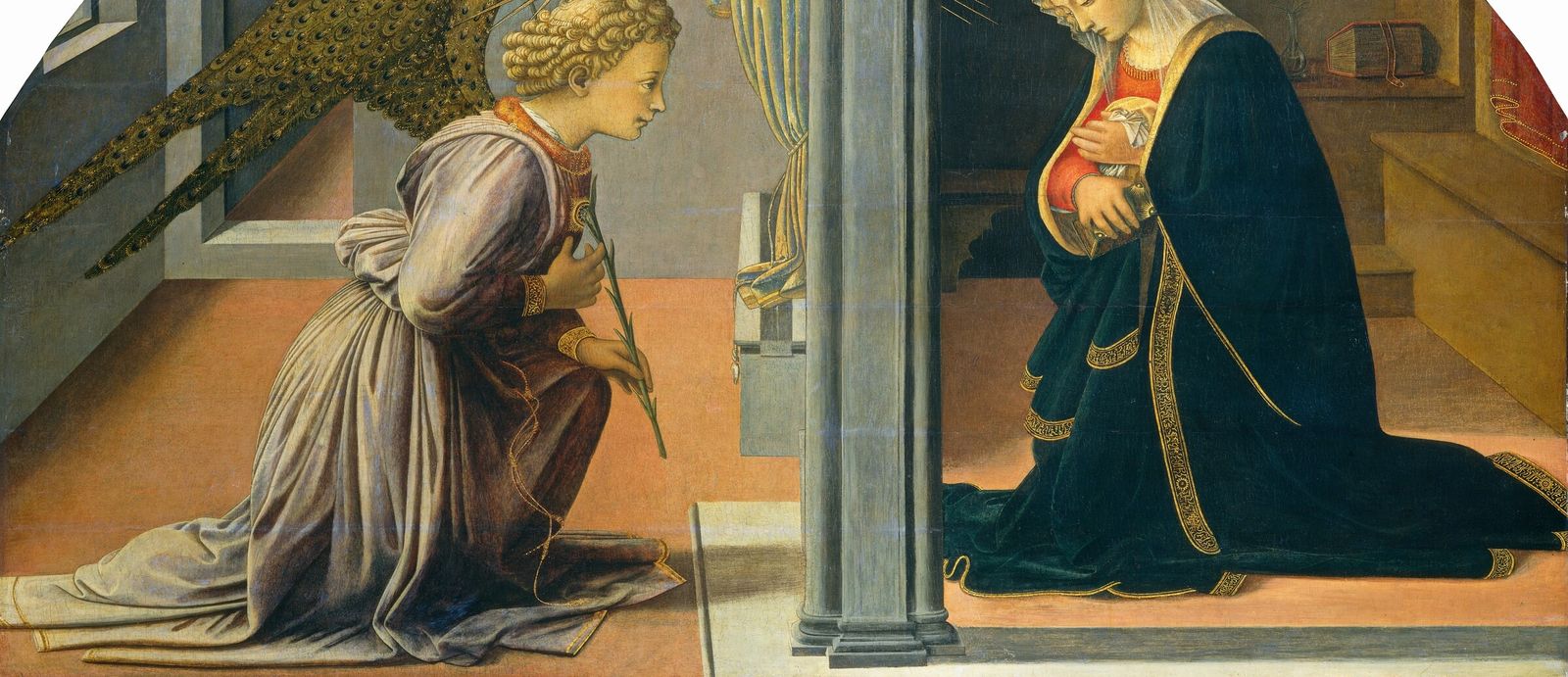
Fra Filippo Lippi · The Annunciation
Mary was a young Jewish girl, probably no more than fifteen, from Nazareth, a small town in Galilee. Luke’s Gospel tells how the angel Gabriel came to her and announced that she would bear the Son of God by the power of the Holy Spirit, with no human father. Her answer became one of the turning points of the whole Christian story: "Behold the handmaid of the Lord; be it done to me according to thy word."
Fiat: The Woman Who Said Yes
The Church calls this short sentence Mary’s fiat (Latin for "let it be done") and sees it as one of the decisive moments in the history of salvation. Eve said no to God in the garden of Eden; Mary said yes, and so the early Church Fathers called her the "new Eve." While she was expecting, Mary went to visit her relative Elizabeth, who greeted her with the words "Blessed art thou among women." Mary answered with the Magnificat, the hymn the Church still prays every evening in the Liturgy of the Hours: "My soul doth magnify the Lord."
From Bethlehem to the Foot of the Cross
The Gospels show Mary in only a handful of scenes, but each one stays with you: giving birth in a stable in Bethlehem; searching for three days for the twelve-year-old Jesus and finding him in the Temple; at the wedding at Cana, when the wine ran out, telling the servants, "Whatsoever he shall say to you, do ye," and so prompting his first miracle. The hardest scene of all is at the foot of the cross. John’s Gospel tells us she stayed with her son through his last hours, and from the cross Jesus gave her into the care of his beloved disciple, John. The Church remembers her grief in the devotion to Our Lady of Sorrows.
Dogmas and Devotion
Over the centuries the Church has defined four dogmas about Mary: that she is the Mother of God (Council of Ephesus, 431); that she remained a virgin all her life; the Immaculate Conception, meaning she was kept free from original sin from the first moment of her existence (1854); and the Assumption, meaning that at the end of her earthly life she was taken up body and soul into heaven (1950). Catholics do not worship Mary. They ask her to pray to God for them, the way you would ask a friend, except that this friend is the most reliable of all. The Rosary, the apparitions at places like Lourdes and Fatima, and the shrines all over the world are different ways of showing that love. For Catholics, Mary is the most complete "yes" any human being has ever given to God, and a mother whose faith every believer can learn from.