Emblem: The flaming, pierced heart
Bishop of Hippo, Doctor of the Church · 354-430
Saint Augustine of Hippo
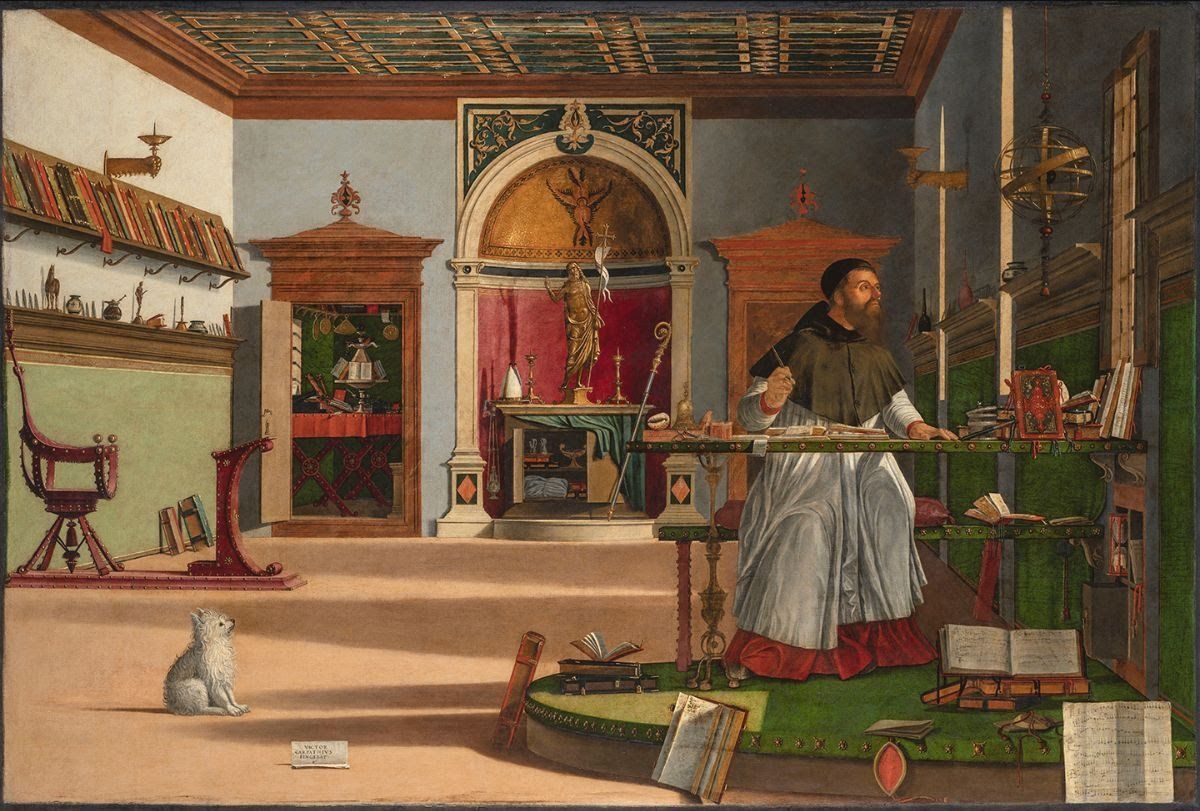
Vittore Carpaccio · The Vision of Saint Augustine
Augustine was born in what is now Algeria, to a Christian mother, Saint Monica, and a pagan father. By his own account he spent his youth chasing success and pleasure. As a student of rhetoric in Carthage he lived with a woman he wasn’t married to and had a son with her. He admits that he used to pray, "Give me chastity and continence, but not yet." For years he followed Manichaeism, a religion that saw the world as a battle between two equal powers of good and evil, before he left that behind too.
"Tolle, Lege"
While he was teaching rhetoric in Milan, he started going to hear the city’s famous bishop, Saint Ambrose. At first he only admired the way Ambrose spoke, but little by little what he said began to get through to him. In his Confessions he tells how, torn apart inside, he was sitting in a garden when he heard a child’s voice from next door chanting, "Take up and read" (tolle, lege). He opened the Scriptures at random, read a sentence from Paul’s Letter to the Romans, and at that moment gave in to the faith he had resisted for years. He was baptized in 387. His mother, who had lived to see him converted, died in peace soon afterwards.
Bishop of Hippo
Back in Africa, Augustine was chosen as bishop of the city of Hippo, and he led it for thirty-five years. His writings shaped Western Christian thought for centuries. The Confessions, his life story told as a long prayer to God, is one of the first great autobiographies ever written. The City of God, written after the Visigoths sacked Rome, argues that earthly empires rise and fall, but our true home is the City of God. "Our heart is restless until it rests in you" may be the most quoted line in all of Christian literature. His thinking on original sin, grace and free will has deeply shaped Catholic and Protestant theology alike. He died in 430 while the Vandals were besieging Hippo. His feast day is August 28.