Emblem: The sword
Apostle to the Gentiles · c. 5-67 AD
Saint Paul the Apostle
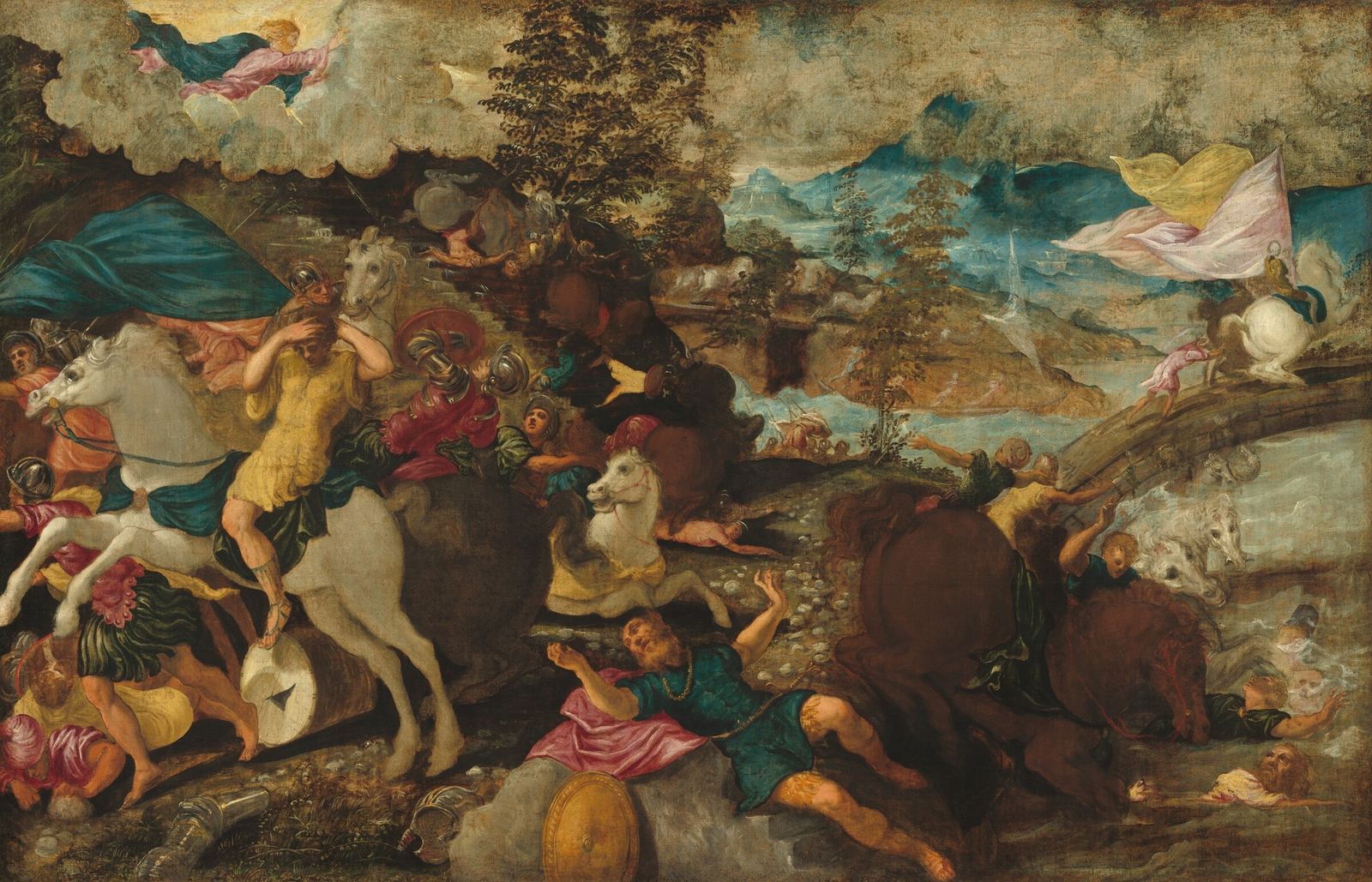
Jacopo Tintoretto · The Conversion of Saint Paul
Paul’s conversion is one of the most dramatic events of the first Christian century, and one of the most important. His original name was Saul. He was born in Tarsus, in what is now Turkey, was both a Jew and a Roman citizen, and had a strict training as a Pharisee. The Acts of the Apostles says he had Christians thrown into prison and approved of their execution. On his way to Damascus to arrest the Christians there, he was struck to the ground by a light from heaven and heard a voice: "Saul, Saul, why persecutest thou me?" He was blind for three days. Then he was baptized, and from then on he went by Paul.
A Door Opened to the Nations
One of the biggest arguments in the early Church was whether Gentiles (Greeks, Romans and others) had to keep the Law of Moses, circumcision included, before they could become Christians. Paul was clear: we are saved not by the works of the Law but by faith in Christ. The Council of Jerusalem (around AD 49) agreed with him, and that opened the way for Christianity to become a faith for the whole world rather than a group within Judaism. That is why Paul is called "the Apostle to the Gentiles."
Three Great Journeys, and the Letters
Paul made three great missionary journeys through what is now Turkey, Greece and Cyprus, founding churches in cities such as Ephesus, Corinth, Philippi and Thessalonica. His thirteen letters (Romans, Corinthians, Galatians and the rest) make up almost half the books of the New Testament and laid the foundations of Christian theology: that we are justified by grace, that the Church is "the body of Christ," and that love is greater than every other virtue ("though I have all faith, so that I could remove mountains, and have not charity, I am nothing"). He lived with what he called "a thorn in the flesh," and was imprisoned, flogged and stoned again and again. Tradition says he was finally beheaded in Rome under Nero. He shares his feast day with Peter on June 29.