Answering Islam
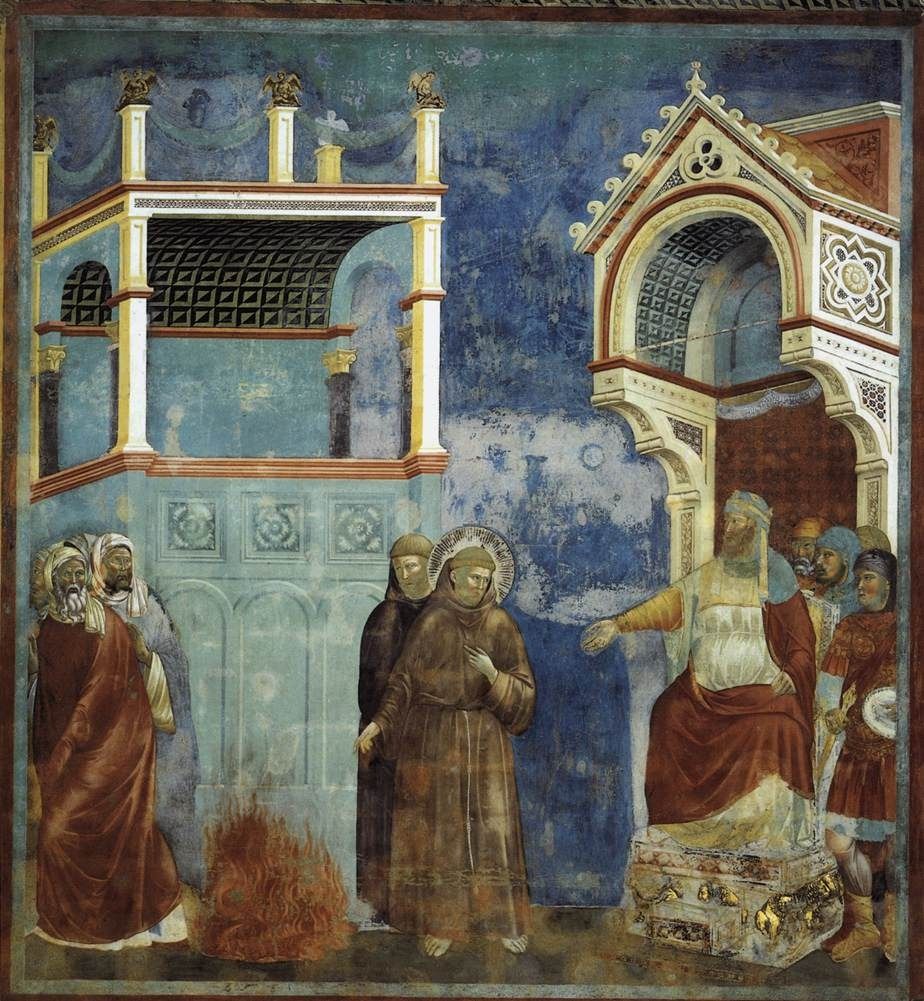
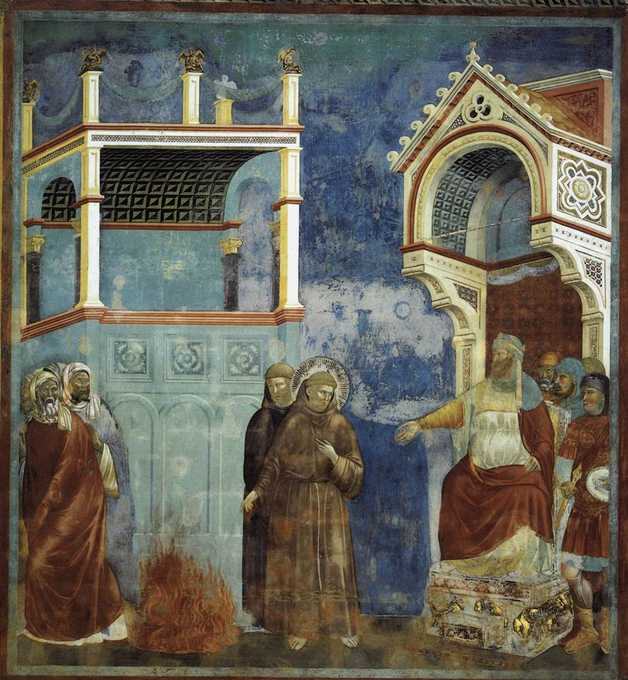
Giotto · Saint Francis before the Sultan
Islam says the Qur’an is God’s final, perfectly preserved word, and that Muhammad is the last prophet and the perfect example for all mankind. We test those claims against Islam’s own sources: the Qur’an, the hadith and the early biographies.
Most of the evidence here comes from the work of the Christian apologists Sam Shamoun, David Wood and Avery Austin (GodLogic Apologetics) and their debates with Muslim scholars. Every point has been checked against the original source. Tap any verse or hadith reference to read it yourself.
TL;DR
- 1The Islamic DilemmaThe Qur’an calls the Torah and the Gospel God’s word, yet contradicts them. If they are true, the Qur’an is wrong; if they are corrupted, it is still wrong.Read all
- 2The myth of “preserved letter for letter”According to Aisha, a goat ate the page a verse was written on. According to Bukhari, some of Umar’s sayings later became verses.Read all
- 3The Qur’an’s own contradictionsThe sun sets in a muddy spring (Qur’an 18:86). It does not know the Gospel it calls true. It does not even say how to pray.Read all
- 4Is this a role model?Marriage to nine-year-old Aisha. Death for apostates. Even Aisha says: “Your Lord hastens to fulfill your desires.”Read all
- 5The mysterious power at HiraThe being at Hira squeezed him as if to choke him. The Qur’an says whoever lies in God’s name has his aorta cut (Qur’an 69:44-46). Dying, Muhammad felt his aorta being severed.Read all
- 6The Kaaba’s real historyCircling the Kaaba, kissing the Black Stone, running between Safa and Marwa, ihram: the pagan Arabs did all of it before Islam.Read all
- 7Answering the objectionsThe wars in Canaan were limited to one place and time; Qur’an 9:29 has no limit. The Qur’an says Jesus’ followers will prevail: the Church did.Read all
Part I
The Qur’an by Its Own Sources
1The Islamic Dilemma
Muslims grow up hearing that the Torah and the Gospel were corrupted, while the Qur’an reached us without a letter changed. The Qur’an itself says nothing of the kind. It treats the books Jews and Christians had in its own day as the word of God. It tells them to judge by those books, and tells Muhammad that if he is ever in doubt, he should ask the people who read them.
How did Muhammad treat the Torah?
Every Muslim agrees that no one understood the Qur’an better than Muhammad. So how did he treat the Torah the Jews actually had? Look at what happened when the Jews of Medina asked him to settle a case:
“They placed a cushion for the Messenger of Allah and he sat on it, then he said, ‘Bring me the Torah.’ It was brought. He withdrew the cushion from beneath him, placed the Torah on it and said, ‘I believed in you and in Him who revealed you.’”
Abu Dawud 4449 (al-Albani: hasan)
The book Muhammad placed on the cushion was not some ancient Torah lost over time. It was the copy in the hands of the Jews of Medina, and Muhammad touched it with his own hands.
In another hadith Muhammad says that knowledge will be taken away from his community. A companion objects: “We recite the Qur’an, and our women and children recite it too. How can knowledge be taken from us?” Muhammad answers: “Are not the Torah and the Gospel in the hands of the Jews and the Christians? What good has it done them?” (Tirmidhi 2653). In Muhammad’s eyes their problem was not that their books had been corrupted. Their books were in their hands, and still they had lost their way.
The first person to convince Muhammad that he was a prophet was Waraqa, Khadija’s Christian cousin. According to Bukhari, Waraqa used to write from the Gospel in Hebrew (Bukhari 3). The Gospel was right there, being read in Mecca.
The Qur’an even quotes a parable from the Gospel: the likeness of Muhammad’s companions “in the Gospel is as a plant which produces its shoots and strengthens them, so they grow firm and stand upon their stalks” (Qur’an 48:29). This is Jesus’s parable of the seed that grows by itself, and it appears only in the Gospel of Mark (Mark 4:26-29). Many Muslim translations also point the reader to Mark in their footnote to this verse. So the book the Qur’an calls “the Gospel” is the Gospel we read today.
This is the dilemma, and there is no way out of it:
- If the Torah and the Gospel are God’s preserved word, as the Qur’an claims, then the Qur’an is wrong, because the Qur’an rejects the most basic teachings of these books: it does not accept that Jesus is the Son of God, that He died on the cross and rose again, or that the one God is Father, Son and Holy Spirit.
- If the Torah and the Gospel were corrupted, the Qur’an is still wrong. In that case it has vouched for corrupted books as the word of God, even though it says itself that no one can change God’s words.
David Wood and Sam Shamoun made this dilemma famous, and today it is the question Muslim apologists dread most. In a debate held for young people who doubt their religion, one Muslim apologist asked openly: “Do you think the imam at your local mosque can answer the Islamic dilemma?” He can’t, because the answer is not in the Qur’an.
The Qur’an’s own test
The Qur’an sets a clear rule for telling whether a prophet is genuine (Qur’an 3:81). By this rule, a newly arrived prophet counts as genuine only if he confirms the books that came before him. If someone comes who contradicts the earlier books, then by the Qur’an’s own rule he is not a true prophet.
The Qur’an also says that Jews and Christians will find Muhammad written in the Torah and the Gospel in their own hands (Qur’an 7:157). So to confirm Muhammad, the Qur’an names the earlier books themselves as the judge. Some commentators explain “those who have been reading the Book” in Qur’an 10:94 as Jews and Christians who had become Muslims, but the result is the same, because the source they were reading was still the same Torah and Gospel.
Let’s run the test:
- The New Testament clearly says that Jesus died on the cross and rose again (1 Corinthians 15:3-4).
- The Qur’an, however, claims that Jesus was never killed and never crucified (Qur’an 4:157).
The result is plain: by the very test the Qur’an sets, Muhammad fails. And we are doing exactly what the Qur’an commands: as people who believe in the Gospel, we make our judgments by looking to the Gospel (Qur’an 5:47).
Escape routes
For years Muslim apologists have tried one way out after another. The debates always look the same: the Christian reads out what Allah and the prophet actually said, and the Muslim retreats to commentators who lived centuries later. David Wood sums this up as a contest between “Team Allah” and “Team Defense”.
Here they are, one by one:
1. “It was corrupted after Muhammad”
The most common claim is this: the Torah and the Gospel were intact in Muhammad’s time and were corrupted afterwards. That doesn’t get them out of the corner; it backs them further into it. We have manuscripts from centuries before Muhammad’s birth: the Dead Sea Scrolls (3rd century BC to 1st century AD), the Septuagint, the Greek translation of the Old Testament (3rd to 1st centuries BC), and the Codex Sinaiticus and Codex Vaticanus, which contain the whole Bible (4th century). Muhammad was born in 570. So the texts he confirmed in his own day are exactly the same as the books we hold today.
Then there’s simple logic. Jews and Christians were rivals for centuries, scattered across different countries. How would they have rewritten the same text together? If one side had tampered with it, the other would have said so at once. And the Hebrew text both groups use today is the same. Of course the manuscripts have small differences of spelling and copying; but none of them creates an alternative Jesus who did not die on the cross, did not rise, or was not the Son of God. Islam’s claim needs a massive rewrite of the core beliefs, and not one manuscript shows a trace of it.
2. “Muhammad picked and chose”
Some Muslim apologists argue that the Qur’an confirms not the whole Gospel but only the parts that suit it. The Qur’an itself answers this claim directly: “Do you believe in part of the Book and disbelieve in part? What is the recompense of those among you who do that, but disgrace in the life of this world, and on the Day of Resurrection being sent to the severest punishment?” (Qur’an 2:85). The Qur’an also tells Muslims plainly to make no distinction between the revelations (Qur’an 3:84).
And think about it: any cult leader could say “I confirm your scriptures, but only the parts I like.” The Qur’an’s main argument to Jews and Christians is that it confirms the books they hold. A confirmation that picks and chooses proves nothing.
3. “The Qur’an’s Torah is not your Torah”
The escape route most often used lately is this: the Torah and the Gospel that the Qur’an confirms are the original books Allah sent down to Moses and Jesus, and they have nothing to do with the ones we have today. One Muslim apologist took this idea all the way in his debate with David Wood. According to him, the Torah of Moses was lost, sent down again to Jesus, lost again together with the Gospel, turned up in seventh-century Medina, was confirmed by Muhammad, and then vanished once more without a trace. There is not a single manuscript, translation or quotation of these books. That isn’t history. It’s “trust me”.
This escape also demolishes Islam’s own evidence. The Qur’an gives Jews and Christians two great proofs for believing in Muhammad: Muhammad confirms their books, and their books foretell Muhammad (Qur’an 7:157; 2:146). If the books are nowhere to be found, both proofs collapse.
The Qur’an also promises that Allah will keep the followers of Jesus on top until the Day of Resurrection (Qur’an 3:55), and says that this promise was fulfilled: “We supported those who believed against their enemy, and they became dominant” (Qur’an 61:14). The Christians who prevailed in history are the Church that holds today’s Gospel. If Jesus’s true book remained in no Christian’s hands, then Allah failed to keep His promise.
4. “Allah’s words” only means His promises
Some argue that the verses “none can change the words of Allah” (Qur’an 6:34; 6:115) mean not the written books but only Allah’s promises. But Qur’an 18:27 uses the same words about the book itself: “Recite what has been revealed to you of the Book of your Lord; there is none who can change His words.”
And even if it did mean promises, it wouldn’t help. Allah says He sent down the Torah and the Gospel “as guidance for mankind” (Qur’an 3:4). If these books were completely corrupted and lost, then that promise of guidance was not kept either.
5. “The Qur’an says the text was corrupted”
This one is a simple misreading. The Qur’an never says the text of the Torah and the Gospel was corrupted. It says people twisted what the text meant.
The very verses quoted for the claim show it:
- Twisting words: Qur’an 4:46 says some Jews shifted the meaning of words. But right after it, Qur’an 4:47 calls on them: “we confirm the book you have; believe in it.” So the problem is not in the book but in the tongues of those who read it. Qur’an 3:78 makes this plain: “They twist their tongues with the Book so that you may think it is from the Book.”
- Concealment and forgery: Qur’an 5:13-15 says certain things were hidden. Hiding something does not destroy the text. Qur’an 2:79 condemns forgers who sell what they themselves wrote as “from Allah”. Condemning forgers does not mean the true Torah is gone. And Qur’an 2:41 and 2:91 both repeat that the Qur’an confirms the book they hold.
The classical sources also confirm that the text was not corrupted:
- Bukhari’s view: Bukhari (Sahih, Book of Tawhid) writes that no one can remove even a single word from Allah’s book, and that distortion means only misinterpreting the text.
- The Ibn Abbas contradiction: Ibn Abbas says, “The Jews and Christians changed their books; why do you ask them anything?” (Bukhari 7363). But this saying contradicts Allah’s command. Allah tells Muhammad, “If you are in doubt, ask those who have been reading the Book before you” (Qur’an 10:94). A companion’s word cannot override Allah’s verse.
The claim that the text was changed wholesale is not in the Qur’an. Those who turned this claim into doctrine were Ibn Hazm in the 11th century and Ibn Taymiyya in the 14th. So what’s being defended isn’t the Qur’an; it’s a theory from centuries later.
6. “Jesus and the Qur’an both abrogated laws”
This claim confuses “abrogating a law” with “corrupting a book”.
Abrogating a law does not corrupt the text: According to the Qur’an, Jesus confirmed the Torah while lifting some old prohibitions (Qur’an 3:50). The Qur’an too says it later changed the ruling of some of its own verses. But renewing a rule does not show that the old book was fabricated or corrupted. For Muslims, after all, even a Qur’anic verse whose ruling was abrogated is still God’s holy word.
The real point of the dilemma: The dilemma does not claim that Muslims must follow the rules of the Torah and the Gospel. The real issue is this: the Qur’an confirms these books as God’s unchangeable word. That a rule changes with the times does not mean the confirmed book was corrupted.
2The Myth of Perfect Preservation
Millions of Muslims rest their faith on one claim: that the Qur’an has come down from Muhammad to today without a single letter or dot changed. Islam’s own sources contradict that claim seven different ways.
1. Aisha’s lost verse
In Muslim’s authentic hadith collection, Muhammad’s wife Aisha says:
“It had been sent down in the Qur’an that ten clear sucklings make marriage unlawful. Then this was replaced by five clear sucklings. When the Messenger of Allah died, it was among what was recited of the Qur’an.”
Muslim 1452a
Aisha says it plainly: when Muhammad died, this verse was part of the Qur’an and was being recited. Yet today it is in no Qur’an, no mosque, no manuscript. So Aisha’s Qur’an was different from today’s. The Muslim has two options: either Aisha, “the mother of the believers”, was wrong, or the Qur’an was not preserved letter for letter. There is no third option.
So where did this verse go? Aisha answers that too, in a report in Ibn Majah: “The verse of stoning and the verse of breastfeeding an adult ten times were revealed. The page they were written on was under my pillow. When the Messenger of Allah died, we were busy with him, and a domestic animal of the house (a sheep or goat) came in and ate the page” (Ibn Majah 1944).
And this business of suckling isn’t a minor detail. In another report in Muslim, a woman named Sahla said her husband was uneasy about the grown man Salim coming in and out of their home. Muhammad told her, “Suckle him.” When she asked, “He is a grown man; how can I suckle him?”, Muhammad smiled and replied, “I know that he is a grown man” (Muslim 1453a). This is in the core sources of a religion that calls itself God’s final, flawless revelation. Judge for yourself.
2. The forgotten surah
Abu Musa al-Ash’ari, one of Muhammad’s close companions, told the Qur’an reciters of Basra: “We used to recite a surah as long and as severe in its words as Surat al-Tawba. I have forgotten it; I remember only this part of it: ‘If the son of Adam had two valleys full of wealth, he would want a third…’” (Muslim 1050). That sentence is not in today’s Qur’an. A surah as long as al-Tawba vanished from the memories of those who had learned it by heart.
3. Different surahs: Umar and Hisham
Umar heard Hisham reciting Surat al-Furqan differently from the way he had been taught it. He barely held himself back until the prayer was over. Then he seized Hisham by the collar and took him to Muhammad. Muhammad had both of them recite the surah and said to each, “It was revealed like this.” Then he said the Qur’an was revealed in “seven letters” (Bukhari 4992). Both men were from the same tribe; so the issue was not dialect, but the very words being recited. Muslim scholars have offered dozens of explanations and still don’t agree on what the “seven letters” are.
4. The compilation: verses left with a single man
When Muhammad died, the Qur’an was not a single text gathered into a book. When many of those who knew the Qur’an by heart died at the Battle of Yamama, Umar grew worried and put to Abu Bakr the idea of collecting the Qur’an. Abu Bakr at first objected, “How can we do something the Prophet did not do?”, but in the end he gave the task to Zayd ibn Thabit.
Zayd gathered the pieces of the Qur’an from palm stalks, flat stones and people’s memories. But he could find the last verses of Surat al-Tawba (9:128-129) with only one man, Abu Khuzayma (Bukhari 4986). A verse of Surat al-Ahzab, too, was held by only one man, Khuzayma ibn Thabit (Bukhari 2807). Normally two witnesses were required to record a verse. Khuzayma was accepted as a lone witness because in his lifetime Muhammad had counted Khuzayma’s word as equal to the word of two men.
So the word of God, supposedly preserved word for word, depended on the memories of men killed in battle, and in places on one man.
5. The burned Qur’ans
About twenty years after Muhammad’s death, the caliph Uthman noticed that people were reciting the Qur’an in different ways. He had a single master text prepared and sent it to the cities. Then he ordered every other Qur’anic text in people’s hands, whether a single page or a whole book, to be burned (Bukhari 4987).
If the copies were all the same, why burn them? Because they weren’t. Uthman picked one and burned the rest. That isn’t divine preservation; it’s the state imposing one text.
6. Different texts, different meanings
The most widely printed Qur’an in the world today is the Hafs text, standardized in Cairo in 1924 (the Hafs transmission of Asim’s reading). But in Morocco, Algeria and West Africa, the Warsh text is read. There are others too, such as Qalun, Duri and Khalaf. These are not translations; they are all Arabic, and they differ from one another in letters, words and even meaning.
An example: in the Hafs text, Qur’an 37:12 reads, “No, you wonder, while they mock”; so here the one who wonders is Muhammad. In the readings of Hamza, al-Kisa’i and Khalaf, the same verse reads, “No, I wonder”; in that case the one who wonders is God Himself. Since Muhammad and God are not the same being, who actually wondered? Two different meanings mean two different Qur’ans.
On a YouTube live stream, Avery Austin (GodLogic Apologetics) showed a Moroccan Muslim two different Qur’an texts side by side. Pointing to the Hafs text, the most widely used in the world today, the Moroccan said, “This is not the correct Qur’an.” If there were only one Qur’an, a Muslim would not need to choose between versions of his own book.
7. The manuscripts
In 1972, during restoration work at the Great Mosque of Sanaa in Yemen, one of the oldest known fragments of the Qur’an was found. It is a palimpsest, a parchment that was scraped clean and written over. Under the visible text lies an older, erased Qur’an text, and that lower text has words and phrases that differ from today’s Qur’an. So the same parchment page holds two different Qur’an texts.
The Birmingham manuscript, which Muslim apologists so often cite as proof, consists of only two leaves. From a fragment of just two leaves, no one can claim that an entire book was preserved without a single letter changing.
How was the Bible preserved?
Now the Bible. No caliph ever gathered up every copy and burned all but one. From the first centuries on, thousands of copies in Greek, Latin, Syriac, Coptic and Armenian were reproduced by communities in different regions.
That is why no one was ever able to change the text on their own. Even if a scribe miswrote a word, the thousands of copies in other regions exposed the error at once. With the Qur’an, however, because the other texts were burned on Uthman’s orders, traces of different readings can only be sought inside the one text he chose.
The test in reverse
Faced with the evidence, many Muslims now say: “There may be differences in the details, but the main message was preserved.”
Yet this is exactly what Christians have always said about the Bible: the manuscripts may have small scribal errors or differences, but the main message, the truth of who God is and what Christ has done, has been preserved in full.
Once a Muslim says that, he can no longer call the Bible “corrupted”. Same standard, both books.
“Produce something like it”: the verses of Umar
The Qur’an counts being a unique text as proof that it came from God, and issues this challenge: produce a surah like it (Qur’an 2:23; 10:38), produce ten surahs (Qur’an 11:13), produce the like of this Qur’an (Qur’an 17:88), “let them produce a statement like it” (Qur’an 52:34). The bar is low: one sentence would do.
Now open Bukhari, the most trusted book in Islam after the Qur’an. Umar, Muhammad’s closest friend and the second caliph, says:
“My Lord agreed with me in three things. I said, ‘O Messenger of Allah, I wish we took the station of Abraham as a place of prayer’, and the verse came down: ‘Take the station of Abraham as a place of prayer.’ I said, ‘O Messenger of Allah, good and bad people come in to your wives; I wish you would order them to veil themselves’, and the verse of the veil came down. When the Prophet’s wives banded together against him out of jealousy, I said to them, ‘It may be that if he divorces you, his Lord will give him in your place wives better than you’, and this verse came down in exactly those words.”
Bukhari 402
These three verses are Qur’an 2:125, 33:53 and 66:5. Umar said it first, and then the Qur’an repeated the same words. Inside a book that says “you cannot produce the like of it”, the words of an ordinary man became verses.
Faced with this, a Muslim is left with only two options:
- Umar was a prophet and received revelation: But according to the Qur’an, Muhammad is the last of the prophets (Qur’an 33:40). Muhammad himself says, “There is no prophet between me and Jesus” (Bukhari 3442).
- Umar was not a prophet: Then some verses in the Qur’an are human words, and the book’s great challenge collapses.
“But the Arabic isn’t word for word the same” doesn’t help. The challenge was to produce something like it, not an exact copy. Umar did, three times, while Muhammad was alive.
3What the Qur’an Didn’t Know
It didn’t know the book it confirmed
Behind the dilemma lies a very simple fact: the Qur’an confirms the Torah and the Gospel, but it does not know what is written in them.
- Muhammad’s name: The Qur’an claims that Jews and Christians find Muhammad “written in the Torah and the Gospel they have” (Qur’an 7:157). It even says that Jesus announced “a messenger to come after me, whose name is Ahmad” (Qur’an 61:6). Yet no such name appears in either the Torah or the Gospel.
- The promise of jihad: According to the Qur’an, God has promised Paradise to the believers who fight, kill and are killed in the cause of Allah, and this promise is written in the Torah, the Gospel and the Qur’an (Qur’an 9:111). There is no such promise of war in the Gospel. On the contrary, in Matthew 5:39 Jesus says, “But I say to you, Do not resist one who is evil. But if any one strikes you on the right cheek, turn to him the other also.” Elsewhere He told His disciple who drew his sword, “Put your sword back into its place” (Matthew 26:52). The central theme of the New Testament is forgiveness and love (John 13:34).
- The claim of recognition: The Qur’an says that the followers of the Gospel know Muhammad “as they know their own children” (Qur’an 2:146; 26:197). This claim was repeated for years in Mecca. But when Muhammad went to Medina, the Jews there did not recognize him. So the Qur’an began accusing them of concealing the truth.
Muhammad and his companions could not read these books themselves. A report in Bukhari makes the situation clear: “The People of the Book used to read the Torah in Hebrew and explain it to the Muslims in Arabic. And Muhammad would say: ‘Neither believe them nor disbelieve them’” (Bukhari 4485). The Qur’an knew the Gospel by hearsay, not by reading it.
And what they heard included many folk legends that are not in the real Gospel:
- Clay birds: According to the Qur’an, Jesus makes birds out of clay, breathes on them, and the birds come to life (Qur’an 3:49). This story is not in the Gospel. It comes from the Infancy Gospel of Thomas, written in the 2nd century and regarded by the Church as spurious (chapter 2).
- The palm tree: According to the Qur’an, while in labor pains Mary takes refuge at the foot of a palm tree; fresh dates fall from the tree and water flows beneath her (Qur’an 19:23-26). This account is not in the Gospel either. It is a legend from apocryphal texts such as the Gospel of Pseudo-Matthew, where it originally belongs to the story of the flight into Egypt (chapter 20). The Qur’an took this legend and moved it to the moment of birth.
- A rabbi’s commentary: Right after the story of Cain and Abel, the Qur’an says: “Because of that, We decreed upon the Children of Israel: whoever kills a person, it is as if he had killed all mankind; and whoever saves one, it is as if he had saved all mankind” (Qur’an 5:32). This sentence does not appear in the Torah. It is a comment the rabbis made on the story of Cain, and it is found in the Mishnah (Sanhedrin 4:5). The Qur’an passed off a rabbi’s commentary as God’s command.
Muhammad’s contemporaries noticed this too. The Qur’an quotes their words: “These are legends of the ancients; he has had them written down, and they are read to him morning and evening” (Qur’an 25:5). They even said of him, “He believes everything he hears” (Qur’an 9:61). The Qur’an denies it, but the sources are there for anyone to check: a prophet who had never read the book he confirmed told people, in God’s name, what was in it.
Scientific miracle, or muddy spring?
Muslim apologists claim to find many “scientific miracles” in the Qur’an, from the Big Bang to embryology. The argument: scientific truths in the Qur’an prove it came from God.
Fine. Then the same logic cuts the other way: one clear scientific error proves it didn’t. One is enough.
“Until, when he reached the setting place of the sun, he found it setting in a spring of black mud, and he found near it a people.”
Qur’an 18:86
The verse does not say “he saw it as if it were setting”; it says “he found it setting” (Qur’an 18:86). Dhul-Qarnayn reaches the place where the sun sets and meets a people living there. The Muslim apologists’ claim that “this was only his point of view” is refuted by Muhammad’s own words:
Abu Dharr said: I was behind the Messenger of Allah as the sun was setting. He asked: “Do you know where this sets?” I said: “Allah and His Messenger know best.” He said: “It sets in a spring of hot water.”
Abu Dawud 4002
Nobody asked him. Muhammad raised the question himself, and answered it: the sun sets in a spring. According to another hadith, in Bukhari, after setting the sun goes and prostrates beneath the Throne and asks permission to rise again (Bukhari 3199). That is not a point of view; it is a description of the cosmos. And that description is wrong.
“You don’t know Arabic”
The usual answer to criticism is: “You don’t know Arabic.”
If that were true, the hundreds of millions of Muslims who don’t read Arabic couldn’t understand their own religion either. The argument backfires on whoever uses it.
Besides, the Arabic of these verses is quite clear, and the meanings above are given by Islam’s greatest commentators themselves. Just as we look to the Hebrew and Greek sources when a translation question comes up about the Bible, for the Qur’an too we look to the Arabic text and to the Muslim scholars’ own commentaries.
The Qur’an is not enough on its own
The Qur’an presents itself as “a detailed explanation of all things” (Qur’an 12:111; 6:114; 16:89). But the five daily prayers are not in the Qur’an; they come from the hadith of the Night Journey (Bukhari 349). Qur’an 17:1 speaks of God, “who took His servant by night from al-Masjid al-Haram to al-Masjid al-Aqsa”. But the Qur’an does not explain who this servant is or where these mosques are. Likewise, the return of Jesus, the Antichrist (Dajjal) and the signs of the Last Day are told not in the Qur’an, but in the hadith.
Which leaves a Muslim with a second dilemma:
- If he accepts the hadith: then Aisha’s age at marriage, the lost suckling verse, the suckling of a grown man, Umar’s words becoming verses and the sun setting in a hot spring also become part of his religion. A Sunni Muslim cannot reject authentic hadith; if he does, he is counted as rejecting the prophet’s Sunnah.
- If he rejects the hadith and takes refuge in the Qur’an alone: he must admit that the book that “explains everything in detail” does not even explain how to perform the daily prayers. On top of that, the Sunni majority counts him as having left the faith.
The Qur’an-only Muslims who reject the hadith are in fact noticing something true: the portrait of the prophet drawn in the hadith is deeply troubling. But those who drew this portrait are not Islam’s enemies; they are Islam’s first and most respected scholars.
Part II
The Prophet: “The Finest Example”
4“Is this a role model?”
Aisha and child marriage
The Qur’an presents Muhammad to believers as “an excellent example” (Qur’an 33:21). But once the authentic hadith sources were translated and the internet made them easy to reach, young Muslims began to read in their own sources exactly what kind of person this example was. One of the facts that shook them most was this:
“The Prophet married her (Aisha) when she was six years old, he consummated the marriage when she was nine, and she remained with him for nine years.”
Bukhari 5133; also Bukhari 3894 and Muslim 1422a
Muhammad was past fifty at the time. There is not a single authentic hadith that makes Aisha older than nine at her marriage; all the authentic sources give the same age. Lines like “girls matured early in the desert heat” or “nine then is eighteen now” don’t come from the texts. They come from embarrassment.
“It was normal back then” doesn’t work either. The Qur’an calls Muhammad “the finest example” (uswa hasana) not just for 7th-century Arabia but for all people at all times (Qur’an 33:21). If his conduct only made sense in its own time and place, he can’t be a timeless example.
Before this marriage, Muhammad says he saw Aisha in a dream: an angel brought her wrapped in a piece of silk and said, “This is your wife” (Bukhari 3895). So a little girl is presented to him as if by revelation.
A report in Muslim offers another detail: when Aisha was taken as a bride at nine, her dolls were with her (Muslim 1422c). Aisha went on playing with her dolls in Muhammad’s house. The great hadith scholar Ibn Hajar al-Asqalani explains why this was allowed, even though Islam forbids pictures and statues: Aisha was still a child and had not yet reached puberty (Bukhari 6130 and Fath al-Bari). So according to Islam’s most qualified scholars too, Aisha was still a child even after the marriage.
And it isn’t only about Muhammad’s own marriage. When the Qur’an sets the waiting period (iddah) for divorced women, it includes “those who have not yet menstruated” as well (Qur’an 65:4). Classical commentators such as Ibn Kathir and al-Tabari define these as girls who have not yet reached puberty. Bukhari, too, cites this very verse as proof in his chapter heading on marrying off children. So the text contains rules governing marriage to, relations with and divorce of a girl who has not reached puberty. Some Muslim apologists today don’t even hide it; they defend it, because it is simply what the sources say.
Slaves, the sword and the critics
Young Muslims are usually told that Muhammad abolished slavery. Yet the sources say the exact opposite. According to a report in Muslim, a slave had pledged allegiance to Muhammad to emigrate, thinking he would win his freedom. But when his master came and asked for him back, Muhammad bought him back in exchange for two black slaves (Muslim 1602). The Qur’an, too, makes lawful for Muhammad the slave women who fell to his share from the captives of war (Qur’an 33:50). A man who abolished slavery doesn’t trade slaves.
His response to critics is just as clear. Ka’b ibn al-Ashraf was a poet who mocked Muhammad in his poems. Muhammad asked, “Who will get rid of Ka’b ibn al-Ashraf, who has hurt Allah and His Messenger?” Muhammad ibn Maslama, who volunteered for the task, asked permission to lie in order to lure Ka’b into a trap. Muhammad allowed it, and Ka’b was tricked one night and killed (Bukhari 4037). In another hadith he sums up the principle: “War is deceit” (Bukhari 3030).
In a report in Abu Dawud, a blind man kills his slave woman in her sleep at night because she kept insulting Muhammad. This woman is also the mother of the man’s children. After hearing what happened, Muhammad declares, “Bear witness that her blood is forfeit”, meaning it will go unpunished, and gives the killer no punishment at all (Abu Dawud 4361).
Just as the penalty for criticism is death, the penalty for leaving the religion is death too. Muhammad commanded, “Whoever changes his religion, kill him” (Bukhari 6922). That is why, for a Muslim, changing faith and turning to Christ often means putting at risk not only his friendships and his family, but his very life.
When Christians criticize Muhammad and get death threats in return, kind-hearted Muslims often say, “That’s not Islam.” Sadly, it is: the threats follow the prophet’s own example.
His approach to war is no different. The Qur’an commands:
“Fight those among the People of the Book who do not believe in Allah or in the Last Day, who do not forbid what Allah and His Messenger have forbidden, and who do not follow the religion of truth, until they pay the jizya with their own hands, humbled.”
Qur’an 9:29
This verse mentions no attack and no need for defense. The only reason given for the fighting is unbelief. Muhammad states it clearly too: “I have been commanded to fight the people until they testify that there is no god but Allah and that Muhammad is the Messenger of Allah” (Bukhari 25). This doesn’t come from extremists. It comes straight from the Qur’an and from Muhammad.
Nor is this command a temporary rule from Islam’s early years. In the Meccan period, while Muslims were still a minority, the Qur’an said, “For you is your religion, and for me is my religion” (Qur’an 109:6). But in the last years of Muhammad’s life, Surat al-Tawba came down. According to a report in Bukhari, it was also the last surah revealed as a whole (Bukhari 4364). So the Qur’an’s last word to the followers of the Gospel is Qur’an 9:29.
“He gained nothing”
A claim often heard is this: Muhammad gained nothing of this world and only suffered for his message; so he was a true prophet. Yet his wife Aisha, the witness closest to him, saw things from a very different angle.
The Qur’an directly gives Muhammad the right to marry, or put off, as he wishes, any of the women who offer themselves to him freely (Qur’an 33:50-51). When this verse came down, Aisha’s reaction was:
“I see that your Lord hastens to fulfill your desires.”
Muslim 1464a; Bukhari 4788
These words belong not to an enemy, but to Aisha herself, counted as “the mother of the believers” (Bukhari 4788). Whenever Muhammad had a personal wish, a verse making it lawful for him came down at once. Just look at this list:
- The limit on wives: While Muslim men were limited to at most four wives (Qur’an 4:3), Muhammad was exempt from this limit. Women who offered themselves to him freely were also made lawful to him, with the words “for you alone” (Qur’an 33:50).
- His wives’ future: After Muhammad’s death, his wives were not allowed to marry any other man (Qur’an 33:53).
- A share of the wealth: A fifth of the spoils of war was set aside directly for God and the Prophet (Qur’an 8:41).
- Total authority: In Medina all political, military and religious power was gathered in his hands; those who criticized or mocked him were eliminated.
Women, wealth, total power, immunity from criticism. “He gained nothing” is the exact opposite of what Islam’s own sources describe.
The adopted son’s wife
Muhammad’s adopted son Zayd was married to Zaynab bint Jahsh. When Zayd divorced his wife, Muhammad married Zaynab. Since Arab society at the time regarded an adopted son’s wife as a true daughter-in-law, this caused a great outcry. The Qur’an answered with this verse: “So when Zayd had no longer any need for her, We married her to you, so that there be no difficulty for the believers concerning the wives of their adopted sons” (Qur’an 33:37). The same verse also says that in this matter Muhammad hid certain things within himself, fearing what people would say.
After this, the Qur’an abolished adoption altogether: adopted sons would not count as true sons and would be called by the names of their biological fathers (Qur’an 33:4-5). And a verse that follows says, “Muhammad is not the father of any of your men” (Qur’an 33:40).
In the end, a divine rule was introduced on the grounds that believers must be free to marry the former wives of their adopted sons. But right afterwards adoption was abolished, so that no other believer could ever make use of this rule. And the only person who benefited from the arrangement was, once again, Muhammad himself.
Permission to break an oath
According to the report in Nasa’i, after a reaction from Aisha and Hafsa, Muhammad declared his slave woman forbidden to himself. Then Qur’an 66:1-2 came down, allowing him to break his oath (Nasa’i 3959). Bukhari 4912, however, ties the event to an oath about a honey drink.
Whatever the background, God provided a way to expiate the oath. And in Qur’an 66:5 the wives were threatened with divorce and with being replaced by better ones.
Muhammad really was persecuted in Mecca and really did flee to Medina. But sincerity doesn’t make someone right. The apostles, by contrast, bore witness to Christ’s resurrection without gaining political power, spoils or slave women, and gave their lives for it.
5Revelation: The Mysterious Power at Hira
Bukhari tells of Muhammad’s first experience in the cave of Hira as Aisha reported it. The being says to him, “Read!” Muhammad replies, “I cannot read.” The being seizes him and squeezes him until he has no strength left to bear it, then lets him go. This happens three times. Muhammad returns home trembling with fear and says, “Cover me.” As he tells his wife Khadija what he went through, he says, “I feared for myself” (Bukhari 3).
According to Ibn Ishaq’s biography of the prophet, Muhammad’s first reaction to this event was this: of all God’s creatures, the ones he hated most were poets and the possessed, and he feared he had become one of them. So he thought of climbing to the top of the mountain and throwing himself down. Bukhari, too, reports that during the period when revelation stopped, Muhammad set out again and again to throw himself from the mountains (Bukhari 6982).
The first person to suspect a dark power was not some outside critic. It was Muhammad. And those who convinced him that what came to him was an angel were his wife Khadija and her Christian relative Waraqa ibn Nawfal.
Some Muslim apologists compare this event to the prophet Daniel being shaken before Gabriel. Put them side by side: when Gabriel approaches, Daniel falls on his face, and Gabriel touches him and raises him to his feet (Daniel 8:17-18). In another vision, when Daniel loses his strength, he is again touched, given strength and told: “O man greatly beloved, fear not, peace be with you; be strong” (Daniel 10:10-19). Gabriel spoke to both Zechariah and Mary with the same reassurance: “Do not be afraid” (Luke 1:13; 1:30). Likewise, when the risen Jesus appeared to John, and John fell at His feet as though dead, Jesus laid His right hand on him and said, “Fear not, I am the first and the last” (Revelation 1:17).
The angel in the Bible lifts up the frightened man, gives him strength and wishes him peace. The being at Hira, however, squeezes a terrified man three times until he is breathless, and brings him to the brink of suicide. These are not the same Gabriel.
The way revelation came followed a similar pattern in later years. Muhammad said revelation sometimes came “like the ringing of a bell”, and that this was the hardest. Aisha reports that even in freezing cold, sweat poured from his forehead when revelation came (Bukhari 2). Because those around him thought he had lost his mind, the Qur’an had to declare again and again, “You are not mad”, “Your companion is not insane” (Qur’an 68:2; 52:29; 81:22).
The Satanic verses
The first generation of Muslim historians (Ibn Ishaq, al-Tabari and Ibn Sa’d) report that Muhammad once spoke words praising al-Lat, al-Uzza and Manat, the idols of Mecca. Muhammad later said these words had been put into his mind by Satan. The Qur’an itself accepts that Satan can interfere with a prophet’s wishes and recitation (Qur’an 22:52; see Qur’an 53:19-23). The first Muslim generations reported this event openly, but scholars of later centuries, uncomfortable with it, chose to reject it. Once you accept that Satan spoke through the prophet’s mouth even once, there is no way to be sure how often it happened.
The Bible is extremely clear on this. The best-known verse Muslims claim points to Muhammad is Deuteronomy 18:18: “I will raise up for them a prophet like you from among their brethren.” But two verses later the same text gives this warning: “But the prophet who presumes to speak a word in my name which I have not commanded him to speak, or who speaks in the name of other gods, that same prophet shall die” (Deuteronomy 18:20). By the Torah of Moses, anyone who speaks in praise of idols like al-Lat, al-Uzza and Manat is a false prophet.
The bewitched prophet
According to a report in Bukhari, a man named Labid ibn al-A’sam cast a spell on Muhammad. While under its effect, Muhammad for a time imagined he had done things he had not actually done (Bukhari 5763). If a man couldn’t trust his own memory for a time, how far can we trust the messages he said came from God?
The aorta
The Qur’an itself says what will happen to one who invents words in God’s name:
“And if he had invented against Us some sayings, We would have seized him by the right hand, then We would have cut his aorta.”
Qur’an 69:44-46
At Khaybar, Muhammad had eaten from the lamb that a Jewish woman had poisoned and served to him (Bukhari 3169). According to Bukhari, on his deathbed he said to Aisha:
“O Aisha! I still feel the pain of the food I ate at Khaybar. At this moment I feel as if my aorta is being cut by that poison.”
Bukhari 4428
The Qur’an’s “al-watin” (Qur’an 69:46) and the hadith’s “al-abhar” (Bukhari 4428) are two different words that Arab linguists use for the main artery leaving the heart (the aorta).
The Qur’an clearly stated that a false prophet who spoke invented words would have his aorta cut; and on his deathbed Muhammad described his own end as the severing of that same artery.
We did not set this standard; the Qur’an itself did.
The Lamb of God
A Christian can’t miss this. John the Baptist pointed to Jesus and said: “Behold, the Lamb of God, who takes away the sin of the world!” (John 1:29). According to the Bible, the father of lies is Satan (John 8:44), and false prophecy is his work too. The Son of God came into the world to destroy the works of the devil (1 John 3:8). And in the Book of Revelation, the Lamb defeats all the powers that make war on Him together with the false prophet (Revelation 17:14; 19:20).
The book says that whoever invents words in God’s name will have his aorta cut; its prophet died poisoned by the meat of a lamb. Just as the Lamb takes away the sin of the world, He also destroys false prophecy and the Satan behind it.
Part III
God: Who Is the Lord of the Kaaba?
6Who Is the Lord of the Kaaba?
Father or master?
Islam claims to have restored the pure monotheism (tawhid) of Abraham. Yet Christianity is fully monotheistic too: God is one, and He reveals Himself as Father, Son and Holy Spirit.
The real, fundamental difference lies not in monotheism but in who God is. According to the Bible, the God of Abraham is a Father; the god of the Qur’an is no one’s father.
“There is no one in the heavens and the earth but that he comes to the Most Merciful as a slave.”
Qur’an 19:93
The Qur’an rejects the claim of Jews and Christians, “We are the children of Allah”, and asks, “Then why does He punish you for your sins?” (Qur’an 5:18). The Bible says exactly the opposite: “The Lord disciplines him whom he loves”; being disciplined is the proof that you are His child (Hebrews 12:6-8). God told Moses, “Israel is my first-born son” (Exodus 4:22). Jesus teaches us to pray “Our Father who art in heaven” (Matthew 6:9). And Paul says, “You are no longer a slave but a son” (Galatians 4:7). This isn’t the same God seen from another angle. It’s a different idea of God altogether.
The word “Islam” means “submission”. The Qur’an asks for this submission to be shown to Muhammad: “He who obeys the Messenger has obeyed Allah” (Qur’an 4:80). In the Gospel, however, there is someone else who wants people to bow down to him: Satan (Matthew 4:8-9). Christ, by contrast, gives this assurance: “If the Son makes you free, you will be free indeed” (John 8:36).
Hubal, the idol of the Kaaba
The Christian apologist Sam Shamoun builds his thesis on Islam’s own classical sources. According to Ibn Hisham and Ibn Kathir, the Meccan leader Amr ibn Luhayy made a journey to the old land of Moab. There he saw a people worshipping idols and asked what they were doing; he was told, “We ask them for rain, and they send us rain.” Amr asked for an idol of his own, and they gave him Hubal. Amr brought this idol back and set it up at the Kaaba. The Muslim scholar Martin Lings also confirms that Hubal was the chief idol of Mecca. Even Karen Armstrong, known for her sympathy toward Islam, grants that in Muhammad’s time the Kaaba was officially dedicated to Hubal.
Hubal is Baal
Baal is the storm and rain god of the land of Canaan. All through the Bible he is the greatest idol drawing Israel away from the true God, and Moab was one of the main centers of his worship (Numbers 25:1-3). Hubal, too, was brought from the land of Moab, and like Baal, people begged him for rain. Some linguists and researchers note that the name “Hubal” comes from the Aramaic “hu-Bel”, meaning “he is Baal”. And Jesus says that Be-elzebul is Satan himself (Mark 3:22-26).
According to the Qur’an, the Meccans before Muhammad also acknowledged God as the creating power (Qur’an 29:61). According to Shamoun, if the greatest god of Mecca was Hubal, then the word “Allah” was his general title. Yet there is not a single pre-Islamic historical record confirming that Abraham or Ishmael ever went to Mecca. The Bible states plainly that Ishmael lived in the wilderness of Paran, hundreds of miles from Mecca (Genesis 21:21).
Traces that remain today
- The Black Stone: Kissing the Black Stone, Umar said: “I know that you are a stone; you can neither harm nor benefit anyone. Had I not seen the Messenger of Allah kissing you, I would never have kissed you” (Bukhari 1597).
- al-Samad: In Surat al-Ikhlas, God is called “al-Samad” (Qur’an 112:2). The commentators could not agree on what this word means. According to the orientalist Franz Rosenthal, in Canaanite culture the word is the name of Baal’s war mace; an inscription from ancient Sam’al, in today’s southern Turkey, even calls a god “Baal-Samad” (Baal of the Mace).
- Human sacrifice: Muhammad’s grandfather Abd al-Muttalib had vowed to sacrifice one of his sons at the Kaaba. The divining arrow, cast before Hubal, fell on Abdullah, Muhammad’s father. Abdullah was saved only by advice that a female soothsayer received from her jinn. In the Bible’s account, by contrast, the God of Abraham firmly stopped a human sacrifice (Genesis 22:12).
“But the Qur’an condemns Baal”
The Qur’an reports that the prophet Elijah said to his people, “Do you call upon Baal?” (Qur’an 37:125). But this is a direct retelling of the Bible’s account of Elijah (1 Kings 18). The Meccans knew their own idol not by the name Baal, but by the name Hubal. Condemning an old name isn’t the same as recognizing the god actually being worshipped in Mecca.
Shamoun’s conclusion is this: the god of the Kaaba was Hubal; Hubal was a form of Baal; and Baal, by Jesus’ own statement, is Satan himself (Mark 3:22-26). We would add this: Muslims are not our enemies. They are people we long to see find the truth. Our fight is with the error, not with them.
Part IV
Objections
7Objections Against Christianity
“But the Old Testament is full of violence too”
It comes up in almost every debate. Read the texts and the difference is obvious:
- A land with fixed borders: God did not send Israel to war against all the nations of the world; He gave it a piece of land with clearly drawn borders (Numbers 34:1-12). He even strictly forbade touching the lands of the neighboring peoples of Edom, Moab and Ammon: “do not contend with them; for I will not give you any of their land, no, not so much as for the sole of the foot to tread on” (Deuteronomy 2:4-5, 9, 19).
- A historical verdict: God did not give that land to Abraham’s descendants at once; He waited four hundred years, saying, “the iniquity of the Amorites is not yet complete” (Genesis 15:16). The wars in Canaan carried out a divine judgment that had been held back for centuries. They came not from Israel’s righteousness, but from the moral collapse of those nations (Deuteronomy 9:4-5).
- A finished process: These wars took place at a particular moment in history, in a particular place, and they ended. Today no Christian is commanded to fight on the basis of these texts. The command the Gospel gives to Christ’s community is to go and make disciples of all nations (Matthew 28:19).
The Qur’an, by contrast, commands fighting Jews and Christians, not in response to an attack but simply because they do not believe, until they submit and pay the jizya (Qur’an 9:29). It sets the goal of the fighting as “until there is no more oppression and discord, and religion is wholly for Allah” (Qur’an 8:39). Muhammad, too, says he was commanded to fight people until they believe (Bukhari 25). These commands have no limit in time or place. So while the Old Testament records a judgment carried out in the past, the Qur’an lays out an ongoing program.
Compare family law too. The Torah forbids a woman who divorced and married another man to return to her first husband, and calls this “an abomination before the LORD” (Deuteronomy 24:4). The Qur’an, however, requires a woman divorced three times to marry another man first before she can return to her first husband (Qur’an 2:230). Muhammad also requires that this second marriage be actually consummated (Bukhari 5260). So what the Torah rejects, the Qur’an presents as a precondition. This is yet another contradiction in a text that claims to confirm the earlier revelations.
“The Bible is full of contradictions”
One of the methods Muslim apologists use most often is to present a list of supposed “contradictions” in the Bible. Sam Shamoun doesn’t waste time on them one by one; he goes to the root. Muhammad confirmed these texts, with all their nuances and differences, as the word of God valid in his own day. Every alleged “contradiction” was also present in the copies available in the seventh century. This leaves two possibilities: either Muhammad did not know about these differences and confirmed texts whose content he did not know, or he knew and gave his approval anyway. Either way, anyone who thinks he has refuted the Bible has really refuted Muhammad’s testimony as a prophet. Such an argument might pull someone away from the Bible, but it can never pull them toward Islam, because Muhammad himself vouched for these texts.
Besides, most of the claims on these lists are either statements torn from their context or historical copying errors by scribes. For example: in the Hebrew text, Ahaziah’s age when he came to the throne is given as twenty-two in 2 Kings 8:26 and as forty-two in 2 Chronicles 22:2. Since in ancient Hebrew numbers were written with letters, confusing two similar letters produced this kind of copying difference. Some ancient translations, such as the Syriac, even give twenty-two in the second passage. All ancient texts copied by hand have technical differences of this kind; the same is true of the earliest copies of the Qur’an. What really matters is that, thanks to the wealth of manuscripts, such scribal errors can be easily identified. None of them can change who Jesus Christ is, what He taught, or His death on the cross and His resurrection.
“Paul corrupted Christianity”
The apostle Paul, who wrote a large part of the New Testament, is one of the names Muslim apologists target most often. The claim is that Jesus’s real followers were monotheistic Muslims, and that Paul later appeared and distorted the faith. The Qur’an rules this out too.
According to the Qur’an, Jesus’s disciples said, “We are the helpers of Allah; we have believed in Allah, so bear witness that we are Muslims” (Qur’an 3:52). And God made this promise to Jesus: “I will make those who follow you superior to those who disbelieve until the Day of Resurrection” (Qur’an 3:55). The Qur’an also confirms that this promise was fulfilled in history: “A faction of the Children of Israel believed and a faction disbelieved. So We supported those who believed against their enemy, and they became dominant” (Qur’an 61:14).
So which followers of Jesus actually prevailed in history? They are the Church community that read Paul’s letters, proclaimed Jesus as the Son of God, and preached His death on the cross and His resurrection. A separate, “Muslim” community of Jesus awaiting Muhammad’s coming never held sway in history; not even a historical trace of such a group has been found. If Paul really defeated Jesus’s own disciples and corrupted their teaching, two unavoidable conclusions follow: either God failed to keep His promise in the Qur’an, or Paul proved stronger than God’s will.
The only consistent answer: Paul was himself part of the very community that God supported and made to prevail. In one of his letters Paul records that the apostle James the Less, Peter and John gave him “the right hand of fellowship” (Galatians 2:9). And the Church has always held that Paul was martyred in Rome, together with the apostle Peter, for his witness to Christ.
In the end
First the Walls, Then the Gospel
This page wasn’t written against Muslims. It was written for them. We speak plainly not to belittle anyone, but because Christ loves Muslims as much as anyone else. Vague, careful words don’t carry the truth to a Muslim; they just leave him more sure of his own faith. The most respectful thing we can do is take his sources seriously and say what they say.
The Bible teaches us both to be “wise as serpents and innocent as doves” (Matthew 10:16) and to destroy every thought raised up against the knowledge of God (2 Corinthians 10:5). Experience says the same: while the walls Islam builds in the mind are standing, the Trinity, the Son of God and the cross make no sense to a Muslim. Once they come down, the Gospel suddenly does.
And they are coming down fast. The hadith and the commentaries are a search away. Imams hold conferences about young Muslims doubting and leaving. And from every corner of the Muslim world, people tell of seeing Jesus Christ in a dream, calling them out of darkness into light.
One of these people was Nabeel Qureshi. He grew up a devout Muslim and for years debated faith with his friend David Wood. But when he examined his own sources for himself, he saw that the stories he had been taught were not in them. In a time of deep doubt he asked God for guidance. In a dream he saw himself standing outside a narrow door, with a banquet being prepared inside. Later he read the same scene in the Gospel: “Strive to enter by the narrow door” (Luke 13:24). In the end he came to faith in Christ and told this journey in his book Seeking Allah, Finding Jesus.
If you are a Muslim and you’ve read this far, check the sources yourself. Read Bukhari, Muslim and the Qur’an; then read the Gospel. Jesus says: “I am the way, and the truth, and the life” (John 14:6). If you have questions, write to us, or walk into the nearest Catholic church and ask for the priest.
And know this: every day, at every Mass, Catholics pray for you, for every one of you. God bless you.
Sources
- The Qur’an (Arabic text and translations)
- Hadith: Bukhari, Muslim, Abu Dawud, Tirmidhi, Ibn Majah, Nasa’i (numbering follows sunnah.com)
- Ibn Ishaq, Sirat Rasul Allah (recension of Ibn Hisham); in English, A. Guillaume, The Life of Muhammad, 1955
- Ibn Kathir, al-Sira al-Nabawiyya, vol. 1 (in English, T. Le Gassick, The Life of the Prophet Muhammad)
- al-Tabari, Tarikh al-Rusul wa’l-Muluk (The History of the Prophets and Kings)
- Ibn Hajar al-Asqalani, Fath al-Bari (commentary on Bukhari)
- Martin Lings, Muhammad: His Life Based on the Earliest Sources, 1983, p. 5
- F. E. Peters, The Hajj: The Muslim Pilgrimage to Mecca and the Holy Places, 1994, pp. 24-25
- Karen Armstrong, Muhammad: A Biography of the Prophet, 1991; Islam: A Short History, 2000
- Philip K. Hitti, History of the Arabs
- Franz Rosenthal, “Some Minor Problems in the Qur’ān”, The Joshua Starr Memorial Volume, 1953
- Behnam Sadeghi and Mohsen Goudarzi, “Ṣan‘ā’ 1 and the Origins of the Qur’ān”, Der Islam 87, 2012
- Mishnah, Sanhedrin 4:5
- Infancy Gospel of Thomas (2nd century), chapter 2; Gospel of Pseudo-Matthew, chapter 20
- Nabeel Qureshi, Seeking Allah, Finding Jesus, 2014
- Sam Shamoun, David Wood and Avery (GodLogic Apologetics): the starting point of the case on this page; in particular the Islamic dilemma debates of David Wood with John Fontaine and of Avery with Jake Brancatella, and the interviews of David Wood by Matt Fradd and of Sam Shamoun by Bryce Crawford