Emblem: The book and quill
Mystic and Reformer, Doctor of the Church · 1515-1582
Saint Teresa of Ávila
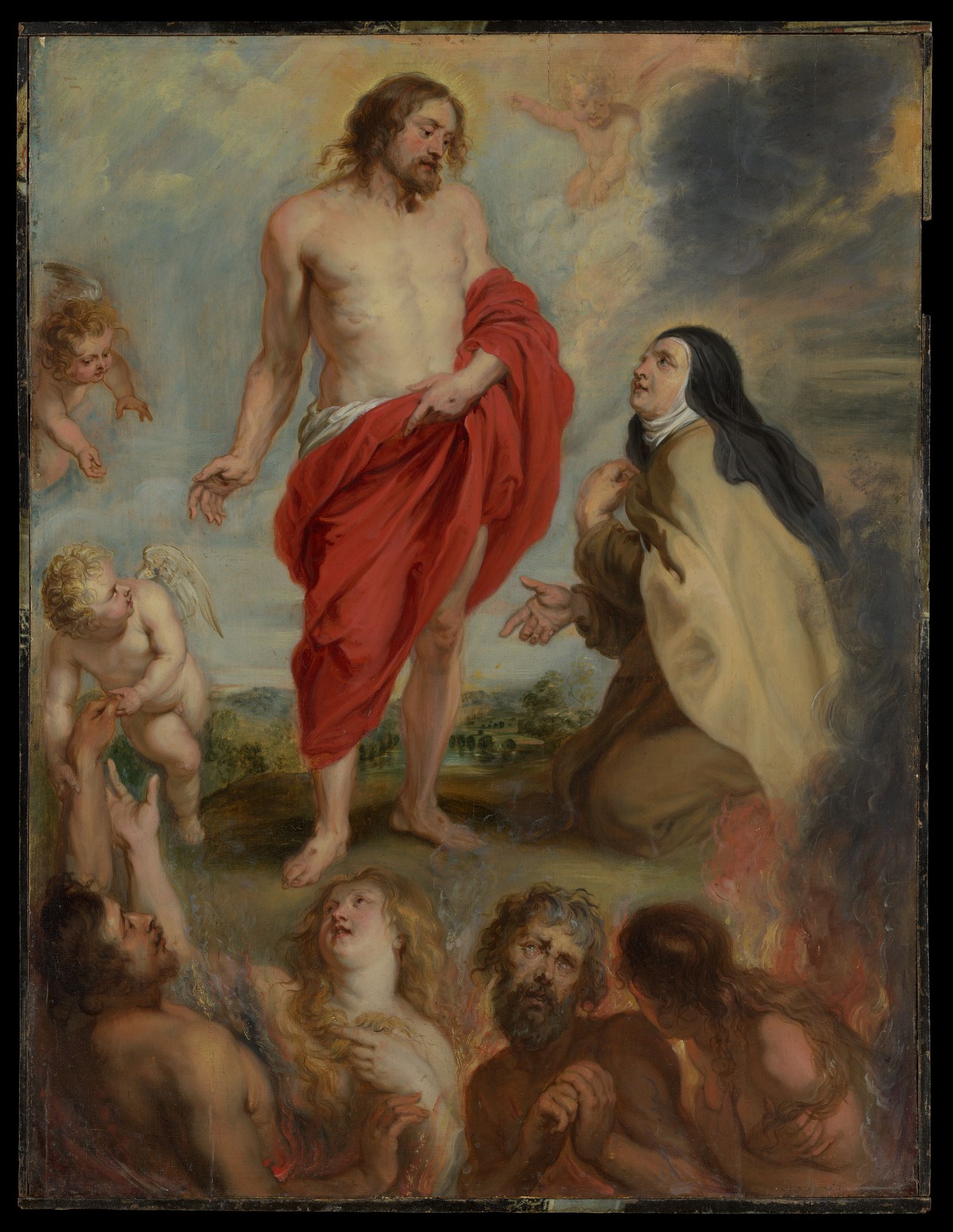
Peter Paul Rubens · Saint Teresa of Ávila Interceding for Souls in Purgatory
Teresa was born in Ávila, in Spain, to a noble family with Jewish roots. As a girl she was outgoing and loved the pleasures of the world, and by her own account she spent a long time torn "between serving God and serving the world." At twenty, without her father’s permission, she entered a Carmelite convent. But convents in those days were busy places, with visitors coming and going, and discipline had become very relaxed.
"The Interior Castle"
In her late thirties Teresa went through a deep conversion, and her experiences of union with God in prayer grew more and more intense. She described them in The Interior Castle, where she pictures the soul as a castle with seven sets of rooms. The soul moves step by step from the noise outside toward the center, where God lives in silence. In another book, her Life, she tells her own story and how she learned to pray. Her famous vision of an angel piercing her heart with a golden spear, known as the "transverberation," was later captured by Bernini in one of his best-known sculptures.
The Discalced Carmelites
Seeing how lax the convents had become, Teresa set out to take her order back to its first spirit of strict poverty and prayer. With a young friar, Saint John of the Cross, she started the reform of the "Discalced" (barefoot) Carmelites. She founded seventeen small, simple convents, crossing the length of Spain by mule to do it. Opponents of the reform put obstacles in her way at every turn, and John of the Cross was even imprisoned for a time, but Teresa never gave up. She was known for her wit and common sense. Once, after falling off her mule into the mud in the rain, she is said to have told God, "If this is how you treat your friends, no wonder you have so few."
Teresa died in 1582, while on the road. In 1970 Pope Paul VI made her the first woman Doctor of the Church; Catherine of Siena followed a week later. Her feast day is October 15.