Emblem: The crown of thorns
Doctor of the Church · 1347-1380
Saint Catherine of Siena
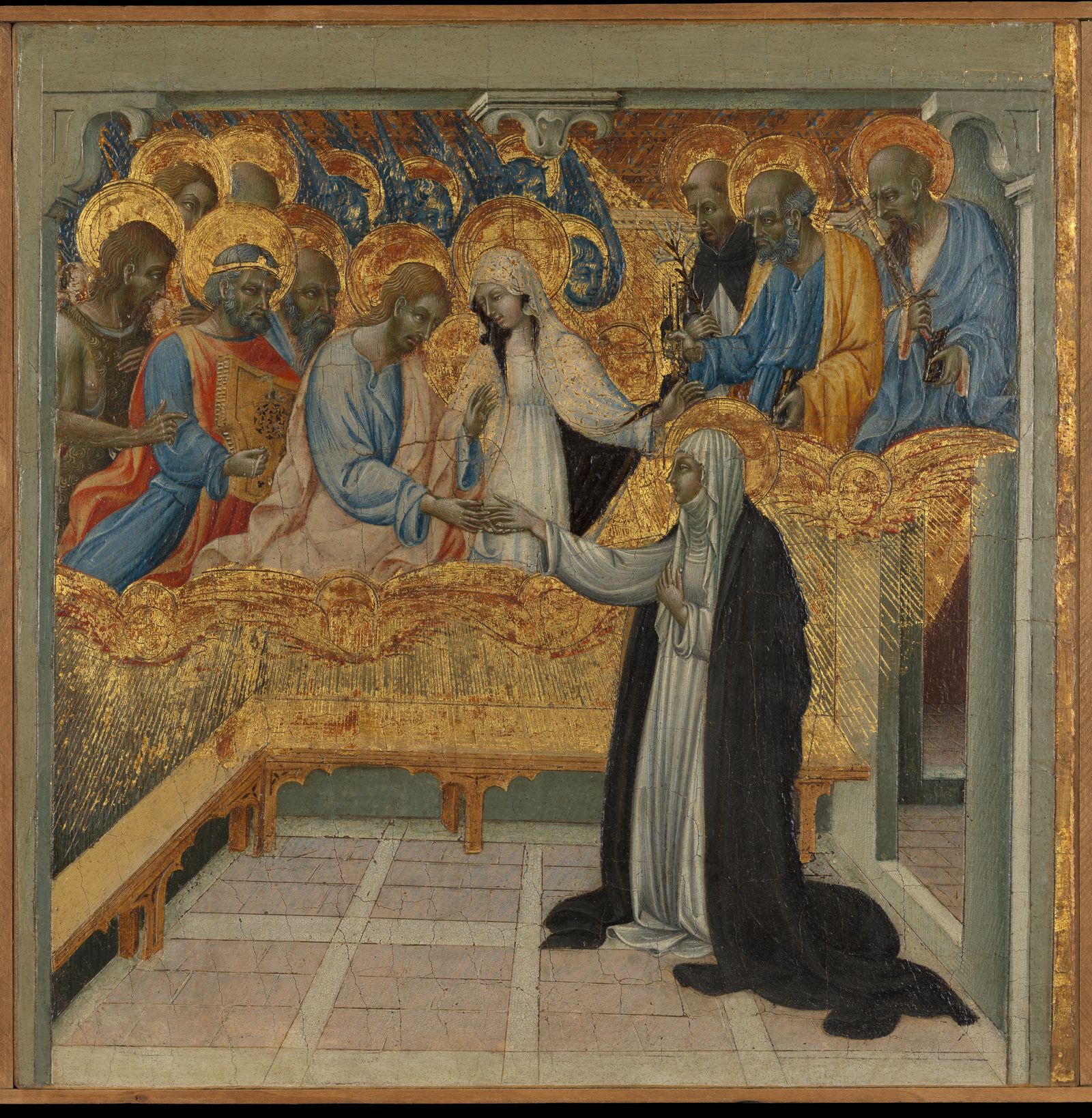
Giovanni di Paolo · The Mystic Marriage of Saint Catherine of Siena
Catherine was born in the Italian city of Siena, the twenty-fifth child of a dyer of cloth. By her own account, when she was only six she saw a vision of Christ in the sky while walking down the street with her brother. At sixteen she refused the marriage her family had planned for her, cut off her hair and gave herself completely to God. She joined the Mantellate, a group of Dominican laywomen who lived at home and spent their lives in prayer and service.
A Writer Who Couldn’t Read
Catherine had no schooling. She only learned to read as an adult, and perhaps never fully. Even so, the four hundred or so letters she dictated, and her great mystical work, the Dialogue, are counted among the classics of Italian literature. She had no fear of writing to kings, cardinals or the Pope himself, and she spoke to the most powerful people of her time in a direct, passionate voice that was all her own.
Bringing the Pope Home from Avignon
In the fourteenth century, under pressure from France, the popes had moved from Rome to Avignon, and stayed there for some seventy years, a period known as the "Avignon Captivity." Catherine, still in her twenties, wrote to Pope Gregory XI and then traveled to Avignon herself to persuade him to go back to Rome. That she succeeded is one of the most remarkable feats of diplomacy of the Middle Ages. She also worked to make peace between the warring Italian city-states, and cared for plague victims and prisoners.
Fasting and Death
In her last years Catherine ate less and less. Historians still argue about why, but she herself saw it as penance and prayer. She died in Rome in 1380, at thirty-three, probably of a stroke. She was canonized in 1461. In 1970 Pope Paul VI made her one of the first two women Doctors of the Church, together with Teresa of Ávila, and in 1999 Pope John Paul II named her one of the patron saints of Europe. Her feast day is April 29.