Frequently Asked Questions
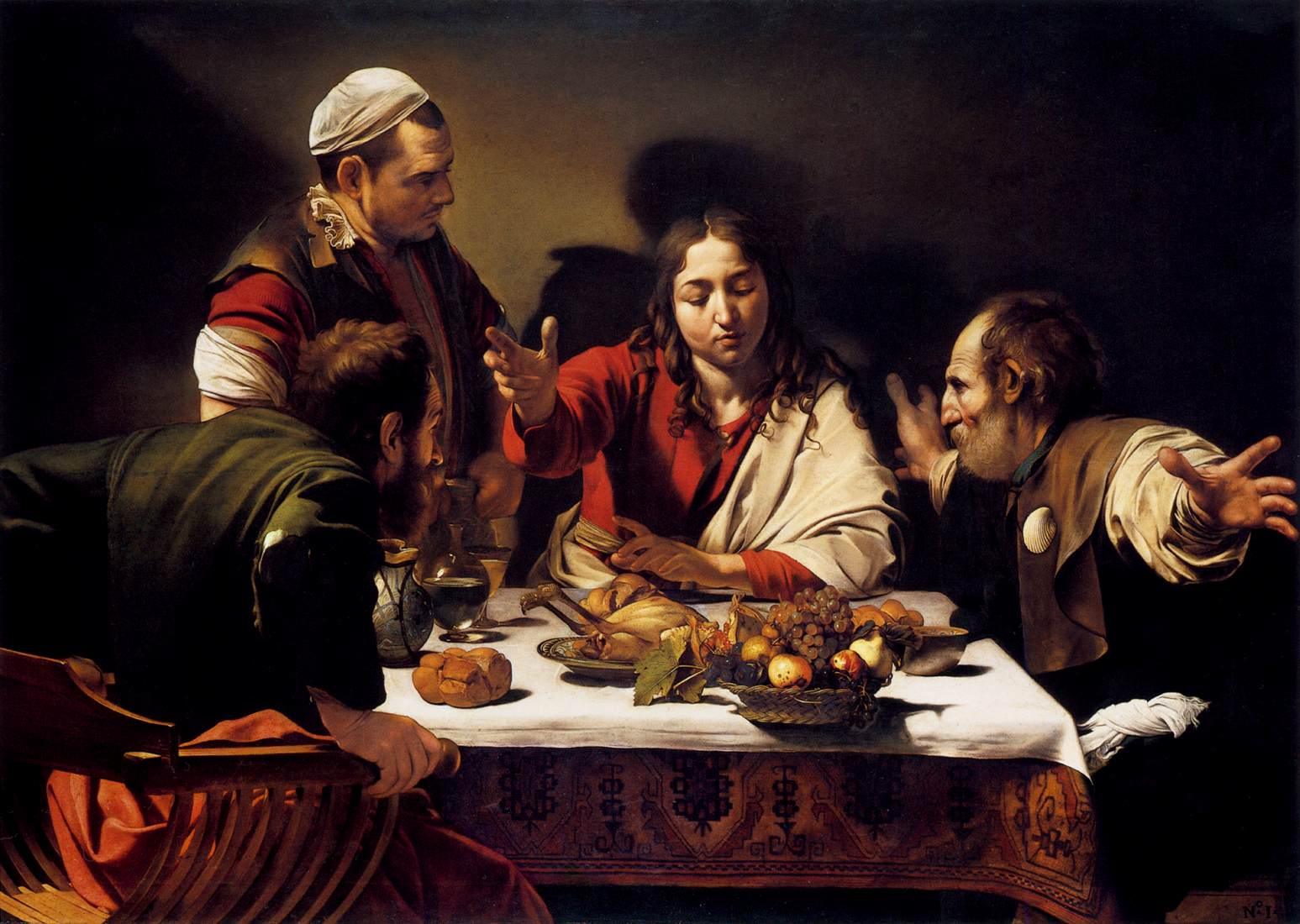
Caravaggio · Supper at Emmaus
5 questions
Common Misunderstandings
Do Catholics worship Mary and the saints?
No. The Church draws a hard line between worship and honor. Worship (Latin latria) belongs to God alone; worshipping a creature is idolatry. Mary and the saints receive honor and love (dulia). Mary gets a special degree of it, called hyperdulia, but it still isn’t worship.
Asking a saint to “pray for us” is no different from asking the friend next to you to pray. The saints aren’t dead; they are alive in Christ, and death doesn’t split the Church in two. Christ is the one Mediator, and the saints don’t compete with him: they share in his work, and their prayers, too, reach the Father through Christ.
When a Catholic prays to Mary, they aren’t asking her to stand in for God. They’re asking her to pray to God for them.
Do Catholics believe in three Gods?
No. There is one God; Christians aren’t polytheists. The Trinity doesn’t mean three gods. It means the one God exists as three Persons: Father, Son and Holy Spirit.
There is no contradiction, because God isn’t “one” and “three” in the same sense. He is one in nature, undivided, and three in Persons. The Father isn’t the Son, the Son isn’t the Holy Spirit, and yet each is fully the one God. They don’t split the divine nature into thirds; each has all of it.
Human reason could never have worked this out alone. It’s a mystery God revealed about himself, and we hold it by faith.
Why do Catholics pray in front of statues and images?
Nobody is praying to the statue. The honor goes to the person it shows, the way kissing a photo of someone you love isn’t about the paper. The image itself has no power.
The Old Testament ban on images was aimed at idolatry: shrinking the invisible God down to an idol. The same God told Moses to make cherubim for the Ark of the Covenant and a bronze serpent in the desert (Exodus 25:18-20; Numbers 21:8-9). So the ban was never on images as such, but on idols.
The real basis for Christian art is the Incarnation: the invisible God became visible in Christ. The Second Council of Nicaea (787) said it plainly: because Christ took a body, his face can be painted.
Hasn’t the Bible been changed over the centuries?
No, and you don’t have to take that on faith; you can check it. The New Testament survives in more than five thousand Greek manuscripts, some fragments going back to the 2nd century. For the Old Testament, the Dead Sea Scrolls gave us Hebrew texts a thousand years older than anything we had before.
These copies were made independently, on different continents and in different languages. Put side by side, they say essentially the same thing. The differences are spelling, word order and the like, and not one doctrine depends on them. To change the text across the board, hundreds of communities that never met would have had to make the same edit at the same time.
The Church holds that Scripture is inspired by God and teaches without error the truth God wanted written down for our salvation.
Why is Christ called the Son of God?
It doesn’t mean a physical birth. God has no wife, and the Son isn’t a creature God made at some point.
“Son” names an eternal relationship. The Nicene Creed says he is “begotten, not made, consubstantial with the Father”. There was never a time when the Son didn’t exist; the Father was never without him. The Church’s image is light and its source: wherever the source is, its light is too.
Being born of Mary is something else. In time, the eternal Son also took on a human nature (the Incarnation). So Christ is one Person with two natures, fully God and fully man.
5 questions
Sacraments and Church Practices
Why do Catholics confess to a priest instead of going directly to God?
God forgives sins, not the priest. The real question is how God chose to hand that forgiveness on.
On the evening of the Resurrection, Christ breathed on the apostles and said: “Receive the Holy Spirit. If you forgive the sins of any, they are forgiven; if you retain the sins of any, they are retained” (John 20:22-23). You can’t decide whether to forgive or retain without hearing the sins. The priest acts in the person of Christ (in persona Christi), not on his own account, and he is bound to total secrecy.
We are also bodies, not just souls. We need to hear, with our own ears, that we are forgiven. “I suppose I’m forgiven” is not the same as hearing “I absolve you from your sins.”
Catholics also confess their sins to God directly, and for venial sins that is enough. Mortal sin needs the sacrament.
Are the bread and wine at Mass just a symbol of Jesus?
No. The Church couldn’t be clearer on this. After the consecration, the appearances of bread and wine stay (taste, shape, chemistry), but what they are is now the Body and Blood of Christ. This is called transubstantiation, a change of substance.
Christ is there truly, really and substantially: Body and Blood, Soul and Divinity. Not a part of him, all of him; not a symbol, himself.
This isn’t reading too much into the text. Jesus said, “This is my body” (Matthew 26:26). In John 6, when he said, “Unless you eat the flesh of the Son of Man and drink his blood, you have no life in you,” many of his followers found it too hard and walked away. He didn’t call them back to say, “Wait, I meant it symbolically.”
Do I really have to go to Mass every Sunday?
Yes. Going to Mass on Sundays and holy days of obligation is one of the precepts of the Church, and it’s a serious obligation. Skipping it deliberately, without a serious reason, is a mortal sin.
Serious reasons do exist, and the Church doesn’t read them narrowly: being sick, looking after small children or someone ill, having no church within reach, work you truly can’t get out of. If you’re not sure, ask your pastor.
It isn’t an arbitrary rule. It’s how the Third Commandment (“Remember to keep holy the Lord’s day”) is lived. And if you say you love God but can’t give him one hour a week, the love isn’t worth much.
Who can receive Holy Communion?
To receive Communion you need to be baptized and in full communion with the Catholic Church, believe that Christ is really present in the Eucharist, and not be aware of any unconfessed mortal sin. If you have committed a mortal sin, go to confession first. There’s also a one-hour fast beforehand (water and medicine don’t count).
Asking non-Catholics not to receive isn’t a snub. Communion expresses a unity that already exists; it doesn’t create one. Acting out a shared faith that isn’t shared yet wouldn’t be honest on anyone’s part.
If you can’t receive, you can still go up in line with your arms crossed over your chest and ask for a blessing. People do it all the time, and you’re welcome to.
Are Catholics required to fast?
Yes, but not much. In the Latin Church, Ash Wednesday and Good Friday are days of fasting and of abstaining from meat. Fasting applies from 18 to 59 and means one full meal a day, plus two small ones; abstaining from meat applies from age 14.
Every Friday in Lent is meatless. Every Friday of the year is in principle a day of penance too, and in many countries the bishops let you swap the meatless rule for another act of penance or charity.
Illness, pregnancy, hard physical work and the like excuse you. Fasting isn’t a punishment or a bargain with God. Along with prayer and almsgiving, it puts your appetites in their place and makes room for God.
5 questions
Authority and Church Teachings
Is the Pope sinless?
No. People mix up two very different things: infallibility and sinlessness. The Church has never said the Pope is sinless. Popes sin, popes go to confession, and some popes in history sinned badly.
Infallibility is very narrow. The Pope is infallible only when, as shepherd of the whole Church, he defines a teaching on faith or morals as final and binding (ex cathedra). His politics, his management decisions, his views on science and his off-the-cuff remarks aren’t covered.
It has been used very rarely. And it doesn’t let the Pope invent new revelation; it only guarantees that he faithfully guards and explains the faith handed down to him.
What's the basic difference between Catholic, Orthodox and Protestant Christians?
With the Orthodox, the split is mostly about the authority of the Bishop of Rome, Peter’s successor, plus a few points of doctrine (for example the Filioque: whether the Holy Spirit proceeds from the Son as well). Beyond that, we share a great deal: valid sacraments, apostolic succession, the real presence in the Eucharist, devotion to Mary and the saints. The Church sees this split as a wound.
With Protestants the differences go deeper, on four points: whether Scripture alone is the rule or Tradition and the Magisterium carry authority too; the number and nature of the sacraments; Christ’s real presence in the Eucharist; and how we are justified.
Still, the Church sees every validly baptized Christian as a brother or sister, in a real if incomplete communion in Christ. Division is a scandal, and we are bound to pray for unity.
What is Purgatory?
Purgatory isn’t a “second chance” or hell on easy mode. Everyone in Purgatory is saved for good; nobody falls from there into hell. It is the cleansing of people who die in God’s friendship but aren’t yet completely purified, so that they can enter the joy of heaven.
The idea is that being forgiven a sin and being healed of it are two different things. A forgiven liar doesn’t lose the habit of lying overnight. Since nothing unholy can see God, that healing has to be finished somehow.
The Church has prayed for the dead from the very start. That only makes sense if the dead can still be helped by our prayers.
Does the Catholic Church reject science and the theory of evolution?
No. The Church teaches that faith and honest science can’t really conflict, because all truth comes from the same God. When they seem to, either the science isn’t finished or the faith has been misread.
Scientists are free to study how the universe developed and where living bodies came from; the Church doesn’t hand down a biology textbook. The first chapters of Genesis aren’t a lab report. They say that everything was made by a good God, made good, and made for a reason.
The Church insists on two things: God the Creator is the source of everything, and every human soul is created directly by God, not produced by matter. Put simply: science asks “how”; faith asks “why” and “by whom”.
Can the Church's core teachings of faith change over time?
No. God’s public revelation was complete in Christ. There is no new revelation to wait for, and no private revelation can add to it.
But the Church’s understanding of it can grow. This is called the development of doctrine, and it works like a seed growing into a tree: the tree doesn’t look like the seed, but it didn’t come from a different seed. Stating a doctrine more precisely is not the same as reversing it.
Discipline can change: fasting rules, the language of the liturgy, celibacy for priests in the Latin Church. The Church set those rules and can change them. Defined teaching on faith and morals can’t change.
A simple test: if a new teaching would make an old one false, it isn’t development but a break, and the Church says plainly it has no power to do that.
6 questions
Faith and Reason: Common Objections
Why does God allow suffering and evil in the world?
The Church doesn’t offer a quick, tidy answer. The Catechism itself says that only the Christian faith as a whole can answer it.
Some things are clear, though. God doesn’t want evil and doesn’t do it. Evil isn’t a “thing”; it is a good that should be there and isn’t, the way blindness is missing sight. God made free creatures, and real freedom can be misused. That is where most of the evil in the world comes from: human choices. If God gave us freedom and then blocked every misuse of it, it wouldn’t be freedom.
But the real Christian answer isn’t an explanation; it’s a person. God didn’t watch suffering from a safe distance. In his Son he walked into it: he went hungry, was betrayed, was tortured and died. On the cross God doesn’t stand next to the sufferer; he is the sufferer. And the Resurrection shows that suffering doesn’t get the last word.
None of this explains suffering away or makes it good. It says that God can bring a greater good out of evil, and admits that we will only see that fully at the end.
Can God's existence be proven by reason?
The Church is optimistic here: reason alone, starting from the world around us, can know for certain that God exists. The First Vatican Council defined this.
There are several roads to it: things that exist don’t explain their own existence; the universe has an order we can understand; every human being has a sense of right and wrong that won’t go quiet, and a longing for the infinite that nothing finite satisfies.
But these aren’t mathematical proofs that force a yes. They ask for attention, honesty and humility, because accepting the conclusion changes your life, and people are very good at dodging conclusions they don’t want.
And reason only gets you so far. It can reach the fact that God is. Who he is (that he is love, that he is Trinity, that he is looking for us) we know only because he told us.
How can a loving God allow hell to exist?
God doesn’t create anyone for hell or want anyone lost. The Church wants and prays for the salvation of every single person.
Hell isn’t God’s anger landing on someone. It is the name for choosing, finally, to stay away from God. God doesn’t force love on anyone, because forced love isn’t love. If someone says a conscious, unrepented “no” right up to death, God takes them seriously. As the saying goes, the doors of hell are locked from the inside.
For a sin to be mortal, three things have to come together: the matter is grave, the person fully knows it, and they freely and fully consent. The Church has declared many people to be in heaven; it has never declared a single person to be in hell.
The teaching on hell isn’t a scare tactic. It says that our freedom and our choices really matter.
Can people who have never heard of Christ be saved?
Yes, they can. Salvation comes only through Christ (there is “no other name”), but that doesn’t mean people who never heard his name are condemned.
The Church teaches that people who, through no fault of their own, don’t know the Gospel or the Church, but sincerely seek God and try to do his will as their conscience shows it to them, can be saved. The grace that reaches them is still Christ’s, even if they don’t know it.
That doesn’t make preaching the Gospel pointless; quite the opposite. The Church owes people the truth and the sure road of the sacraments. Settling for a vague possibility wouldn’t be love.
Children who die without baptism the Church likewise entrusts to God’s mercy, without spelling out how they are saved.
Don't the sins and scandals in the Church's history disprove its claim to be holy?
The Church is holy and full of sinners at the same time. Its holiness doesn’t come from its members but from Christ: its Head is holy, the Holy Spirit who gives it life is holy, and so are its teaching and sacraments. Its members, from laypeople to priests to popes, can sin and have sinned.
The Church doesn’t hide this. The Catechism calls the Church “at once holy and always in need of purification”, and in 2000 John Paul II publicly asked forgiveness for the sins of the Church’s children.
One point of logic matters here: a teaching isn’t true or false depending on whether its defenders live up to it. Hypocrisy shows a principle was betrayed, not that it was wrong. In fact, these sins are scandals precisely because they’re measured against the Church’s own standard.
None of that lessens the guilt. Christ’s harshest words were for those who lead the little ones astray.
If God really exists, why doesn't he show himself plainly?
The Church’s answer: God isn’t hiding. He has shown himself, but without forcing anyone. In creation, in conscience, in the history of Israel, and most clearly in Christ.
Why no knock-down proof? Because of what God is after. A sign blazed across the sky would convince everyone, but it would produce submission, not love. God wants love, and love has to be free. So he gives enough light for anyone looking to find him, but not so much that it blinds someone who doesn’t want to see.
That doesn’t make faith a blind leap. It isn’t against reason; it goes further than reason can go alone. Reason prepares the way but doesn’t force it. The Church says both that “faith is a gift” and that “believing is reasonable”, and the two fit together.
In the end, the Christian claim isn’t that people who look for God find him. It’s that God came looking for us first.
10 questions
Apologetics and Hard Questions
Did Christ really found the Catholic Church?
Question: Did Christ found a single, visible Church meant to hold everyone who believes in him, and does he offer salvation through that Church?
Yes. Just as God worked through the patriarchs and Moses in the Old Testament, Christ founded one Church, with a visible authority built into it by God. This Church carries on and completes the kingdom of Israel under the new covenant, and Christ now rules it as "King of kings" (Revelation 17:14).
Matthew sums this up in the opening verse of his Gospel: "The book of the genealogy of Jesus Christ... the son of Abraham, the son of David" (Matthew 1:1). Christ says plainly that he built his Church on Peter and the other apostles: "You are Peter, and on this rock I will build my church" (Matthew 16:18-19). Right after saying "all authority in heaven and on earth has been given to me," he hands that authority on to the apostles (Matthew 28:18-20) and sends them as the Father sent him (John 20:21-23).
If it weren't, the gates of hell would have prevailed against the Church for nearly fifteen hundred years, until the Reformation, despite the Lord's promise (Matthew 16:18). And the Reformation didn't bring the unity that marks Christ's body (1 Corinthians 12:13; Ephesians 4:4-6). It brought more and more division, the very opposite of what Christ prayed for in John 17:20-23.
The early Church bears witness to apostolic succession and to the primacy of the Pope as well, as the first ecumenical councils, such as Nicaea, show. If the Church were merely a human institution, it would long since have vanished under persecution from outside and scandal from within. But it is the mystical bride of the divine Bridegroom, and for that reason it is indestructible (Matthew 16:18-19).
Can Catholics get divorced?
Question: What does the Church teach about divorce? When is a marriage valid, and what happens when a union breaks down, especially regarding Communion and remarriage?
The Church teaches that a valid marriage between two baptized Christians is indissoluble; no civil authority can break a bond God has joined, and neither can the Church itself (CCC 2382). What the Church does have, by God's authority, is the power to judge whether valid consent was given at the wedding (see Matthew 16:18-19, 18:15-18) and, if it wasn't, to issue a declaration of nullity: a finding that the marriage was never valid in the first place (CCC 2384, 1625-1629). A civil divorce can declare a marriage "ended" in the eyes of the state, but the state has no power to dissolve a marriage bond or make it invalid.
God made marriage a natural, lasting union (Genesis 2:23-24) and in Christ raised it to a sacrament (Matthew 19:3-9; Ephesians 5:21-33); that is why Scripture says he hates divorce (Malachi 2:16). So the Church treats divorce as a grave sin when it is chosen in order to leave a marriage or start a new relationship. A divorced person who enters a new union without a declaration of nullity places themselves in a state of "public and permanent adultery" (CCC 2384).
But the Church also recognizes that civil divorce is sometimes forced on an innocent spouse, or may be the only way to protect oneself, one's children, or one's property from an unjust spouse. In such cases the innocent spouse commits no sin, and civil divorce can function as a form of separation without ending the marriage (CCC 2383). What civil divorce cannot do is decide whether the marriage itself was valid; that authority belongs to Christ and his Church alone: "What God has joined together, let no one separate" (Matthew 19:6).
Does Paul forbid women from teaching the faith?
Question: If St. Paul says in 1 Timothy 2:12, "I permit no woman to teach or to have authority over men; she is to remain silent," why does the Catholic Church have women catechists?
1 Timothy 2:12 doesn't mean women can never teach in any form. We know this because Paul himself, writing to the Corinthians, describes women "prophesying" in the assembly: "Any woman who prays or prophesies with her head uncovered brings shame upon her head" (1 Corinthians 11:5). "Prophesying" here doesn't mean predicting the future but proclaiming God's mind, which is exactly what a teacher does. Every baptized person shares in the common priesthood of the faithful, so everyone is called to "prophesy" in this sense (1 Peter 2:5-9; CCC 1268).
And straight after this passage, Paul lists the qualifications for bishops and deacons (1 Timothy 3:1-13). Read in context, the verse means women cannot teach as ordained ministers in the liturgy, a ministry that belongs only to bishops, priests and deacons.
Most people, male or female, can't preach at Mass anyway. That doesn't mean they aren't "prophet, priest and king" by their baptism; everyone is. All Christians are called to teach in the sense of the spiritual work of mercy "instructing the ignorant." Only a few are called to be ordained clergy, who teach formally by preaching at Mass.
How can IVF be wrong if it creates life?
Question: Since IVF creates life, how could someone think it's wrong?
A common mistake with IVF is to look at the children born through it and assume that the goodness of the child justifies the method that produced them. Children conceived through adultery, prostitution, rape or surrogacy are equally valuable, but that doesn't mean the way they were conceived is good or ought to be defended.
One of the main objections is that embryos that aren't implanted are often deliberately destroyed, and that is the direct killing of innocent human beings. The process also often relies on persuading women in financial need to donate eggs, and on surrogate mothers to carry the embryos. In January 2024, Pope Francis called surrogacy "a grave violation of the dignity of the woman and the child" and called for it to be banned worldwide.
There's also a practical problem: there's no principled way to keep IVF limited to infertile married couples. An unmarried person could just as easily find a sperm and egg donor, create an embryo, hire a surrogate mother, and take custody of the child.
But the deepest problem is this: children have a right to come into being inside their mother's body, as the concrete act of their parents' married love, not in a laboratory. The Catechism says children have the right "to be the fruit of the specific act of the conjugal love of their parents" and "to be respected as a person from the moment of their conception" (CCC 2378).
Can other prophets come after Christ?
Question: A Muslim friend of mine says he loves Christ and believes he's a prophet, but that this doesn't mean no other prophets could come after him. What should I tell him?
Scripture says Christ is the fullness of God's revelation, and that no other prophet will come after him bringing public revelation. There can be people who receive private revelations, as at Fatima, but no prophet like Moses, bringing new public revelation, will come again. Moses himself said, "The LORD your God will raise up for you a prophet like me from among your own kinsmen; to him you shall listen" (Deuteronomy 18:15). That prophet was Christ.
In Acts 3:22, Peter quotes this verse and applies it to Christ; just before, he says: "What God announced beforehand by the mouth of all the prophets, that his Messiah would suffer, he has thus fulfilled" (Acts 3:18). The opening verses of Hebrews say the same thing: "In times past, God spoke in partial and various ways to our ancestors through the prophets; in these last days, he has spoken to us through the Son, whom he made heir of all things and through whom he created the universe" (Hebrews 1:1-2).
Christ also makes clear that he is more than a prophet: in the parable of the wicked tenants, the tenants first kill the servants (the prophets) and finally the owner's son (Christ himself). So the age of public prophecy is over, because God has sent someone greater than a prophet: his only Son, who fully shares the Father's own divine nature.
How should I love a relative who identifies as trans?
Question: A relative of mine identifies as a "trans woman," and we'll soon be attending a wedding together. Should I be there? How should I prepare my young grandchildren for this?
Going to the wedding and spending time with your relative there doesn't mean endorsing their identity. It would be different if the event itself were a so-called "marriage" or a ceremony celebrating the new identity; then going could count as endorsing it. But this is another couple's real wedding, and your relative is just one of the guests.
Shutting out your relative and their family would mean forgetting that our real enemy isn't other people but the fallen angels (Ephesians 6:12). Every person is made in the image and likeness of God (Genesis 1:26-27), and Christ gave his life on the cross for everyone; your relative deserves love for that reason. You already know that love doesn't mean endorsing their identity, and that leaves plenty of room for conversation, hugs and showing your love.
When and how to introduce your grandchildren to this situation is a prudential matter you should decide together with their parents. With their permission, you can explain that your relative is confused, searching for their identity, and in need of real love. The Church asks that people struggling with gender identity be treated "with respect, compassion, and sensitivity" (CCC 2358; the Dicastery for the Doctrine of the Faith's 2024 declaration Dignitas Infinita also addresses this).
Are Mormons considered Christian?
Question: I've heard that Mormons worship the same Jesus we do, and are therefore Christian; even their church's name is "The Church of Jesus Christ of Latter-day Saints." Is that right?
Calling yourself Christian doesn't make you Christian; a Christian has to be validly baptized and believe in the God of Christianity. The Catholic Church considers Mormon baptisms invalid, because even though the formula used is correct, the meaning they attach to the words "Father, Son and Holy Spirit" is so far from Christian belief that it amounts to a different religion (the Dicastery for the Doctrine of the Faith's 2001 declaration).
Christians believe Christ is fully human and fully God, always divine as the second Person of the Trinity. Mormons, however, believe Christ was not always divine. They teach that, like us, he existed eternally as an "intelligence", and that God made him the "firstborn" among intelligences by giving him the first "spirit body". The Mormon Church's leadership published a statement in 1909 that reads: "Jesus Christ's Father... is our Father also. Jesus Christ is our elder brother."
So this Christ is not a different kind of being from us, only a greater one, which is why he is called our "elder brother". The eternal Creator of the universe is reduced to a highly exalted "spirit child" of God the Father. That is not the Christian faith.
According to the Catholic Church, which baptisms are invalid?
Question: People converting to Catholicism from another denomination are sometimes re-baptized, sometimes not. Which baptisms does the Church consider valid, and which not?
For a baptism to be valid, three things are needed together: real water, the correct words ("I baptize you in the name of the Father, and of the Son, and of the Holy Spirit"), and the intention to do what the Church does (CCC 1239-1240, 1256). When all three are present, the baptism is valid regardless of who performed it; that's why the Catholic Church recognizes the baptisms of the Eastern Orthodox and Eastern Churches, the Old Catholics, and most Protestant denominations (including Anglicans, Lutherans, Presbyterians, Methodists, Baptists, and Reformed and Congregationalist churches) as valid. Someone from those traditions isn't re-baptized on becoming Catholic, only received into full communion with the Church.
A baptism can be invalid for one of two reasons. The first is that although the correct words are used, the meaning attached to them is foreign to Christian belief: this includes Mormons (The Church of Jesus Christ of Latter-day Saints, declared invalid by the Dicastery for the Doctrine of the Faith's 2001 declaration), Oneness Pentecostal communities who baptize "in Jesus' name only" (rejecting the Trinity by saying only "in Jesus' name" instead of Father, Son and Holy Spirit), and Unitarians (who reject the Trinity outright). Jehovah's Witnesses also fall in this category, since their own teaching rejects Christ's full divinity. The second is that the community doesn't baptize with water at all: this includes Quakers (the Religious Society of Friends), the Salvation Army, and Christian Science; their members have never been baptized with water, so they are baptized for the first time upon becoming Catholic.
If you aren't sure your own baptism is valid, especially if you're in the process of becoming Catholic, it isn't up to you to research it; talk to the priest or catechist guiding you through the Becoming Catholic process. Your baptismal record will be examined, and a conditional baptism or a full baptism will be given if needed.
I'm becoming Catholic, and my spouse and I married before either of us was baptized. Does our marriage need to be convalidated?
CCC 1601, 1631 · CIC can. 1055 §2, 1086
No. The Catholic Church recognizes a civil marriage between two unbaptized people as a valid natural union. Convalidation applies to marriages the Church considers invalid because of a lack of canonical form or an impediment. The canonical impediment of disparity of cult (Canon 1086) only applies when one spouse is baptized and the other is not at the time of marriage. A valid natural marriage is no obstacle to receiving the sacraments of initiation through RCIA/OCIA.
How does a valid natural marriage become a sacramental marriage?
CCC 1617 · CIC can. 1055 §2
A valid natural marriage automatically becomes a sacrament once both spouses are baptized. According to Canon 1055 §2, a valid marriage between two baptized persons is raised to the dignity of a sacrament by that very fact. If one spouse is baptized through RCIA/OCIA and the other spouse is baptized at a later date, the marriage becomes sacramental at the exact moment of the second spouse's baptism. No additional ceremony or convalidation process is required.