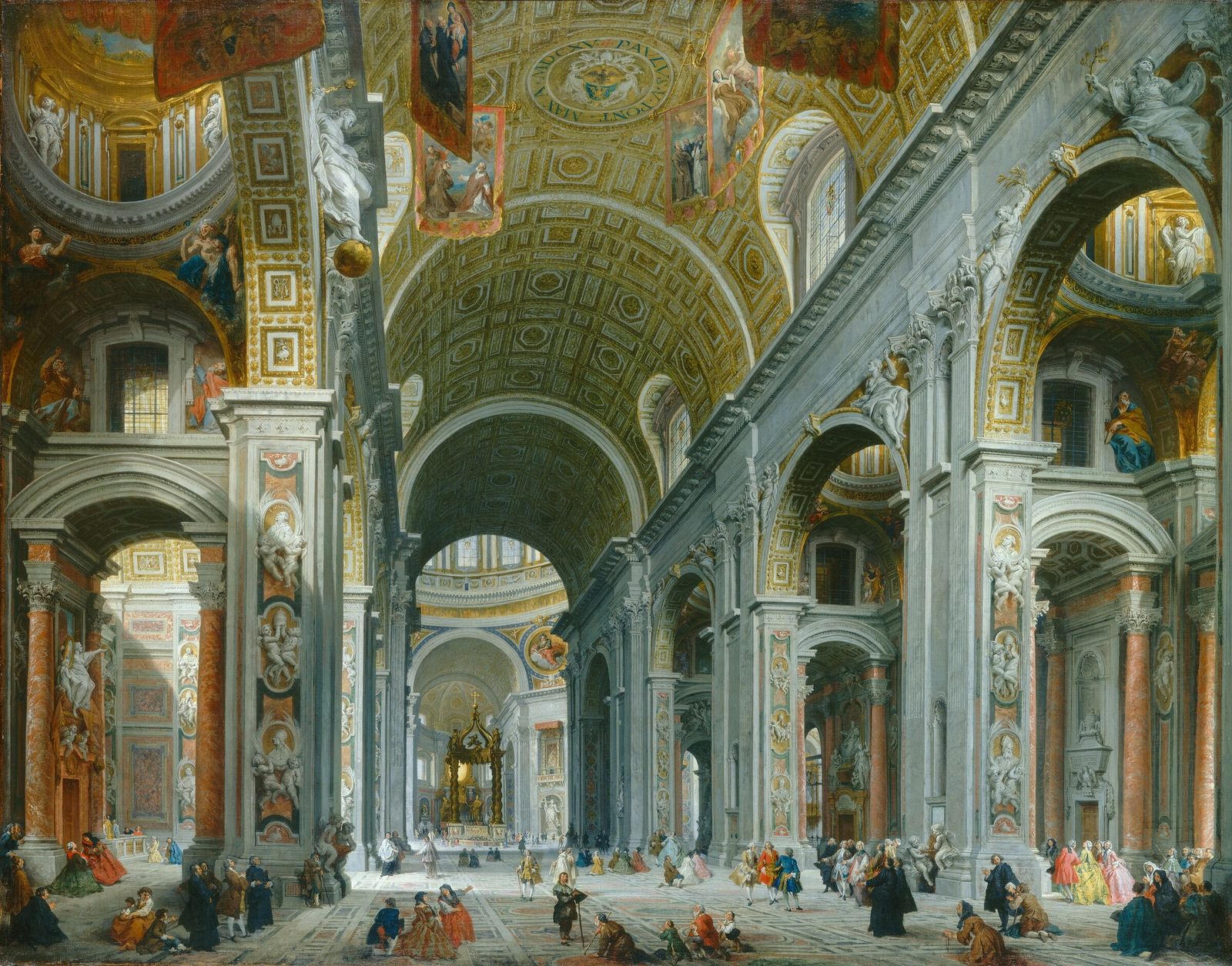
Giovanni Paolo Pannini · Interior of Saint Peter’s, Rome
Compendium of the Catechism of the Catholic Church
Open a part to see its headings, or search for a question.
Part One: The Profession of Faith
Section TwoThe Profession of the Christian Faith
Read this part- The Creed
- Chapter OneI Believe in God the Father33–78
- The Symbols of Faith33–35
- “I believe in God the Father Almighty, Creator of heaven and earth.”36–58
- Heaven and Earth59–65
- Man66–72
- The Fall73–78
- Chapter TwoI Believe in Jesus Christ, the Only Son of God79–135
- Question 79What is the Good News for humanity?
- Question 80How is the Good News spread?
- “And in Jesus Christ, His only Son our Lord”81–84
- “Jesus Christ was conceived by the power of the Holy Spirit, and was born of the Virgin Mary”85–111
- “Jesus Christ suffered under Pontius Pilate was crucified, died, and was buried.”112–124
- “Jesus Christ descended into hell; on the third day He rose again from the dead.”125–131
- “Jesus Ascended into Heaven and Is Seated at the Right Hand of God the Father Almighty”132
- “From thence He shall come to judge the living and the dead”133–135
- Chapter ThreeI Believe in the Holy Spirit136–217
- Question 136What does the Church mean when she confesses: “I believe in the Holy Spirit”?
- Question 137Why are the missions of the Son and the Holy Spirit inseparable?
- Question 138What are the names of the Holy Spirit?
- Question 139What symbols are used to represent the Holy Spirit?
- Question 140What does it mean that the Spirit “has spoken through the prophets”?
- Question 141What did the Holy Spirit accomplish in John the Baptist?
- Question 142What is the work of the Spirit in Mary?
- Question 143What is the relationship between the Spirit and Christ Jesus in his earthly mission?
- Question 144What happened at Pentecost?
- Question 145What does the Spirit do in the Church?
- Question 146How do Christ and his Spirit act in the hearts of the faithful?
- “I Believe in the Holy Catholic Church”147–199
- “I Believe in the Forgiveness of Sins”200–201
- “I Believe in the Resurrection of the Body”202–206
- “I Believe in Life Everlasting”207–216
- “Amen”217
Part Two: The Celebration of the Christian Mystery
Section OneThe Sacramental Economy
- Question 218What is the liturgy?
- Question 219What place does the liturgy occupy in the life of the Church?
- Question 220In what does the sacramental economy consist?
- Chapter OneThe Paschal Mystery in the Age of the Church221–232
- The Liturgy - Work of the Most Holy Trinity221–223
- The Paschal Mystery in the Sacraments of the Church224–232
- Chapter TwoThe Sacramental Celebration of the Paschal Mystery233–249
- Celebrating the Liturgy of the Church233–246
- Liturgical Diversity and the Unity of the Mystery247–249
Section TwoThe Seven Sacraments of the Church
Read this part- Question 250How are the sacraments of the Church divided?
- Chapter OneThe sacraments of Christian initiation251–294
- Question 251How is Christian initiation brought about?
- The Sacrament of Baptism252–264
- The Sacrament of Confirmation265–270
- The Sacrament of the Eucharist271–294
- Chapter TwoThe Sacraments of Healing295–320
- Question 295Why did Christ institute the sacraments of Penance and the Anointing of the Sick?
- The Sacrament of Penance and Reconciliation296–312
- The Sacrament of Anointing of the Sick313–320
- Chapter ThreeThe Sacraments at the Service of Communion and Mission321–350
- Question 321What are the sacraments at the service of communion and mission?
- The Sacrament of Holy Orders322–336
- The Sacrament of Matrimony337–350
- Chapter FourOther Liturgical Celebrations351–356
- The Sacramentals351–353
- Christian Funerals354–356
Part Three: Life in Christ
Section OneMan’s Vocation: Life in the Spirit
- Question 357How is the Christian moral life bound up with faith and the sacraments?
- Chapter OneThe Dignity of the Human Person358–400
- Man the Image of God358
- Our Vocation to Beatitude359–362
- Man’s Freedom363–369
- The Morality of the Passions370–371
- The Moral Conscience372–376
- The Virtues377–390
- Sin391–400
- Chapter TwoThe Human Community401–414
- The Person and Society401–404
- Participation in Social Life405–410
- Social Justice411–414
- Chapter ThreeGod’s Salvation: Law and Grace415–433
- The Moral Law415–421
- Grace and Justification422–428
- The Church Mother and Teacher429–433
Section TwoThe Ten Commandments
Read this part- Question 434“Teacher, what good must I do to have eternal life?” (Matthew 19:16).
- Question 435How did Jesus interpret the Law?
- Question 436What does “Decalogue” mean?
- Question 437What is the bond between the Decalogue and the Covenant?
- Question 438What importance does the Church give to the Decalogue?
- Question 439Why does the Decalogue constitute an organic unity?
- Question 440Why does the Decalogue enjoin serious obligations?
- Question 441Is it possible to keep the Decalogue?
- Chapter One“You Shall Love the Lord Your God With All Your Heart, With All Your Soul, and With All Your Mind”442–454
- The First Commandment: I Am the Lord your God, You Shall not Have Other Gods before Me442–446
- The Second Commandment: You Shall not Take the Name of the Lord your God in Vain447–449
- The Third Commandment: Remember to Keep Holy the Lord’s Day450–454
- Chapter Two“You Shall Love Your Neighbour as Yourself”455–533
- The Fourth Commandment: Honor your Father and your Mother455–465
- The Fifth Commandment: You Shall not Kill466–486
- The Sixth Commandment: You Shall not Commit Adultery487–502
- The Seventh Commandment: You Shall not Steal503–520
- The Eighth Commandment: You Shall not Bear False Witness against your Neighbor521–526
- The Ninth Commandment: You Shall not Covet your Neighbor’s Wife527–530
- The Tenth Commandment: You Shall not Covet your Neighbor’s Possessions531–533
Part Four: Christian Prayer
Section OnePrayer in the Christian Life
Read this part- Question 534What is prayer?
- Chapter OneThe Revelation of Prayer535–556
- Question 535Why is there a universal call to prayer?
- The Revelation of Prayer in the Old Testament536–540
- Prayer is Fully Revealed and Realized in Jesus541–547
- Prayer in the Age of the Church548–556
- Chapter TwoThe Tradition of Prayer557–566
- Question 557What is the importance of Tradition in regard to prayer?
- At the Wellsprings of Prayer558
- The Way of Prayer559–563
- Guides for Prayer564–566
- Chapter ThreeThe Life of Prayer567–577
- Question 567What times are more suitable for prayer?
- Question 568What are the expressions of the life of prayer?
- Expressions of Prayer569–571
- The Battle of Prayer572–577
PrefaceMotu ProprioBenedict XVI, 28 June 2005
PrefaceIntroductionCardinal Joseph Ratzinger, 20 March 2005
AppendixPrayers and FormulasA. Common Prayers · B. Formulas of Catholic Doctrine
Scripture references follow the Catholic canon (including the deuterocanonical books) and the Catholic verse numbering of the source text. The numbers under each question are the matching paragraph numbers of the Catechism of the Catholic Church.