Emblem: The sun on his breast
The Angelic Doctor · 1225-1274
Saint Thomas Aquinas
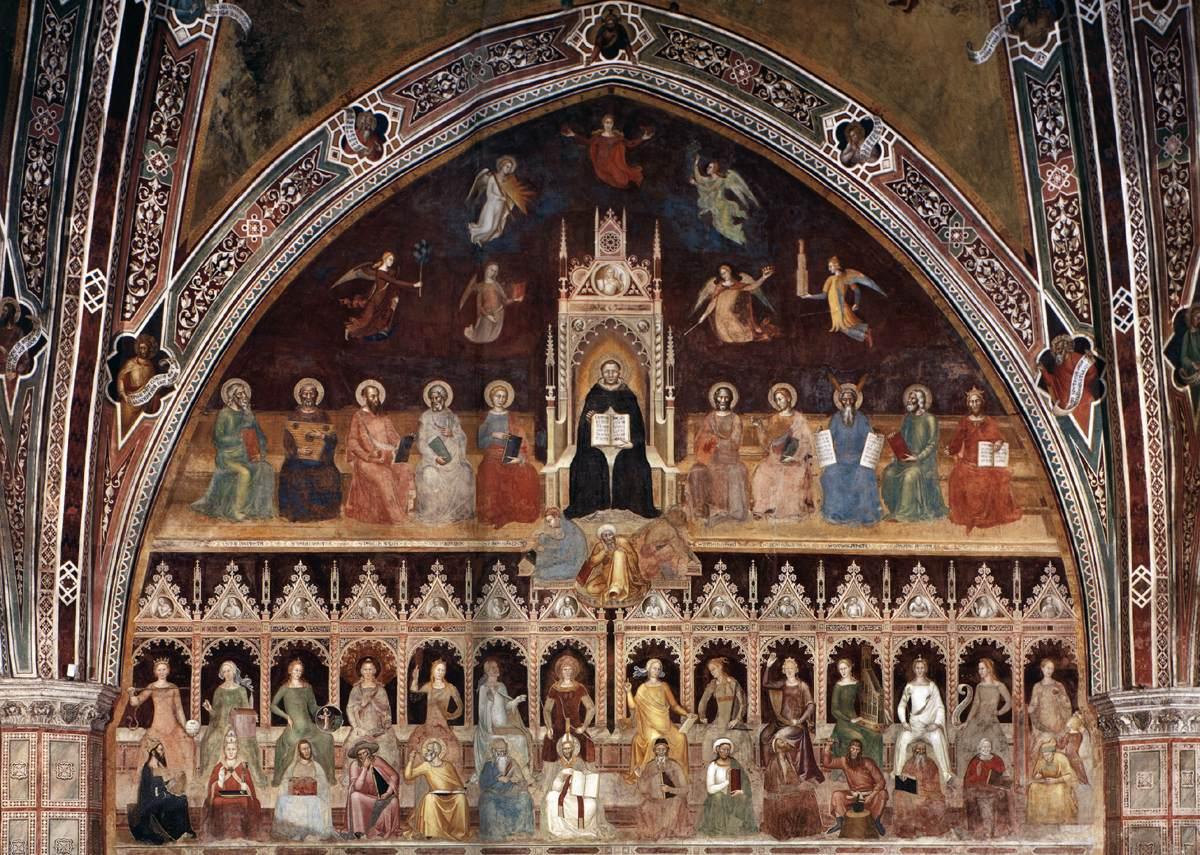
Andrea da Firenze · The Triumph of Saint Thomas Aquinas
Thomas was born into a noble Italian family that hoped he would one day become abbot of a famous Benedictine monastery. Instead, the young Thomas wanted to join the Dominicans, a new order of friars who owned nothing and begged for their food in the streets. His family was furious. His brothers kidnapped him and locked him up in a castle, and the story goes that they even sent a woman to his room to tempt him out of his vocation. Thomas chased her out with a burning stick from the fire and marked a cross on the door with it. After a year his family gave up.
"The Dumb Ox"
He studied in Paris and Cologne under Albert the Great, the leading teacher of the day. Because he was big and quiet, his classmates called him "the dumb ox." Albert is said to have answered them: "We call him the dumb ox, but he will yet bellow so loud his teaching will resound throughout the world." Thomas set out to bring together the philosophy of Aristotle, which Europe was only then rediscovering, and Christian revelation in a single, coherent system. It was one of the boldest projects of his time, because many people saw Aristotle as a threat to the faith.
The Summa, and Silence
His greatest work, the Summa Theologiae, covers the whole of Christian teaching, from the existence of God to morality and the sacraments, as a series of questions answered by careful argument. It became the backbone of Catholic theology for centuries. But in 1273, a few months before he died, something happened to him during Mass, and he never wrote again. He told his secretary that compared with what he had seen, everything he had written seemed "like straw." He fell ill on his way to a council the Pope had called him to, and died at a monastery in 1274. He was declared a Doctor of the Church in 1567 and is the patron of Catholic schools and of students of philosophy and theology. His feast day is January 28.