Answering Atheism
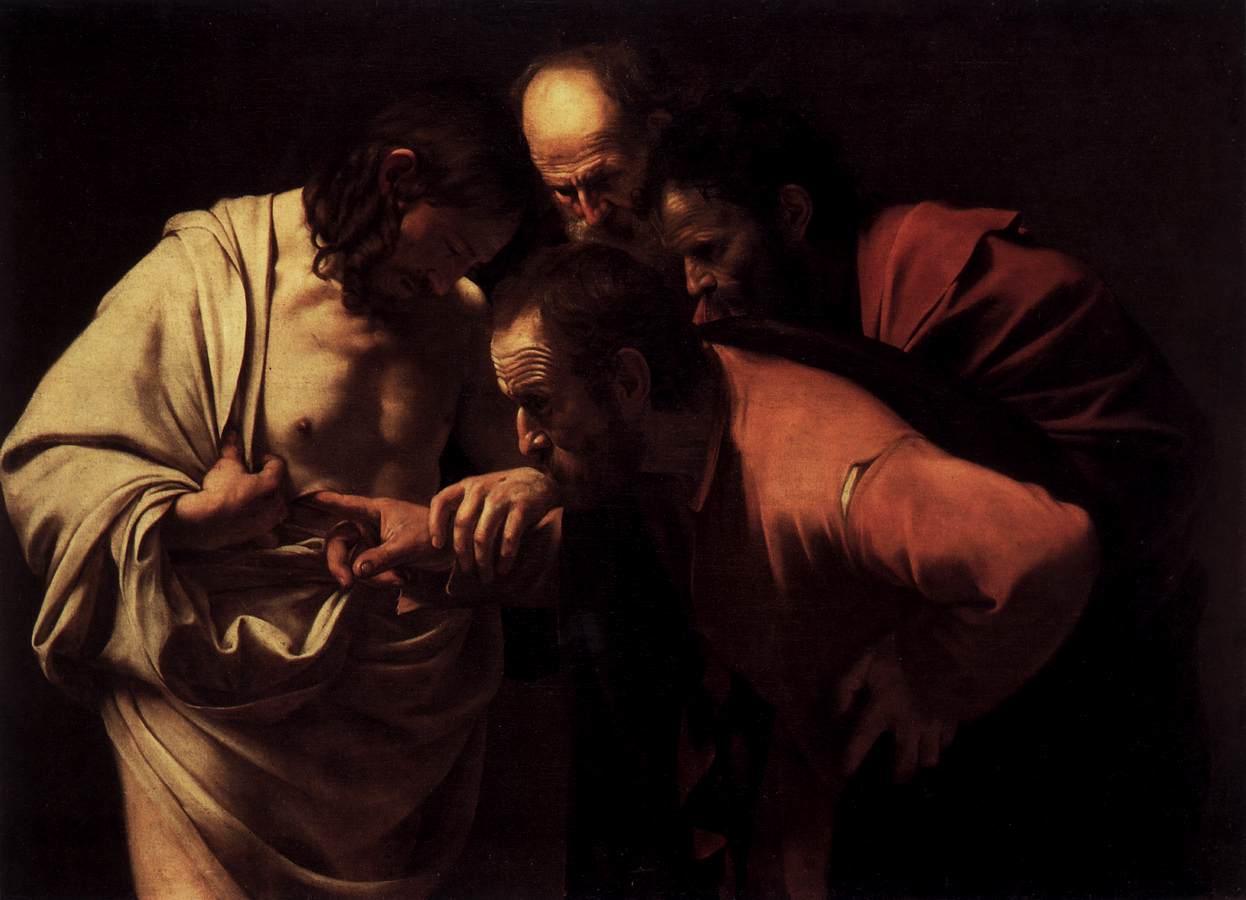
Caravaggio · The Incredulity of Saint Thomas
Does God exist? Here are the best answers from famous debates, from philosophers who spent years as atheists before they believed, and from what skeptical historians themselves admit.
Most of these answers come from people who have argued with atheists face to face: Trent Horn, Cliffe Knechtle, the historians Gary Habermas and Michael Licona, the biblical scholar Brant Pitre, and Joe Schmid, Pat Flynn and Fr. Mark Goring, who believed after years as atheists or agnostics. The full list of sources is at the end of the page. Click any Bible or Catechism reference to read the text yourself.
TL;DR
- 1Ten answers that ended the argumentMoments from famous debates where the other side had no reply.Read all
- 2Atheists said it in their own wordsGraham Oppy, Alex O’Connor, Bart Ehrman: what the best on the other side admit.Read all
- 3Nothing comes from nothingThe universe can’t explain itself. And “Who made God?” asks about the wrong God.Read all
- 4Odds of 1 in 10¹³⁶The universe’s settings landed against odds far worse than rolling a six 70 times in a row.Read all
- 5Three things matter can’t explainConsciousness, conscience and reason. Even a famous atheist says, “I don’t know what consciousness is.”Read all
- 6The sources closest to JesusThe Gospels are hundreds of years closer to Jesus than our sources are to Alexander the Great.Read all
- 7An empty tomb, and witnessesEven skeptical historians accept four facts. One thing explains all four: the Resurrection.Read all
- 8Miracles that went to the labA severed leg restored, a sun dancing before tens of thousands, heart tissue from bread.Read all
- 9If evil exists, where is God?Without God there is no problem of evil at all. Even our outrage needs a standard of good.Read all
- 10Did science kill God?A Catholic priest discovered the Big Bang. Science answers “how”; faith answers “why”.Read all
Part I
In Short
1Ten Answers That Ended the Argument
The rest of the page walks through the evidence. First, though, some highlights. Every one comes from a real debate or interview, against atheists and agnostics who knew their stuff.
1. “If there’s evil, there’s no God.”
Cliffe Knechtle’s reply: “Friends, if there is no God, there is no problem of evil. There’s no problem of good. Everything just is.” To call anything “evil” you need a real standard of good. Atheism can’t supply one.
2. “I’m agnostic. I don’t know.”
Knechtle told the Oxford-educated atheist Alex O’Connor: You can be agnostic about whether you prefer tea or coffee. But you can’t be agnostic at a funeral. The coffin is right in front of you. Will you see this person again or not? Is human life valuable? Does life have meaning? Is there anything after death? You can’t shrug these off with “I don’t know”, because every day you live by some answer to them.
3. The button that destroys the universe
The atheist philosopher J. L. Mackie held that a perfectly good being would eliminate evil whenever it could. Trent Horn’s reply was: “Then if you had an antimatter button that wiped out the whole universe in an instant, the most moral thing to do would be to press it. That way, evil would drop to zero.” Nobody thinks that. So goodness isn’t about getting evil down to zero; it’s about bringing a good greater than the evil out of it.
4. “Who would die for a lie?”
Atheists rightly point out that people die for lies too; look at suicide bombers. Trent Horn agrees and takes the question deeper: “The real question is: who would die for something they KNOW is a lie?” Jesus’ disciples knew whether or not they had seen Him.
5. Group hallucinations
The historian Michael Licona emailed the authors of a textbook on hallucinations and asked why they never discussed group hallucinations. Their answer: “We couldn’t find a single documented case.” As Licona puts it: “I can’t wake my wife in the middle of the night and say, ‘Honey, I’m dreaming about a holiday in Maui. Go back to sleep and join me. Free holiday.’”
6. “The Gospels were written far too late.”
Gary Habermas asked an atheist physicist who said this: “Do we know a lot about Alexander the Great?” “Yes.” “How long after his death were those sources written?” “I don’t know, I’m a physicist.” The answer: there are only 5 main sources on Alexander the Great, and all of them were written an estimated 400 years after his death. The Gospels, by contrast, were written while the people who saw the events were still alive, 40 to 60 years later.
7. “So who made God?”
Richard Dawkins put this question at the heart of The God Delusion. In their debate, the Oxford mathematics professor John Lennox turned it back on him: “Richard, you believe the universe created you. So let me use your own question: who created your creator?” Years later Lennox says: “I’m still waiting for the answer.”
8. “The Mormons have witnesses too.”
Skeptics say: “Mormonism, too, is built on witnesses who say they saw miracles. Why should we believe only Jesus’ witnesses?”
Trent Horn’s answer: Joseph Smith, the founder of Mormonism, gained power, political leadership and many wives from those testimonies; even when he was arrested, he exchanged fire from his jail cell. Jesus’ disciples, on the other hand, gained nothing of this world by lying; all they got was torture, prison and death. People don’t choose to suffer and die for a lie they made up.
9. “I’m just atoms.”
Against the atheist philosopher Alex Rosenberg, who denies consciousness, the self and morality altogether, William Lane Craig told the audience: “If you believe that you are the same person who walked in here tonight, then you should reject Rosenberg’s atheism.”
10. “Miracles are always made up.”
Trent Horn’s closing line was this: Either every supernatural event in history is nothing but a lie or a mistake, or at least one of them is true. If even one is true, you can’t be a strict materialist. You’ll see below how well documented some of them are.
2Atheists Said It in Their Own Words
In court, the strongest evidence is an admission from the other side. Everything below was said by atheists, agnostics or skeptics.
Graham Oppy: one of the most respected atheist philosophers alive
- He says agnostics can’t just opt out with “I don’t know”: “I don’t know” is a claim that needs reasons too. If someone is standing in front of a bear and still says “I’m not convinced”, you’d ask him for his reasons.
- He rejects Richard Dawkins’ famous line, “We are all atheists about most gods; some of us just go one god further”: “I would no sooner say that we are all vegans relative to those meals that contain no animal products.”
- He grants that on the question “Why is there something rather than nothing?” the atheist, too, must finally say that something exists necessarily.
- He also grants that there is no argument against God that ought to convince every reasonable person.
Alex O’Connor: one of the most popular atheist YouTubers
- Asked how consciousness could arise naturally: “The short answer is no. I don’t know what consciousness is.”
- He holds that “You ought not murder” can be neither true nor false; it only expresses an emotion.
- Closing a debate, he asked viewers to be nice in the comments and added: “Remember that that other person is an animal with maybe not intrinsic worth, but some kind of vague extrinsic worth related to their capacity for pleasure and pain.”
- He accepts that Jesus lived and died on a cross. He rejects the Resurrection, but says, “I won’t say it didn’t happen.”
- He admits his own atheism may owe something to the country he was born in.
Bart Ehrman: America’s best-known skeptical New Testament scholar
- He dates the resurrection creed that Paul passes on to within a year or two of the crucifixion.
- He counts eleven independent sources for Jesus’ crucifixion.
- He wrote a whole book against those who say Jesus never existed.
- On Paul meeting Peter and James: “These are two good people to know if you want to know anything about the historical Jesus. I wish I knew them.”
Other skeptics
- The historian Dale Allison, who calls himself a skeptic: “I’m sure the risen Jesus appeared to his followers after his death.”
- The liberal historian E. P. Sanders: “The disciples saw the risen Jesus. I don’t know how exactly they saw him, but they saw him.”
- The atheist Richard Carrier, who denies Jesus even existed: Luke is “a better than average historian”.
- The atheist philosopher J. L. Mackie: moral facts are “most unlikely to have arisen” without an all-powerful God to create them.
- The atheist philosopher Thomas Nagel: “I want atheism to be true. I don’t want there to be a God; I don’t want the universe to be like that.”
Part II
Does God Exist?
3Where Did Everything Come From?
Nothing comes from nothing. You don’t need to be a philosopher to know that. Cliffe Knechtle opened a debate with four sentences: Non-existence can’t produce existence. Chaos can’t produce order. The irrational can’t produce the rational. Matter on its own can’t produce love.
The shiny spheres in the forest
You’re walking in a forest with a friend and find some shiny spheres on the ground. “Where did these come from?” you ask. Your friend shrugs: “Nowhere. They just exist.” What would you say to him? Either he’s joking or he’s lost it.
Now let the spheres grow. Make them the size of a stadium. Then the size of the universe. Does the need for an explanation shrink? No, it grows. Even if you say the spheres produced one another, all the way back forever, the question doesn’t go away: why are there these spheres at all, rather than nothing? (Joe Schmid’s example)
The penguin rule
You, me, the Earth, the galaxies: none of us had to exist. If your parents had never met, you wouldn’t be here. Things that don’t have to exist need an explanation. In everyday life this rule never breaks: an elephant doesn’t pop into existence on your balcony for no reason. If it did break, the world would be chaos.
So what explains all the things that don’t have to exist? Not one of them. As Joe Schmid puts it: you can’t explain why all the penguins exist by pointing to a penguin. In the end we have to reach a reality that exists by itself and depends on nothing to exist.
Infinite boxcars, zero motion
“The universe has always existed” doesn’t help either. Trent Horn’s example: line up an infinite number of boxcars. Without a locomotive, not one of them moves. Adding cars doesn’t produce motion. And an infinitely long chain can’t hold up a chandelier; the chain has to be fixed to something.
What could that first reality be?
Not a turtle, a football or a galaxy. They all have arbitrary limits: why this size, this shape, this much power? Every arbitrary limit raises a new “why?” The last link in the chain has to be something without limits: outside time, space and matter, unlimited in power. And since it could choose to bring a universe into being from nothing, it looks like a mind. That is exactly what people call “God”.
“So who made God?”
It sounds clever, but it hides a trap: it starts from the wrong definition of God.
The Oxford mathematician John Lennox points out this mistake in his debate with Richard Dawkins: when you ask “Who created God?”, you put God in the category of “created things” from the start. If Dawkins’ book had been called The Created God Delusion, nobody would have bought it, because we already know that created gods are false; we call them idols. The basic claim of theism is that God was not created but is eternal (John 1:1). So the question is as self-contradictory as asking, “What is the name of the bachelor’s wife?” A created being cannot be God.
And time, space and matter come as a package. Whatever created them has to stand outside all three (Genesis 1:1), just as the person who designed a computer is not a pixel on its screen. If God were inside time, He would become a limited being that itself needs to be created.
The argument doesn’t say “everything has a creator”; it says “things that begin and are limited have an explanation”. And the question turns back on the atheist. As Lennox asked Dawkins: “You believe the universe created you. Then who created your creator (the universe)?” Even the atheist philosopher Graham Oppy grants that at the very bottom there has to be a reality that exists by itself. The real debate is this: is the basic reality at the end of the chain blind matter, or an unlimited mind? Changing matter needs an explanation; an unlimited mind does not.
And of course an unlimited Creator doesn’t fit neatly inside a three-pound brain. A God who fit perfectly into our minds wouldn’t be worth worshipping.
4Fine-Tuning
You roll a die 70 times and get a six all 70 times. Would you say, “Just luck”? Nobody would; everyone would assume the die was loaded. Now let’s look at our universe.
How big are these odds? A picture a child could follow
According to physicists’ calculations, the chance that our universe turned out fit for life by accident is less than 1 in 10¹³⁶. Here is one way to picture that number:
Gather every grain of sand in every desert and on every beach, on Earth and in space. Then fit a whole universe inside each of those grains, and fill each of those universes with sand too.
Now, with your eyes closed, pick a single grain out of that enormous mountain of sand. Your chance of picking the right grain on the first try is billions of times higher than the chance of the universe coming about by accident. If someone told you they had found that grain by luck on the first try, you wouldn’t believe them. That is how precisely the universe’s settings have been tuned.
A single precise setting
There is a single number called the “cosmological constant” that sets how fast the universe expands. Had it been a tiny bit larger, the universe would have flown apart; there would be no stars, no planets and no us. Had it been a tiny bit smaller, the universe would have collapsed on itself the moment it was born. Next to the precision of this number, even the number of atoms in the whole observable universe is like a grain of sand next to a desert.
Could it just be luck?
The physicist Luke Barnes took into account the dozens of other settings that must all be right at the same time for life to exist. To make the result concrete, Joe Schmid gives this example:
Roll a six 70 times in a row. Then win the biggest lottery in human history four times in a row. And at that very moment, get struck by lightning. Even all of these happening together is billions upon billions of times more likely than the universe turning out fit for life by accident.
A universe that’s not only livable but readable
The physicist Robin Collins noticed something else. Some settings could have been anywhere in a wide range without affecting life at all. But they sit exactly where they make the universe easiest for us to study: for example, at the value that lets us see the cosmic background radiation that revealed the Big Bang. Collins’ estimate: the odds of that by chance are about one in a trillion trillion. If someone made us and wanted us to know His world, that’s no surprise at all.
The firing squad and the atheist escape route
The answer atheists turn to most often is this: “If the universe weren’t fit for life, we wouldn’t be here to ask. Since we’re alive, there’s nothing to be surprised about.”
The philosopher John Leslie and Joe Schmid show the flaw in this reasoning:
You stand before a hundred professional marksmen. The order “Fire!” is given, the guns go off, but you survive without a scratch. Would you say, “If I were dead I couldn’t think about this, so there’s no need to be surprised that I’m alive”? No. Being alive doesn’t explain why you survived; it only makes it possible for you to think about it. Any sensible person realizes that a hundred marksmen all missing at once can’t be chance: someone must have told them to miss.
Being here is a precondition for asking; it doesn’t explain why so many settings landed exactly where life needs them. “We’re here because we’re here” isn’t an explanation. It’s a circle. The real question is: who turned the bullets aside?
“Maybe there are infinitely many universes”
The escape route atheists turn to most often (the multiverse hypothesis) runs into three basic problems:
It doesn’t solve the problem, it only postpones it: a mechanism that produces endless universes needs fine-tuning itself. The need for a designer doesn’t go away; it just moves up a level.
It leads to absurdity: which is easier, winning a huge palace in the lottery or finding a single coin in the street? Finding a single coin, of course.
It’s the same with the random-universes theory: according to this theory, a vast, orderly universe 13.8 billion years old coming about by chance is next to impossible. Far easier and more likely is that a mind dreams for a second and vanishes. So if you believe this theory, you can’t even trust that you are reading this text right now, or even that you exist, because everything would be nothing but a one-second illusion.
There’s no evidence for it: it is an entirely unobservable assumption. As Michael Licona put it: “My friend, believing without evidence in an infinite number of universes that can’t be observed takes far more faith than believing in a Creator. My friend, your faith is even bigger than mine!”
The thought that stopped an agnostic
Joe Schmid argued against fine-tuning for years. What stopped him was this: if the atoms at the first moment of the universe had spelled out, in every language, “God made this with love”, everyone would accept that as evidence. But most objections to fine-tuning would work just as well in that world: “We can’t know what God would want,” “Maybe nature just has some blind tendency to do this”... If an objection would refute even plain evidence, the problem is with the objection, not the evidence. Joe says a light bulb went on in his head.
5Consciousness, Conscience and Reason: Three Things Matter Can’t Explain
Consciousness: a film, not static
Your brain is soft, gray tissue. Yet the taste of coffee, the sadness of a song, the face of someone you love all pass through it. How? When he was asked this, Alex O’Connor, one of the most popular atheist YouTubers in the world, answered: “The short answer is no. I don’t know what consciousness is.”
This question was the one that first moved Joe Schmid toward God. Picture a TV screen. Light up the pixels at random and you’ll almost always get snowy static; a meaningful picture almost never comes up. The match between what happens in our brains and what we feel could also have been different. Pain and pleasure could have swapped places. Everything could have felt like a single patch of blue. Our inner life could have been meaningless static. Instead, a clear film is playing on our screen. In Joe’s words, we hit the jackpot. Without God, that’s a coincidence. With God, it’s what you’d expect.
Conscience: is morality just a feeling?
Torturing a baby for fun is wrong. It would be wrong even if everyone thought otherwise. Even the famous atheist philosopher J. L. Mackie admitted that moral facts like this are “most unlikely” to have arisen without God.
Where do you end up without God? Alex O’Connor is honest about it: to him, “You ought not murder” can be neither true nor false; it only expresses an emotion. Closing his debate with Trent Horn, he asked viewers to be nice in the comments and added: “Remember that that other person is an animal with maybe not intrinsic worth, but some kind of vague extrinsic worth related to their capacity for pleasure and pain.” Trent Horn’s closing was this: “You are made in God’s image. You are loved. The only reason you exist is because God wanted you to exist.” Which one rings true to you?
Joe Schmid sees one more problem: on atheism, evolution rewards survival, not truth. Had we evolved like honeybees, we would think it a sacred duty to kill our brothers for the hive. Imagine reading a book about the birds of Madagascar and then finding out that an AI made it up without ever looking at a real bird. Would you keep believing the book? Without God, our conscience is a book like that.
Reason itself
As an atheist, Pat Flynn wrestled with one question: if there is only matter in the universe, my thoughts are nothing but chemical reactions in my brain. Then there’s no free will, and blaming a murderer makes as little sense as blaming a hurricane. Some atheists follow this all the way. Alex Rosenberg, a former chair of the philosophy department at Duke University, denies consciousness, an enduring self, meaning and morality. William Lane Craig replied to him in their debate: “If you believe that you are the same person who walked in here tonight, then you should reject Rosenberg’s atheism.”
For Pat Flynn, atheism finally handed him a bill he couldn’t pay: his self, his freedom, morality and meaning. And if our minds only formed to help us survive, why trust the mind that says “atheism is true”?
Beauty
The world could have been gray and dull. Instead it’s full of beauty, from galaxies to the veins of a leaf, and there are beings who can see it. Even Paul Draper, a philosopher who doesn’t believe in God, grants that a beautiful world is more likely if God exists.
Put it all together
One coincidence could happen. But here’s what the atheist has to accept: that there is a universe, that there are laws, that the laws fit the things in the universe, that the numbers landed against incredible odds, that consciousness appeared, that our inner life is orderly, that our conscience points to what is right, and that the world is beautiful. If the lamp, the TV, the fridge and the phone charger all go off at once, you don’t look for four separate faults; the power has gone out. When one explanation accounts for all of it at once, it’s very likely the right one.
Part III
Has God Spoken? Jesus and the Resurrection
6Can We Trust the Gospels? Centuries Closer Than Alexander the Great
We’ve seen that God exists. The next question: has God spoken to us? Christianity says God spoke in Jesus and that Jesus rose from the dead. Let’s start with the sources.
The question that silenced a physicist
In a debate, the historian Gary Habermas asked an atheist physicist who said the Gospels were written far too late: “Do we know a lot about Alexander the Great?” “Yes.” “How long after his death were the sources for that written?” “I don’t know, I’m a physicist.” The answer: “For Jesus we have about 25,000 manuscript copies and 30 different sources written within the first 150 years, while for Alexander the Great there are only 5 main sources, written an estimated 400 years after his death.” Nobody questions whether Alexander existed, even though his sources are far weaker, yet Jesus’ existence is debated all the time.
The Gospel writers don’t tell ornate legends; they give accounts full of places, dates and names. By the standards of textual criticism and historical evidence, the Gospels are among the best-attested texts of the ancient world.
Why a different standard for the Gospels?
Brant Pitre’s point: Alexander the Great claimed to be a god too. But nobody worships him today, so nobody bothers to question his sources. Jesus’ claims, on the other hand, ask you to change your life. That, not the data, is where the extra suspicion of the Gospels comes from.
The myth of the anonymous Gospels
You hear it online all the time: the Gospels circulated without names, and the authors were made up later. As a student, Pitre went looking for the anonymous manuscripts. The result: there isn’t a single one. From Africa to Italy, every manuscript carries the same four names. Compare the Letter to the Hebrews, which really is anonymous: the manuscripts and the Church Fathers disagree about who wrote it; some say Paul, some Barnabas, some Luke. That’s what an anonymous text looks like. The Gospels don’t look like that.
And if you were inventing an author, you’d pick Jesus or Peter, not Peter’s assistant Mark or Paul’s traveling companion Luke. Matthew was a tax collector. Telling Jewish readers “Trust me, I’m a tax man” didn’t win anyone over then either. But among a group of fishermen, he was the one who could read, write and take notes.
How does Luke begin?
Fairy tales begin with “Once upon a time”. Luke begins by saying he has looked into what eyewitnesses told from the start and written it down carefully and in order (Luke 1:1-4). The Greek word he uses for “eyewitnesses” is the root of our word “autopsy”: to see for oneself. Even the atheist Richard Carrier, who denies Jesus existed, grants that Luke is “a better than average historian”.
“But the Gospels don’t agree”
When the Titanic sank, the survivors disagreed on details: did the ship break in two before it went down or not? But none of them doubted that it sank. Courts get suspicious when testimonies match word for word, because they may have been rehearsed. The Gospels agree on the main point: Jesus was crucified and buried, on the third day the tomb was found empty, and His disciples saw Him alive. Made-up stories aren’t this plain, either. In the fake Gospel of Peter from the second century, Jesus walks out of the tomb as a giant, followed by a talking cross. Mark simply says the women ran away afraid, and that’s it.
We know about Jesus from outside the Gospels too
The Jewish historian Josephus mentions Jesus and His brother James; he even gives more space to John the Baptist than to Jesus. If Christians had made the passage up, they would have done the opposite. The Roman historian Tacitus writes that Jesus was executed under Pontius Pilate. According to Michael Licona, when Richard Carrier listed the scholars who think Jesus never existed, he could find only thirteen living ones, himself included.
7Did Jesus Really Rise? Even Skeptics Accept These Four Facts
In the 1970s, if you mentioned “the empty tomb” at a university, people laughed. Gary Habermas was doing his doctorate back then. Today about two thirds of scholars who publish on the subject accept that the tomb was found empty. What changed? The evidence.
Habermas’ challenge
“Suppose the Bible isn’t inspired, isn’t even reliable, just an ordinary ancient book like Homer. I can still show that Jesus rose from the dead.” How? Using only facts that atheist and skeptical historians accept too:
- Jesus died on a cross.
- Soon afterwards, His disciples truly believed they had seen Him alive, some alone and some in groups.
- Paul, who persecuted Christians, became a Christian because he believed he had seen Jesus.
- James, Jesus’ brother, who hadn’t believed in Him, came to believe.
The historian Dale Allison, who calls himself a skeptic, says: “I’m sure the risen Jesus appeared to his followers after his death.” The liberal historian E. P. Sanders puts it on his list of historical facts: “The disciples saw the risen Jesus. I don’t know how exactly they saw him, but they saw him.”
Within a year or two
In his letter to the Corinthians, Paul passes on a short creed he had been taught: Christ died, was buried and rose on the third day; He appeared to Peter, then to the Twelve, then to more than five hundred people at once (1 Corinthians 15:3-8). He adds that most of those five hundred are still alive; in other words, “If you don’t believe me, go and ask them.” How old is this creed? Even Bart Ehrman, America’s best-known skeptical New Testament scholar, dates it to within a year or two of the crucifixion. According to the well-known scholar James Dunn, it had taken shape within six months at the latest. Legends take generations to grow. Here we have months.
Where did Paul get it? He writes that a few years after the crucifixion he went to Jerusalem, stayed with Peter for fifteen days and saw James, Jesus’ brother (Galatians 1:18). The Greek verb he uses means “to find out, to inquire”. Even Bart Ehrman says: “These are two good people to know if you want to know anything about the historical Jesus. I wish I knew them.”
Could they have been hallucinating?
Only about seven percent of grieving people say they have seen the person they lost. The real problem is the group appearances. Michael Licona asked the authors of a textbook on hallucinations, published by the American Psychological Association, why they never discussed group hallucinations. Their answer: “We couldn’t find a single documented case.” A hallucination is like a dream: private to one person. A crowd doesn’t share a dream. Yet Jesus appeared to three separate groups. And Paul wasn’t a grieving follower but an enemy hunting Christians down; Jesus was the last person he wanted to see.
As Licona sums it up: hallucination explains only two of the six facts historians accept. The Resurrection explains all six. “It’s not even close.”
Could they have been lying?
People die for lies; look at suicide bombers. Trent Horn sharpens the question: the real question is, who would die for something they KNOW is a lie? A martyr today dies believing what others have told him. Jesus’ disciples were the only people who could know the truth: they had seen Jesus or they hadn’t. Peter, Paul and James were killed for telling it. In Licona’s words, liars make poor martyrs.
Could the body have been stolen?
Grave robbers in those days took the valuable linen and left the body. In the Gospels, the linen is still there and the body is gone (John 20:6-7). The Jewish authorities didn’t deny the tomb was empty; they only said the body had been stolen (Matthew 28:13). And the first to find the empty tomb were women. At the time, a woman’s testimony counted for less in court than a criminal’s. Anyone making the story up would have picked Peter as the witness.
“He didn’t rise” isn’t an explanation
Trent Horn’s point: “He didn’t rise” isn’t one explanation but an umbrella. Nothing under it explains all the facts on its own. The skeptic has to stack several explanations together: the body went missing, plus some people hallucinated, plus Paul saw something else, plus James was somehow convinced... Every piece you add makes the whole thing less likely.
“The Mormons have witnesses too”
Alex O’Connor points to the witnesses who said they saw Joseph Smith’s golden plates. Trent Horn shows the difference: Smith picked his witnesses and worked to convince them, and one of them was funding the project. Smith gained power and wives from it; when he was arrested, he had a handgun smuggled into his cell and shot back. Jesus’ disciples had lost all hope and gained nothing. And Mormonism has no Paul, no enemy who turned.
What does the Resurrection show?
The Jews expected the dead to rise at the end of the world, all together. Claiming that one man had risen in the middle of history wasn’t something anyone would think to make up. The Resurrection also confirms what Jesus said about Himself. He did something only God can do and forgave sins (Mark 2:5-7). At His trial He presented Himself as the one the prophet Daniel saw coming with the clouds of heaven (Mark 14:61-64; Daniel 7:13-14). That’s why He was accused of blasphemy and condemned to death. As Brant Pitre says, anyone who claims Jesus never claimed to be God has to take all the evidence for why He was executed off the table. God raised Him from the dead; in other words, God said, “He told the truth.”
Licona’s wife once told him, “Even if Christianity turned out to be false, I’d still be a Christian for Jesus’ teachings.” Licona: “I wouldn’t.” Paul says the same: if the dead are not raised, “let us eat and drink, for tomorrow we die” (1 Corinthians 15:32). Christianity isn’t a nice philosophy; it’s an event that either happened or didn’t.
8God Still Speaks Today: Miracles That Went to the Lab
What convinces an atheist most? Ask Joe Schmid. He was an agnostic doing a philosophy doctorate at Princeton, and he tried to take apart every argument for God in a 12-hour video that became the most-watched on his channel. In the end, what brought him to the Catholic Church wasn’t philosophy but documented miracles. As Trent Horn says, if Jesus rose, it’s no surprise that His mother would appear to those who believe in Him.
A severed leg and two dozen sworn witnesses
In 1637, the leg of a young Spanish farmer, Miguel Pellicer, was amputated in Zaragoza and buried. He lived as a beggar with his stump; his begging license still survives. One night in 1640 he woke up and his leg was back. An official inquiry was opened at once. Its records hold the sworn statements of two dozen people from his village who had felt his stump with their own hands. The surgeons who had amputated the leg were found and testified too. When Joe Schmid read this file, he thought, “Oh no. Christianity might be true.”
A blind man, an insurance company and a fraud investigation
Gregory Spencer was legally blind from macular degeneration, a disease that doesn’t heal by itself. After prayer he could see almost perfectly. His doctor was astonished. His insurance company opened a fraud investigation; once it went through his medical records, it had to drop the case.
“Get up, my child, and walk”
Barbara Snyder had advanced multiple sclerosis. She hadn’t walked in years, one lung had collapsed, she was legally blind, her hands were curled up and her feet were locked. She had been sent home to die. One day, as a friend read her the letters of people praying for her, she heard a voice say, “Get up, my child, and walk.” She took out her tubes and walked. Her feet were flat on the floor, her hands had opened, she could see, and her lung had reopened. Her medical records from before and after are there.
From bread to heart tissue
The flesh and blood kept since the eighth century in Lanciano, Italy, were examined in the 1970s: human heart muscle and human blood of group AB, with no preservatives, unspoiled for centuries. In 1996 in Buenos Aires, a host that began to bleed was kept in distilled water for three years and then examined. The heart specialist Dr Frederick Zugibe, who wasn’t told where the sample came from, said it was heart muscle from the left ventricle of a living heart under severe stress.
Joe Schmid asks: if we had asked Luther or Calvin, “What would convince you of the Catholic teaching?” and they had joked, “Let a priest pray over bread, several times, on different continents, and let it turn into suffering heart tissue, all of the same blood type,” we’d think they were making fun of us. “But it happened. It really happened.”
Fatima: a miracle announced three months ahead
In 1917 in Portugal, three shepherd children announced three months in advance that at noon on 13 October there would be a miracle for everyone to see. The authorities interrogated them and threatened them with death; they didn’t back down. That day between 30,000 and 100,000 people gathered, among them anti-Church journalists who had come to mock. It had been raining since morning. At noon the rain stopped, and a light like the sun began to spin, throw off colors and plunge toward the crowd. Soaked clothes dried within minutes. People in villages miles away saw the same thing. Even Scott Alexander, a writer skeptical of miracles, grants that the agreement among the witnesses is as impressive as you’d expect from a real event.
Padre Pio: wounds that bled for fifty years
For fifty years Padre Pio had bleeding wounds in his hands, his feet and his side. The doctors who examined him wrote that the wounds were perfectly round and never became infected or swollen; one said he could see through his hand. When he ran a fever, a mercury thermometer burst at 42.5°C; according to the newspapers, before the doctors’ eyes his temperature went above 48°C. On the day he died the wounds had closed without a scar; there are photographs. As his friend Ethan Muse read him the reports for four hours, Joe Schmid threw up his hands: “I can’t risk looking Jesus in the face after I die and saying, ‘I knew Padre Pio bore your wounds, but I didn’t believe.’” A few days later he made a confession covering ten years.
Zeitoun: the power was cut, the vision stayed
In 1968, a figure of a woman made of light appeared on the dome of a church in Cairo, and kept appearing on and off for three years. The first to see it were Muslim workers. The worker who pointed at it had a gangrenous finger due to be amputated the next day; when the bandage came off the next day, the finger was healthy. To check for a trick, the Egyptian government cut the electricity to the whole neighborhood. The vision stayed for hours. On some nights hundreds of thousands watched; there are photographs.
Either all lies, or one is true
You can find an excuse for each event one at a time. But the excuses needed to explain them all away become harder to believe than the miracles: calling hundreds of honest strangers liars, saying labs on different continents all made the same mistake... One day Joe Schmid noticed what he was doing: from his armchair, with no evidence at all, he was calling a witness he had never met a liar. For the details and the answers to skeptics, see our Miracles page.
Atheists who came to believe
- Joe Schmid spent ten years as an atheist and agnostic and made hundreds of hours of videos against God. His mother prayed for him every day. On the day he first told his story on camera, a Mass his family had booked for him a year earlier was being said.
- Pat Flynn became an atheist listening to Metallica and reading Nietzsche. It troubled him that atheism left morality and free will hanging in the air. One Christmas Eve, when the priest lifted up the bread, he knew this was where he had to be.
- Mark Goring lost his faith at twelve or thirteen. He told his father, “When I pray the rosary, it feels like I’m talking to a wall.” Every night he prayed, “God, if You’re real, show me. I’m in.” One night the fear he’d lived with for years gave way to a deep peace. Today he is a priest in Canada.
All three say the same thing: whoever seeks God with a sincere heart finds Him (Matthew 7:7-8).
Part IV
Objections
9If Evil Exists, Where Is God?
This is the atheist’s strongest question, and it deserves better than easy answers. It’s what kept Joe Schmid away from faith for years: an elephant stuck in a tar pit, calling for its family, then eaten alive by hyenas. Trent Horn also says this is the question he finds hardest.
Calling something “evil” needs a standard
Cliffe Knechtle: “If there is no God, there is no problem of evil. There’s no problem of good. Everything just is.” Our outrage at evil shows we believe in a real standard of good. Atheism can’t explain that outrage; it can only say, “That’s how the universe is.”
“A good God would get evil down to zero”
The atheist philosopher J. L. Mackie held that a perfectly good being would eliminate evil whenever it could. Trent Horn’s reply: then pressing an antimatter button that wipes out the whole universe in an instant would be the most moral thing to do, since evil would drop to zero. Nobody thinks that. Goodness isn’t getting evil to zero; it’s bringing a greater good out of it.
Some goods don’t exist without pain
There’s no courage without danger, no compassion without suffering, no forgiveness without wrong. Alex O’Connor asked: in heaven there is free will and no evil, so why isn’t the world like that? Trent Horn’s answer: freely choosing to marry the perfect spouse is worth more than being a robot built “perfectly married”. A world that journeys from imperfection to perfection holds goods that a world created perfect from the start doesn’t. A move by a chess master that looks foolish may serve a plan we can’t see.
Suffering before there were humans
Some atheists point out that animals suffered for millions of years before humans appeared. But pain is a warning system; a creature that feels no pain doesn’t live long. Trent Horn asks: if every human left the Earth, would you destroy it because the animals left behind would suffer? Most of us wouldn’t, because the existence of animals is good despite their pain. Philosophers suggest other possibilities too: that animals’ suffering will one day be made good, or that spiritual beings tasked with guiding creation toward the good refused that task. We don’t have to know which is right. It would be no surprise if an infinitely wise God had reasons we can’t see.
Why doesn’t God speak more clearly?
Joe Schmid and the Catholic philosopher Ethan Muse give the same answer: God gives enough evidence to make believing reasonable, but not so much that doubt becomes impossible. That way faith is an answer given in love, not under force. And evidence doesn’t always bring faith. The Israelites had seen a pillar of fire going before them by night; they still made a golden calf and worshipped it. In a story Jesus tells, Abraham says: “If they do not hear Moses and the prophets, neither will they be convinced if some one should rise from the dead” (Luke 16:31).
Gary Habermas spent years studying doubt with a psychologist. Their finding: 70 to 85 percent of doubters doubt for emotional reasons, not factual ones. In one study, 19 percent of atheists said they were angry at God. As one researcher put it: “I don’t believe in unicorns either, but I don’t spend my life hating them.” For Knechtle, the real obstacle is often not evidence but pride. Accepting God means kneeling before Him.
What’s your answer?
Knechtle turned the question back on the atheists. He spoke of his niece who died in a car crash at seven and of his sister born with brain damage, and asked: “I have an answer: the cross, forgiveness, and an end where there is no more death. What do you have besides despair?” Trent Horn stands in the same place: “If I take God out of the picture, all I’m left with are those horrible evils; no justice and no hope.” Christianity doesn’t tell of a God who keeps away from suffering. It tells of a God who took suffering on Himself on the cross.
10Did Science Kill God?
Ask people why they left religion and the same reasons keep coming up: wanting to live by their own rules, being told faith and science are enemies, religion used for money and politics, and believers who read scripture woodenly and reach for violence. None of these shows that God doesn’t exist. All of them deserve a serious answer.
A priest came up with the Big Bang
Science describes how the universe works; it doesn’t tell us why it exists. And it was science itself that found the fine-tuning we saw above. Most of the pioneers of modern science were Christians who saw the world as the work of an intelligent Creator: Copernicus, Kepler, Galileo, Newton. The first person to propose the Big Bang was Georges Lemaître, a Belgian Catholic priest and physicist. Galileo liked to quote the saying that the Bible teaches us how to go to heaven, not how the heavens go.
Genesis isn’t a science textbook
Some atheists say the book of Genesis just repeats an ancient picture of the cosmos. Cliffe Knechtle’s reply: when Jesus said “I am the vine”, was He claiming to be a plant? Every text has to be read for what kind of text it is. The Church never wanted the Bible read like a science textbook. As early as the fifth century, St. Augustine wrote that Christians who pit the Bible against what science clearly shows drive people away from the faith. The Catechism teaches that the six days of creation are a symbolic account (CCC 337). Genesis doesn’t tell us how the universe works; it tells us who made it and why it is good. The Church also accepts that God may have made living things through evolution, while the human soul comes directly from God (CCC 366).
Evil done in the name of religion
People who use religion for money or power don’t show that religion is false. Counterfeit money only exists because real money is worth something. Jesus Himself saved His harshest words for those who used religion for show (Matthew 23:27-28).
“Three and yet one? You’re a mathematician, this is absurd!”
After John Lennox had spoken to about a thousand scientists, a physicist came up to him: “You’re a Christian, aren’t you? Then you have to believe God is three and one, and that Jesus was God and man. Come off it, you’re a mathematician at Oxford. This is absurd. Can you explain it to me?”
Lennox first asked a question: “What is consciousness?” The physicist thought: “I don’t know.” “Let me try an easier one: what is energy?” “I’m a physicist, I can measure energy, I can use it.” “That’s not my question. What is it?” “I don’t know.” Lennox: “Do you believe in consciousness?” “Yes.” “In energy?” “Yes.” “You believe in two things and you don’t know what they are. Should I write you off as an intellectual?” “Please don’t.” “But that’s exactly what you were going to do with me five minutes ago.”
Why do we believe in these things? Because of their explanatory power; we can only make sense of what happens with them. If energy, light, gravity and consciousness are a mystery, it’s no surprise that there is something about God we can’t grasp. Lennox offers a simple analogy: he has been married for 42 years. He and his wife are two persons, yet, as the Bible puts it, “one flesh”. The Trinity tells us something magnificent: God isn’t a lonely monolith who made a few people so He’d have someone to talk to. God is Himself a fellowship of love.
“If you’d been born in Saudi Arabia, you’d be a Muslim”
Maybe. But where a belief comes from doesn’t show whether it’s true. The same yardstick applies to atheism: most atheists were born in certain Western countries. Even Alex O’Connor readily says, “Maybe I’m an atheist because of the country I was born in.” That there are many religions doesn’t mean they are all false; you can look into which one is true. First you look at whether God exists, then at whether Jesus rose. For what comes next, see our Why We’re Catholic and Answering Islam pages. The Church teaches that those who, through no fault of their own, do not know Christ but seek God with a sincere heart can also be saved (CCC 847).
In the end
Opening the Door
Evidence matters, but on its own it doesn’t carry anyone into faith. As Pat Flynn says, neither losing his faith nor finding it again was purely a matter of the intellect. Joe Schmid, too, resisted for months after he was convinced that God exists. Changing his life, giving up ideas he had defended for years and admitting in public that he had been wrong were not easy.
Fire the flare
Joe Schmid’s suggestion: imagine you’re stranded in a forest. Your food has run out. You have unlimited flares, and firing one takes three seconds. Even if you think there’s only a one percent chance that someone is out looking for you, not firing a flare would be foolish. A conditional prayer is a flare. Take three seconds every morning and say it sincerely: “God, if You exist, help me to know You, love You and serve You.” See where it takes you.
Fr. Mark Goring’s three pieces of advice
First, pray, even if you don’t believe: “God, if You exist, show Yourself to me. I’m in.” Jesus says: “When you pray, go into your room and shut the door and pray to your Father who is in secret; and your Father who sees in secret will reward you” (Matthew 6:6). Second, read a good book: one of the Gospels or the life of a saint. Ten hours spent on a good book are, without your noticing, ten hours of meditation. Third, give up the things you know are wrong. It’s hard to see God in the dark.
The Bible says: “You will seek me and find me; when you seek me with all your heart” (Jeremiah 29:13). Wherever you are on the road, the Church’s door is open to you. If you have questions, write to us, or walk into the nearest Catholic church and ask for the priest.
Sources
- Joe Schmid, a comprehensive philosophical case for God’s existence (Majesty of Reason YouTube channel)
- Interviews with Joe Schmid, Pat Flynn and Fr. Mark Goring: from atheism to Catholicism (Pints with Aquinas)
- Trent Horn and Alex O’Connor, debate on the existence of God (Pints with Aquinas, 2020) and “Did Jesus Rise From the Dead?” debate (Unbelievable?, 2026)
- Cliffe Knechtle with Alex O’Connor and Phil Halper, debate on the existence of God
- Graham Oppy in conversation with Alex O’Connor (Within Reason)
- Gary R. Habermas and Michael R. Licona, The Case for the Resurrection of Jesus (Kregel, 2004)
- Michael R. Licona, The Resurrection of Jesus: A New Historiographical Approach (IVP Academic, 2010)
- Brant Pitre, The Case for Jesus (Image, 2016)
- André Aleman and Frank Larøi, Hallucinations: The Science of Idiosyncratic Perception (APA, 2008)
- Selim Özarslan, “Ülkemizde Ateizme Yönelme Sebepleri” (Reasons for Turning to Atheism in Turkey), Diyanet İlmî Dergi 55 (2019): 1011-1025
- Ethan Muse, Motiva Credibilitatis (Substack): articles on Fatima, Lanciano and Padre Pio
- Geraint F. Lewis and Luke A. Barnes, A Fortunate Universe: Life in a Finely Tuned Cosmos (Cambridge University Press, 2016)
- Brian Cutter and Dustin Crummett, “Psychophysical Harmony: A New Argument for Theism” (Oxford Studies in Philosophy of Religion)
- Richard Swinburne, The Existence of God (Oxford University Press, 2nd ed., 2004)
- J. L. Mackie, The Miracle of Theism (Oxford University Press, 1982)
- Gary Habermas, “The Resurrection Argument That Changed a Generation of Scholars” (Veritas Forum, UC Santa Barbara)
- Michael Licona, “A Closer Look at the Resurrection of Jesus” (lecture at Ohio State University)
- Interview with Brant Pitre: “Yes, Jesus Is God and You Should Be Catholic” (Pints with Aquinas, episode 561)
- Kent Hovind and Reinhold Schlieter, debate: “Where did God come from?”
- William Lane Craig and Alex Rosenberg, debate “Is Faith in God Reasonable?” (Purdue University, 2013)
- Thomas Nagel, The Last Word (Oxford University Press, 1997)
- Robin Collins, “The Fine-Tuning for Discoverability” (2013)
- Craig Keener, Miracles: The Credibility of the New Testament Accounts (Baker Academic, 2011)
- John Lennox, “Who Created God?” (conversation at UCLA) and his debate with Richard Dawkins (Oxford, 2008)
- Catechism of the Catholic Church