Emblem: The tau cross
The Little Poor Man · 1181-1226
Saint Francis of Assisi
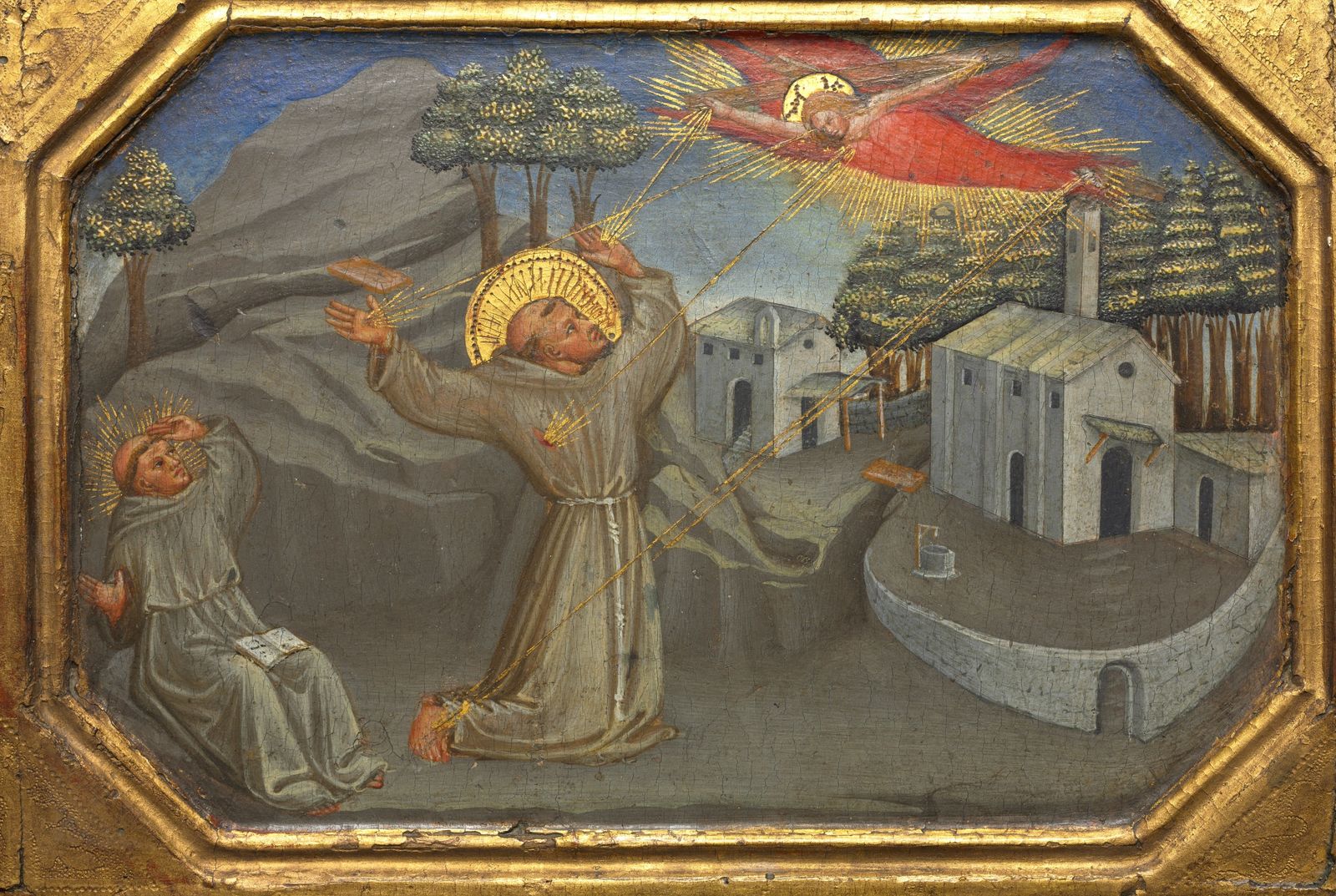
Bicci di Lorenzo · Saint Francis of Assisi Receiving the Stigmata
Francis was the son of a rich cloth merchant in Assisi, in Italy. As a young man he lived for parties, poetry and dreams of becoming a knight. He was taken prisoner in a local war and spent a year in captivity, then fell seriously ill, and both experiences shook him badly. One day, praying in a ruined church outside Assisi, he heard Christ speak to him from the crucifix: "Francis, go, repair my house, which you see is falling into ruin." At first he took it literally and started hauling stones to rebuild that church. Only later did he understand that the call was about the whole Church.
Stripping Before His Father
His conversion came to a head in a dramatic break with his family. His father, furious that Francis had sold some of the family’s cloth to pay for repairing the church, dragged him before the bishop. There, in front of everyone, Francis took off all his clothes, handed them back to his father and said, "From now on I call no man father, but only my Father in heaven." He embraced poverty not as a burden but as a bride, whom he called "Lady Poverty." He lived by working and begging, looked after lepers and preached. Others soon joined him, wanting to live the same radical poverty, and Pope Innocent III, after some hesitation, approved the new order: the Franciscans.
Brother Sun, Sister Moon
What people remember most about Francis is the way he felt related to the whole of creation. In his "Canticle of Brother Sun" he calls the sun, the moon, the wind, water and even death his "brother" and "sister," because he saw God reflected in everything God made. The stories of him preaching to the birds and making peace between a wolf and a town say more about his spirit than about history. In 1223, in the Italian town of Greccio, he is said to have set up the first living Nativity scene, with real animals, and today’s Christmas cribs go back to him. Two years before he died, during a long time of fasting and prayer, marks like Christ’s wounds from the cross (the stigmata) are said to have appeared on his body, the first case on record. He died in 1226, at forty-four, welcoming "Sister Death." Pope Francis took his name from him. His feast day is October 4.