Emblem: The baptismal shell
Forerunner of the Lord · c. early 1st century - c. 30 AD
Saint John the Baptist
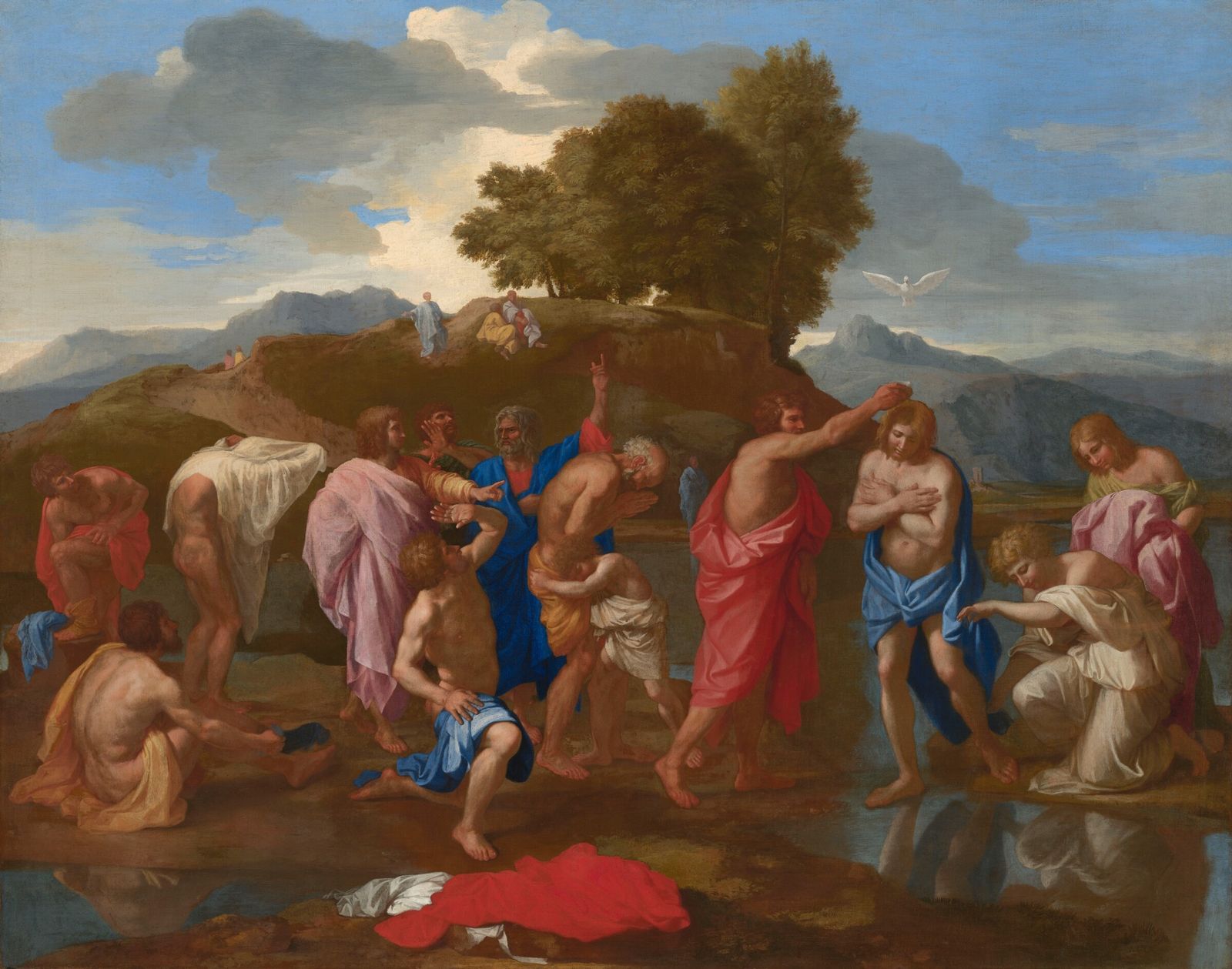
Nicolas Poussin · The Baptism of Christ
According to Luke’s Gospel, even John’s birth was a miracle. His parents, Zechariah and Elizabeth, were old and had never been able to have children. While Zechariah, a priest, was serving in the Temple, the angel Gabriel told him they would have a son who would "go before the Lord to prepare his ways." Zechariah doubted it, and he was struck dumb until the child was born. The Church’s calendar celebrates the birthdays of only three people: Jesus, Mary and John. That alone shows how special his place is in the story of salvation.
A Voice in the Wilderness
As a grown man, John went out into the wilderness of Judea. He wore a garment of camel’s hair with a leather belt and lived on locusts and wild honey. On the banks of the Jordan he began to preach: "Repent, for the kingdom of heaven is at hand." He baptized those who repented by immersing them in the river, a sign that points ahead to Christian Baptism. He called himself the "voice of one crying in the wilderness" that the prophet Isaiah had spoken of: "Make straight the way of the Lord."
"He Must Increase, But I Must Decrease"
Jesus himself came to John to be baptized. At first John protested that he wasn’t worthy ("comest thou to me?"), but he did as Jesus asked. In John’s Gospel, when he sees Jesus he calls out, "Behold the Lamb of God, who taketh away the sin of the world," and he lets some of his own disciples leave him to follow Jesus, saying, "He must increase, but I must decrease." His life ended tragically. He was thrown into prison for openly condemning King Herod Antipas for marrying his brother’s wife, Herodias. When Herodias’s daughter danced for Herod, he rashly promised her anything she wanted, and she asked for John’s head on a platter. Jesus said of him, "among them that are born of women, there is not a greater prophet than John the Baptist." His birth is celebrated on June 24 and his martyrdom on August 29.