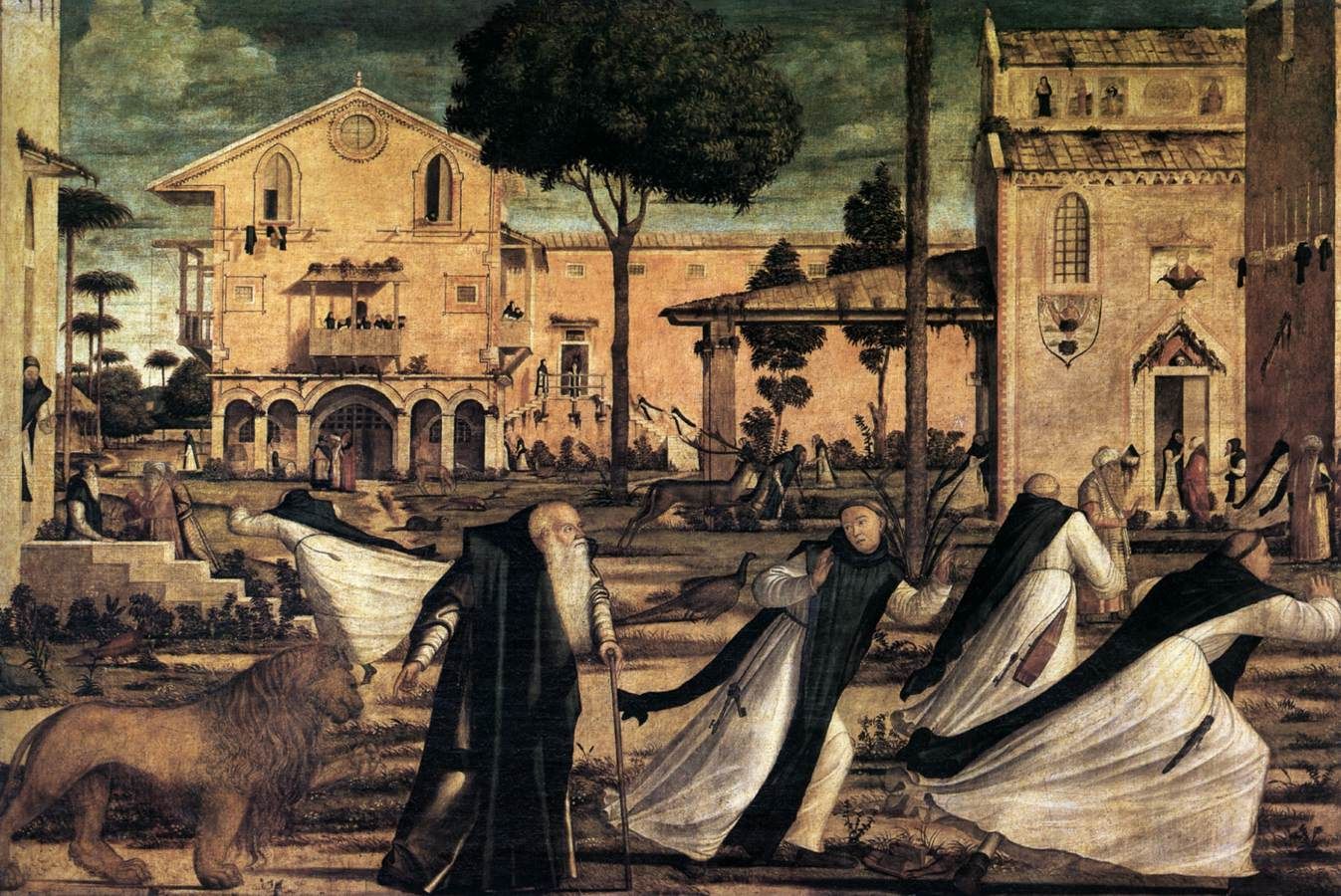
Emblem: The lion
Translator of the Bible, Doctor of the Church · c. 347-420
Saint Jerome
Vittore Carpaccio · Saint Jerome and the Lion in the Monastery
Jerome was born near what is now the border of Croatia and Slovenia. He studied rhetoric and philosophy in Rome and became a brilliant scholar of Latin and Greek. As a young man he had a dream in which he stood before God at the judgment and was told, "Thou art a Ciceronian, not a Christian," meaning that he loved the pagan classics more than his faith, and then he was flogged. The dream shook him badly, and for a while he tried to give up his love of classical literature.
A Scholar in the Desert
He went to live as a hermit in the Syrian desert for several years, and there, almost as a penance, he started learning Hebrew, complaining about its "harsh, guttural sounds." That command of languages became the foundation of his life’s great work. Back in Rome he served for a time as secretary to Pope Damasus I, who asked him to replace the many inconsistent Latin translations of the Scriptures then in use with a single reliable Latin version.
The Vulgate
Jerome spent the rest of his life in Bethlehem, in a monastery he founded near the cave where Christ was born. Over more than twenty years he translated the Old Testament into Latin straight from the original Hebrew and Aramaic, when most scholars of his time worked from the Greek translation, and the New Testament from the Greek. The result, the Vulgate (meaning "in common use"), was the Bible of the Western Church for centuries, and the Council of Trent formally confirmed it in 1546.
Jerome had a sharp and sometimes merciless pen. In theological arguments he didn’t hesitate to write harsh, mocking letters about his opponents, and he fell out with some of the leading figures of his day, even, for a while, with Augustine. Yet it was also Jerome who wrote, with deep humility, "Ignorance of Scripture is ignorance of Christ," and he gave his life to the conviction that ordinary believers should be able to read the word of God in their own language. He died in Bethlehem in 420. His feast day is September 30.