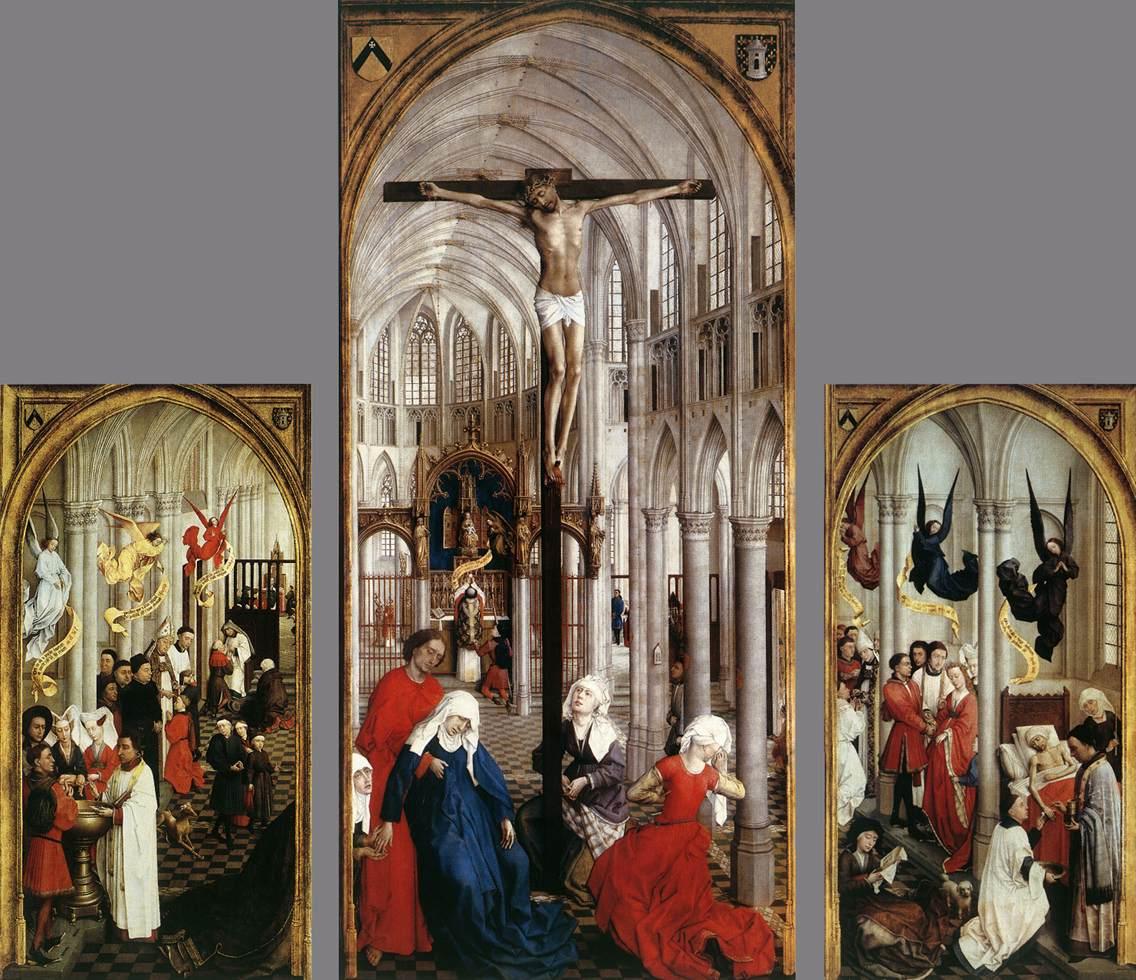
The liturgy is the celebration of the mystery of Christ and in particular his paschal mystery. Through the exercise of the priestly office of Jesus Christ the liturgy manifests in signs and brings about the sanctification of humankind.
The public worship which is due to God is offered by the Mystical Body of Christ, that is, by its head and by its members.
The liturgy as the sacred action par excellence is the summit toward which the activity of the Church is directed and it is likewise the font from which all her power flows. Through the liturgy Christ continues the work of our redemption in, with and through his Church.
The sacramental economy consists in the communication of the fruits of Christ’s redemption through the celebration of the sacraments of the Church, most especially that of the Eucharist, “until he comes” (1 Corinthians 11:26).
Chapter OneThe Paschal Mystery in the Age of the Church
Through the liturgy the Father fills us with his blessings in the Word made flesh who died and rose for us and pours into our hearts the Holy Spirit. At the same time, the Church blesses the Father by her worship, praise, and thanksgiving and begs him for the gift of his Son and the Holy Spirit.
In the liturgy of the Church, it is his own paschal mystery that Christ signifies and makes present. By giving the Holy Spirit to his apostles he entrusted to them and their successors the power to make present the work of salvation through the Eucharistic sacrifice and the sacraments, in which he himself acts to communicate his grace to the faithful of all times and places throughout the world.
The very closest cooperation is at work in the liturgy between the Holy Spirit and the Church. The Holy Spirit prepares the Church to encounter her Lord. He recalls and manifests Christ to the faith of the assembly. He makes the mystery of Christ really present. He unites the Church to the life and mission of Christ and makes the gift of communion bear fruit in the Church.
The Paschal Mystery in the Sacraments of the Church
The sacraments, instituted by Christ and entrusted to the Church, are efficacious signs of grace perceptible to the senses. Through them divine life is bestowed upon us. There are seven sacraments: Baptism, Confirmation, Holy Eucharist, Penance, Anointing of the Sick, Holy Orders, and Matrimony.
Christ has entrusted the sacraments to his Church. They are the sacraments “of the Church” in a twofold sense: they are “from her” insofar as they are actions of the Church which is the sacrament of Christ’s action; and they are “for her” in as much as they build up the Church.
It is a spiritual “seal” bestowed by the sacraments of Baptism, Confirmation, and Holy Orders. It is a promise and guarantee of divine protection. By virtue of this seal the Christian is configured to Christ, participates in a variety of ways in his priesthood and takes his part in the Church according to different states and functions. He is, therefore, set apart for divine worship and the service of the Church. Because this character is indelible the sacraments that impress it on the soul are received only once in life.
The sacraments not only presuppose faith but with words and ritual elements they nourish, strengthen, and express it. By celebrating the sacraments, the Church professes the faith that comes from the apostles. This explains the origin of the ancient saying, “lex orandi, lex credendi,” that is, the Church believes as she prays.
The sacraments are efficacious ex opere operato (“by the very fact that the sacramental action is performed”) because it is Christ who acts in the sacraments and communicates the grace they signify. The efficacy of the sacraments does not depend upon the personal holiness of the minister. However, the fruits of the sacraments do depend on the dispositions of the one who receives them.
For believers in Christ the sacraments, even if they are not all given to each of the faithful, are necessary for salvation because they confer sacramental grace, forgiveness of sins, adoption as children of God, conformation to Christ the Lord and membership in the Church. The Holy Spirit heals and transforms those who receive the sacraments.
Sacramental grace is the grace of the Holy Spirit which is given by Christ and is proper to each sacrament. This grace helps the faithful in their journey toward holiness and so assists the Church as well to grow in charity and in her witness to the world.
In the sacraments the Church already receives a foretaste of eternal life, while “awaiting in blessed hope, the appearing in glory of our great God and saviour Christ Jesus” (Titus 2:13).
Chapter TwoThe Sacramental Celebration of the Paschal Mystery
In the liturgy it is the whole Christ (Christus Totus) who acts, Head and Body. As our High Priest he celebrates with his body, which is the Church in heaven and on earth.
The heavenly liturgy is celebrated by the angels, by the saints of the Old and New Testament, particularly the Mother of God, by the Apostles, by the martyrs, and by the “great multitude which no one could number from every nation, race, people, and tongue.” (Revelation 7:9). When we celebrate the mystery of our salvation in the sacraments we participate in this eternal liturgy.
The Church on earth celebrates the liturgy as a priestly people in which each one acts according to his proper function in the unity of the Holy Spirit. The baptized offer themselves in a spiritual sacrifice; the ordained ministers celebrate according to the Order they received for the service of all the members of the Church; the bishops and priests act in the Person of Christ the Head.
The celebration of the liturgy is interwoven with signs and symbols whose meaning is rooted in creation and in human culture. It is determined by the events of the Old Testament and is fully revealed in the Person and work of Christ.
Some come from created things (light, water, fire, bread, wine, oil); others come from social life (washing, anointing, breaking of bread). Still others come from the history of salvation in the Old Covenant (the Passover rites, the sacrifices, the laying on of hands, the consecrations). These signs, some of which are normative and unchangeable, were taken up by Christ and are made the bearers of his saving and sanctifying action.
Actions and words are very closely linked in the celebration of the sacraments. Indeed, even if the symbolic actions are already in themselves a language, it is necessary that the words of the rite accompany and give life to these actions. The liturgical words and actions are inseparable both insofar as they are meaningful signs and insofar as they bring about what they signify.
Since song and music are closely connected with liturgical action they must respect the following criteria. They should conform to Catholic doctrine in their texts, drawn preferably from Sacred Scripture and liturgical sources. They should be a beautiful expression of prayer. The music should be of a high quality. Song and music should encourage the participation of the liturgical assembly. They should express the cultural richness of the People of God and the sacred and solemn character of the celebration. “He who sings, prays twice” (Saint Augustine).
The image of Christ is the liturgical icon par excellence. Other images, representations of Our Lady and of the Saints, signify Christ who is glorified in them. They proclaim the same Gospel message that Sacred Scripture communicates by the word and they help to awaken and nourish the faith of believers.
The center of the liturgical season is Sunday which is the foundation and kernel of the entire liturgical year and has its culmination in the annual celebration of Easter, the feast of feasts.
In the liturgical year the Church celebrates the whole mystery of Christ from his Incarnation to his return in glory. On set days the Church venerates with special love the Blessed Virgin Mary, the Mother of God. The Church also keeps the memorials of saints who lived for Christ, who suffered with him, and who live with him in glory.
The Liturgy of the Hours, which is the public and common prayer of the Church, is the prayer of Christ with his body, the Church. Through the Liturgy of the Hours the mystery of Christ, which we celebrate in the Eucharist, sanctifies and transforms the whole of each day. It is composed mainly of psalms, other biblical texts, and readings from the Fathers and spiritual masters.
The worship “in spirit and truth” (John 4:24) of the New Covenant is not tied exclusively to any place because Christ is the true temple of God. Through him Christians and the whole Church become temples of the living God by the action of the Holy Spirit. Nonetheless, the people of God in their earthly condition need places in which the community can gather to celebrate the liturgy.
They are the houses of God, a symbol of the Church that lives in that place as well as of the heavenly Jerusalem. Above all they are places of prayer in which the Church celebrates the Eucharist and worships Christ who is truly present in the tabernacle.
They are: the altar, the tabernacle, the place where the sacred Chrism and other holy oils are kept, the chair of the bishop (cathedra) or the chair of the priest, the ambo, the baptismal font, and the confessional.
The answer is that the unfathomable richness of the mystery of Christ cannot be exhausted by any single liturgical tradition. From the very beginning, therefore, this richness found expression among various peoples and cultures in ways that are characterized by a wonderful diversity and complementarity.
It is fidelity to the Apostolic Tradition, that is, the communion in the faith and in the sacraments received from the apostles, a communion that is both signified and guaranteed by apostolic succession. The Church is Catholic and therefore can integrate into her unity all the authentic riches of cultures.
In the liturgy, particularly in that of the sacraments, there are unchangeable elements because they are of divine institution. The Church is the faithful guardian of them. There are also, however, elements subject to change which the Church has the power and on occasion also the duty to adapt to the cultures of diverse peoples.
The sacraments are divided into: the sacraments of Christian initiation (Baptism, Confirmation, and Holy Eucharist); the sacraments of healing (Penance and Anointing of the Sick);, and the sacraments at the service of communion and mission (Holy Orders and Matrimony). The sacraments touch all the important moments of Christian life. All of the sacraments are ordered to the Holy Eucharist “as to their end” (Saint Thomas Aquinas).
Christian initiation is accomplished by means of the sacraments which establish the foundations of Christian life. The faithful born anew by Baptism are strengthened by Confirmation and are then nourished by the Eucharist.
This sacrament is primarily called Baptism because of the central rite with which it is celebrated. To baptize means to “immerse” in water. The one who is baptized is immersed into the death of Christ and rises with him as a “new creature” (2 Corinthians 5:17). This sacrament is also called the “bath of regeneration and renewal in the Holy Spirit” (Titus 3:5); and it is called “enlightenment” because the baptized becomes “a son of light” (Ephesians 5:8).
In the Old Covenant Baptism was pre-figured in various ways: water, seen as source of life and of death; in the Ark of Noah, which saved by means of water; in the passing through the Red Sea, which liberated Israel from Egyptian slavery; in the crossing of the Jordan River, that brought Israel into the promised land which is the image of eternal life.
All the Old Covenant prefigurations find their fulfillment in Jesus Christ. At the beginning of his public life Jesus had himself baptized by John the Baptist in the Jordan. On the cross, blood and water, signs of Baptism and the Eucharist, flowed from his pierced side. After his Resurrection he gave to his apostles this mission: “Go forth and make disciples of all nations, baptizing them in the name of the Father and of the Son and of the Holy Spirit” (Matthew 28:19).
The essential rite of this sacrament consists in immersing the candidate in water or pouring water over his or her head while invoking the name of the Father and the Son and the Holy Spirit.
The Church baptizes infants because they are born with original sin. They need to be freed from the power of the Evil One and brought into that realm of freedom which belongs to the children of God.
Everyone who is to be baptized is required to make a profession of faith. This is done personally in the case of an adult or by the parents and by the Church in the case of infants. Also the godfather or the godmother and the whole ecclesial community share the responsibility for baptismal preparation (catechumenate) as well as for the development and safeguarding of the faith and grace given at baptism.
The ordinary ministers of Baptism are the bishop and the priest. In the Latin Church the deacon also can baptize. In case of necessity any person can baptize provided he has the intention of doing what the Church does. This is done by pouring water on the head of the candidate while saying the Trinitarian formula for Baptism: “I baptize you in the name of the Father and of the Son and of the Holy Spirit”.
Since Christ died for the salvation of all, those can be saved without Baptism who die for the faith (Baptism of blood). Catechumens and all those who, even without knowing Christ and the Church, still (under the impulse of grace) sincerely seek God and strive to do his will can also be saved without Baptism (Baptism of desire). The Church in her liturgy entrusts children who die without Baptism to the mercy of God.
Baptism takes away original sin, all personal sins and all punishment due to sin. It makes the baptized person a participant in the divine life of the Trinity through sanctifying grace, the grace of justification which incorporates one into Christ and into his Church. It gives one a share in the priesthood of Christ and provides the basis for communion with all Christians. It bestows the theological virtues and the gifts of the Holy Spirit. A baptized person belongs forever to Christ. He is marked with the indelible seal of Christ (character).
The name is important because God knows each of us by name, that is, in our uniqueness as persons. In Baptism a Christian receives his or her own name in the Church. It should preferably be the name of a saint who might offer the baptized a model of sanctity and an assurance of his or her intercession before God.
In the Old Testament the prophets announced that the Spirit of the Lord would rest on the awaited Messiah and on the entire messianic people. The whole life and mission of Jesus were carried out in total communion with the Holy Spirit. The apostles received the Holy Spirit at Pentecost and proclaimed “the great works of God” (Acts 2:11). They gave the gift of the same Spirit to the newly baptized by the laying on of hands. Down through the centuries, the Church has continued to live by the Spirit and to impart him to her children.
It is called Chrismation (in the Eastern Churches: Anointing with holy myron or chrism) because the essential rite of the sacrament is anointing with chrism. It is called Confirmation because it confirms and strengthens baptismal grace.
The essential rite of Confirmation is the anointing with Sacred Chrism (oil mixed with balsam and consecrated by the bishop), which is done by the laying on of the hand of the minister who pronounces the sacramental words proper to the rite. In the West this anointing is done on the forehead of the baptized with the words, “Be sealed with the gift of the Holy Spirit”. In the Eastern Churches of the Byzantine rite this anointing is also done on other parts of the body with the words, “The seal of the gift of the Holy Spirit”.
The effect of Confirmation is a special outpouring of the Holy Spirit like that of Pentecost. This outpouring impresses on the soul an indelible character and produces a growth in the grace of Baptism. It roots the recipient more deeply in divine sonship, binds him more firmly to Christ and to the Church and reinvigorates the gifts of the Holy Spirit in his soul. It gives a special strength to witness to the Christian faith.
Only those already baptized can and should receive this sacrament which can be received only once. To receive Confirmation efficaciously the candidate must be in the state of grace.
The original minister of Confirmation is the bishop. In this way the link between the confirmed and the Church in her apostolic dimension is made manifest. When a priest confers this sacrament, as ordinarily happens in the East and in special cases in the West, the link with the bishop and with the Church is expressed by the priest who is the collaborator of the bishop and by the Sacred Chrism, consecrated by the bishop himself.
The Eucharist is the very sacrifice of the Body and Blood of the Lord Jesus which he instituted to perpetuate the sacrifice of the cross throughout the ages until his return in glory. Thus he entrusted to his Church this memorial of his death and Resurrection. It is a sign of unity, a bond of charity, a paschal banquet, in which Christ is consumed, the mind is filled with grace, and a pledge of future glory is given to us.
Jesus instituted the Eucharist on Holy Thursday “the night on which he was betrayed” (1 Corinthians 11:23), as he celebrated the Last Supper with his apostles.
After he had gathered with his apostles in the Cenacle, Jesus took bread in his hands. He broke it and gave it to them saying, “Take this and eat it, all of you; this is my Body which will be given up for you”. Then, he took the cup of wine in his hands and said, “Take this and drink of this, all of you. This is the cup of my Blood, the Blood of the new and everlasting covenant. It will be shed for you and for all so that sins may be forgive. Do this in memory of me”.
It is the source and summit of all Christian life. In the Eucharist, the sanctifying action of God in our regard and our worship of him reach their high point. It contains the whole spiritual good of the Church, Christ himself, our Pasch. Communion with divine life and the unity of the People of God are both expressed and effected by the Eucharist. Through the eucharistic celebration we are united already with the liturgy of heaven and we have a foretaste of eternal life.
The unfathomable richness of this sacrament is expressed in different names which evoke its various aspects. The most common names are: the Eucharist, Holy Mass, the Lord’s Supper, the Breaking of the Bread, the Eucharistic Celebration, the Memorial of the passion, death and Resurrection of the Lord, the Holy Sacrifice, the Holy and Divine Liturgy, the Sacred Mysteries, the Most Holy Sacrament of the Altar, and Holy Communion.
The Eucharist was foreshadowed in the Old Covenant above all in the annual Passover meal celebrated every year by the Jews with unleavened bread to commemorate their hasty, liberating departure from Egypt. Jesus foretold it in his teaching and he instituted it when he celebrated the Last Supper with his apostles in a Passover meal. The Church, faithful to the command of her Lord, “Do this in memory of me” (1 Corinthians 11:24), has always celebrated the Eucharist, especially on Sunday, the day of the Resurrection of Jesus.
The Eucharist unfolds in two great parts which together form one, single act of worship. The Liturgy of the Word involves proclaiming and listening to the Word of God. The Liturgy of the Eucharist includes the presentation of the bread and wine, the prayer or the anaphora containing the words of consecration, and communion.
The celebrant of the Eucharist is a validly ordained priest (bishop or priest) who acts in the Person of Christ the Head and in the name of the Church.
The Eucharist is a memorial in the sense that it makes present and actual the sacrifice which Christ offered to the Father on the cross, once and for all on behalf of mankind. The sacrificial character of the Holy Eucharist is manifested in the very words of institution, “This is my Body which is given for you” and “This cup is the New Covenant in my Blood that will be shed for you” (Luke 22:19-20). The sacrifice of the cross and the sacrifice of the Eucharist are one and the same sacrifice. The priest and the victim are the same; only the manner of offering is different: in a bloody manner on the cross, in an unbloody manner in the Eucharist.
In the Eucharist the sacrifice of Christ becomes also the sacrifice of the members of his Body. The lives of the faithful, their praise, their suffering, their prayers, their work, are united to those of Christ. In as much as it is a sacrifice, the Eucharist is likewise offered for all the faithful, living and dead, in reparation for the sins of all and to obtain spiritual and temporal benefits from God. The Church in heaven is also united to the offering of Christ.
Jesus Christ is present in the Eucharist in a unique and incomparable way. He is present in a true, real and substantial way, with his Body and his Blood, with his Soul and his Divinity. In the Eucharist, therefore, there is present in a sacramental way, that is, under the Eucharistic species of bread and wine, Christ whole and entire, God and Man.
Transubstantiation means the change of the whole substance of bread into the substance of the Body of Christ and of the whole substance of wine into the substance of his Blood. This change is brought about in the eucharistic prayer through the efficacy of the word of Christ and by the action of the Holy Spirit. However, the outward characteristics of bread and wine, that is the “eucharistic species”, remain unaltered.
The worship due to the sacrament of the Eucharist, whether during the celebration of the Mass or outside it, is the worship of latria, that is, the adoration given to God alone. The Church guards with the greatest care Hosts that have been consecrated. She brings them to the sick and to other persons who find it impossible to participate at Mass. She also presents them for the solemn adoration of the faithful and she bears them in processions. The Church encourages the faithful to make frequent visits to adore the Blessed Sacrament reserved in the tabernacle.
The Holy Eucharist is the paschal banquet in as much as Christ sacramentally makes present his Passover and gives us his Body and Blood, offered as food and drink, uniting us to himself and to one another in his sacrifice.
The altar is the symbol of Christ himself who is present both as sacrificial victim (the altar of the sacrifice) and as food from heaven which is given to us (the table of the Lord).
The Church obliges the faithful to participate at Holy Mass every Sunday and on holy days of obligation. She recommends participation at Holy Mass on other days as well.
The Church recommends that the faithful, if they have the required dispositions, receive Holy Communion whenever they participate at Holy Mass. However, the Church obliges them to receive Holy Communion at least once a year during the Easter season.
To receive Holy Communion one must be fully incorporated into the Catholic Church and be in the state of grace, that is, not conscious of being in mortal sin. Anyone who is conscious of having committed a grave sin must first receive the sacrament of Reconciliation before going to Communion. Also important for those receiving Holy Communion are a spirit of recollection and prayer, observance of the fast prescribed by the Church, and an appropriate disposition of the body (gestures and dress) as a sign of respect for Christ.
Holy Communion increases our union with Christ and with his Church. It preserves and renews the life of grace received at Baptism and Confirmation and makes us grow in love for our neighbor. It strengthens us in charity, wipes away venial sins and preserves us from mortal sin in the future.
Catholic ministers may give Holy Communion licitly to members of the Oriental Churches which are not in full communion with the Catholic Church whenever they ask for it of their own will and possess the required dispositions. Catholic ministers may licitly give Holy Communion to members of other ecclesial communities only if, in grave necessity, they ask for it of their own will, possess the required dispositions, and give evidence of holding the Catholic faith regarding the sacrament.
The Eucharist is a pledge of future glory because it fills us with every grace and heavenly blessing. It fortifies us for our pilgrimage in this life and makes us long for eternal life. It unites us already to Christ seated at the right hand of the Father, to the Church in heaven and to the Blessed Virgin and all the saints.
In the Eucharist, we “break the one bread that provides the medicine of immortality, the antidote for death and the food that makes us live forever in Jesus Christ.”
Christ, the physician of our soul and body, instituted these sacraments because the new life that he gives us in the sacraments of Christian initiation can be weakened and even lost because of sin. Therefore, Christ willed that his Church should continue his work of healing and salvation by means of these two sacraments.
It is called the sacrament of Penance, the sacrament of Reconciliation, the sacrament of Forgiveness, the sacrament of Confession, and the sacrament of Conversion.
Since the new life of grace received in Baptism does not abolish the weakness of human nature nor the inclination to sin (that is, concupiscence), Christ instituted this sacrament for the conversion of the baptized who have been separated from him by sin.
The risen Lord instituted this sacrament on the evening of Easter when he showed himself to his apostles and said to them, “Receive the Holy Spirit. If you forgive the sins of any, they are forgiven; if you retain the sins of any, they are retained.” (John 20:22-23).
The call of Christ to conversion continues to resound in the lives of the baptized. Conversion is a continuing obligation for the whole Church. She is holy but includes sinners in her midst.
It is the movement of a “contrite heart” (Psalm 51:19) drawn by divine grace to respond to the merciful love of God. This entails sorrow for and abhorrence of sins committed, a firm purpose not to sin again in the future and trust in the help of God. It is nourished by hope in divine mercy.
Penance can be expressed in many and various ways but above all in fasting, prayer, and almsgiving. These and many other forms of penance can be practiced in the daily life of a Christian, particularly during the time of Lent and on the penitential day of Friday.
The essential elements are two: the acts of the penitent who comes to repentance through the action of the Holy Spirit, and the absolution of the priest who in the name of Christ grants forgiveness and determines the ways of making satisfaction.
They are: a careful examination of conscience; contrition (or repentance), which is perfect when it is motivated by love of God and imperfect if it rests on other motives and which includes the determination not to sin again; confession, which consists in the telling of one’s sins to the priest; and satisfaction or the carrying out of certain acts of penance which the confessor imposes upon the penitent to repair the damage caused by sin.
All grave sins not yet confessed, which a careful examination of conscience brings to mind, must be brought to the sacrament of Penance. The confession of serious sins is the only ordinary way to obtain forgiveness.
Each of the faithful who has reached the age of discretion is bound to confess his or her mortal sins at least once a year and always before receiving Holy Communion.
The confession of venial sins is strongly recommended by the Church, even if this is not strictly necessary, because it helps us to form a correct conscience and to fight against evil tendencies. It allows us to be healed by Christ and to progress in the life of the Spirit.
Christ has entrusted the ministry of Reconciliation to his apostles, to the bishops who are their successors and to the priests who are the collaborators of the bishops, all of whom become thereby instruments of the mercy and justice of God. They exercise their power of forgiving sins in the name of the Father and of the Son and of the Holy Spirit.
The absolution of certain particularly grave sins (like those punished by excommunication) is reserved to the Apostolic See or to the local bishop or to priests who are authorized by them. Any priest, however, can absolve a person who is in danger of death from any sin and excommunication.
Given the delicacy and greatness of this ministry and the respect due to people every confessor, without any exception and under very severe penalties, is bound to maintain “the sacramental seal” which means absolute secrecy about the sins revealed to him in confession.
The effects of the sacrament of Penance are: reconciliation with God and therefore the forgiveness of sins; reconciliation with the Church; recovery, if it has been lost, of the state of grace; remission of the eternal punishment merited by mortal sins, and remission, at least in part, of the temporal punishment which is the consequence of sin; peace, serenity of conscience and spiritual consolation; and an increase of spiritual strength for the struggle of Christian living.
In cases of serious necessity (as in imminent danger of death) recourse may be had to a communal celebration of Reconciliation with general confession and general absolution, as long as the norms of the Church are observed and there is the intention of individually confessing one’s grave sins in due time.
Indulgences are the remission before God of the temporal punishment due to sins whose guilt has already been forgiven. The faithful Christian who is duly disposed gains the indulgence under prescribed conditions for either himself or the departed. Indulgences are granted through the ministry of the Church which, as the dispenser of the grace of redemption, distributes the treasury of the merits of Christ and the Saints.
In the Old Testament sickness was experienced as a sign of weakness and at the same time perceived as mysteriously bound up with sin. The prophets intuited that sickness could also have a redemptive value for one’s own sins and those of others. Thus sickness was lived out in the presence of God from whom people implored healing.
The compassion of Jesus toward the sick and his many healings of the infirm were a clear sign that with him had come the Kingdom of God and therefore victory over sin, over suffering, and over death. By his own passion and death he gave new meaning to our suffering which, when united with his own, can become a means of purification and of salvation for us and for others.
Having received from the Lord the charge to heal the sick, the Church strives to carry it out by taking care of the sick and accompanying them with her prayer of intercession. Above all, the Church possesses a sacrament specifically intended for the benefit of the sick. This sacrament was instituted by Christ and is attested by Saint James: “Is anyone among you sick? Let him call in the presbyters of the Church and let them pray over him and anoint him with oil in the name of the Lord” (James 5:14-15).
Any member of the faithful can receive this sacrament as soon as he or she begins to be in danger of death because of sickness or old age. The faithful who receive this sacrament can receive it several times if their illness becomes worse or another serious sickness afflicts them. The celebration of this sacrament should, if possible, be preceded by individual confession on the part of the sick person.
The celebration of this sacrament consists essentially in an anointing with oil which may be blessed by the bishop. The anointing is on the forehead and on the hands of the sick person (in the Roman rite) or also on other parts of the body (in the other rites) accompanied by the prayer of the priest who asks for the special grace of this sacrament.
This sacrament confers a special grace which unites the sick person more intimately to the Passion of Christ for his good and for the good of all the Church. It gives comfort, peace, courage, and even the forgiveness of sins if the sick person is not able to make a confession. Sometimes, if it is the will of God, this sacrament even brings about the restoration of physical health. In any case this Anointing prepares the sick person for the journey to the Father’s House.
Viaticum is the Holy Eucharist received by those who are about to leave this earthly life and are preparing for the journey to eternal life. Communion in the body and blood of Christ who died and rose from the dead, received at the moment of passing from this world to the Father, is the seed of eternal life and the power of the resurrection.
Chapter ThreeThe Sacraments at the Service of Communion and Mission
Two sacraments, Holy Orders and Matrimony, confer a special grace for a particular mission in the Church to serve and build up the People of God. These sacraments contribute in a special way to ecclesial communion and to the salvation of others.
Orders designates an ecclesial body into which one enters by means of a special consecration (ordination). Through a special gift of the Holy Spirit, this sacrament enables the ordained to exercise a sacred power in the name and with the authority of Christ for the service of the People of God.
This sacrament was prefigured in the Old Covenant in the service of the Levites, in the priesthood of Aaron, and in the institution of the seventy “Elders” (Numbers 11:25). These prefigurations find their fulfillment in Christ Jesus who by the sacrifice of the cross is the “one mediator between God and man” (1 Timothy 2:5), the “High Priest according to the order of Melchizedek” (Hebrews 5:10). The one priesthood of Christ is made present in the ministerial priesthood.
“Only Christ is the true priest, the others being only his ministers.”
The sacrament of Holy Orders is composed of three degrees which are irreplaceable for the organic structure of the Church: the episcopate, the presbyterate and the diaconate.
Episcopal ordination confers the fullness of the sacrament of Holy Orders. It makes the bishop a legitimate successor of the apostles and integrates him into the episcopal college to share with the Pope and the other bishops care for all the churches. It confers on him the offices of teaching, sanctifying, and ruling.
The bishop to whom the care of a particular Church is entrusted is the visible head and foundation of unity for that Church. For the sake of that Church, as vicar of Christ, he fulfills the office of shepherd and is assisted by his own priests and deacons.
The anointing of the Spirit seals the priest with an indelible, spiritual character that configures him to Christ the priest and enables him to act in the name of Christ the Head. As a co-worker of the order of bishops he is consecrated to preach the Gospel, to celebrate divine worship, especially the Eucharist from which his ministry draws its strength, and to be a shepherd of the faithful.
A priest, although ordained for a universal mission, exercises his ministry in a particular Church. This ministry is pursued in sacramental brotherhood with other priests who form the “presbyterate”. In communion with the bishop, and depending upon him, they bear responsibility for the particular Church.
The deacon, configured to Christ the servant of all, is ordained for service to the Church. He carries out this service under the authority of his proper bishop by the ministry of the Word, of divine worship, of pastoral care and of charity.
The sacrament of Holy Orders is conferred, in each of its three degrees, by means of the imposition of hands on the head of the ordinand by the Bishop who pronounces the solemn prayer of consecration. With this prayer he asks God on behalf of the ordinand for the special outpouring of the Holy Spirit and for the gifts of the Spirit proper to the ministry to which he is being ordained.
This sacrament can only be validly received by a baptized man. The Church recognizes herself as bound by this choice made by the Lord Himself. No one can demand to receive the sacrament of Holy Orders, but must be judged suitable for the ministry by the authorities of the Church.
It is always necessary to be celibate for the episcopacy. For the priesthood in the Latin Church men who are practicing Catholics and celibate are chosen, men who intend to continue to live a celibate life “for the kingdom of heaven” (Matthew 19:12). In the Eastern Churches marriage is not permitted after one has been ordained. Married men can be ordained to the permanent diaconate.
This sacrament yields a special outpouring of the Holy Spirit which configures the recipient to Christ in his triple office as Priest, Prophet, and King, according to the respective degrees of the sacrament. Ordination confers an indelible spiritual character and therefore cannot be repeated or conferred for a limited time.
Ordained priests in the exercise of their sacred ministry speak and act not on their own authority, nor even by mandate or delegation of the community, but rather in the Person of Christ the Head and in the name of the Church. Therefore, the ministerial priesthood differs essentially and not just in degree from the priesthood common to all the faithful for whose service Christ instituted it.
God who is love and who created man and woman for love has called them to love. By creating man and woman he called them to an intimate communion of life and of love in marriage: “So that they are no longer two, but one flesh” (Matthew 19:6). God said to them in blessing “Be fruitful and multiply” (Genesis 1:28).
The marital union of man and woman, which is founded and endowed with its own proper laws by the Creator, is by its very nature ordered to the communion and good of the couple and to the generation and education of children. According to the original divine plan this conjugal union is indissoluble, as Jesus Christ affirmed: “What God has joined together, let no man put asunder” (Mark 10:9).
Because of original sin, which caused a rupture in the God-given communion between man and woman, the union of marriage is very often threatened by discord and infidelity. However, God in his infinite mercy gives to man and woman the grace to bring the union of their lives into accord with the original divine plan.
God helped his people above all through the teaching of the Law and the Prophets to deepen progressively their understanding of the unity and indissolubility of marriage. The nuptial covenant of God with Israel prepared for and prefigured the new covenant established by Jesus Christ the Son of God, with his spouse, the Church.
Christ not only restored the original order of matrimony but raised it to the dignity of a sacrament, giving spouses a special grace to live out their marriage as a symbol of Christ’s love for his bride the Church: “Husbands, love your wives as Christ loves the Church” (Ephesians 5:25).
Matrimony is not an obligation for everyone, especially since God calls some men and women to follow the Lord Jesus in a life of virginity or of celibacy for the sake of the Kingdom of Heaven. These renounce the great good of Matrimony to concentrate on the things of the Lord and seek to please him. They become a sign of the absolute supremacy of Christ’s love and of the ardent expectation of his glorious return.
Since Matrimony establishes spouses in a public state of life in the Church, its liturgical celebration is public, taking place in the presence of a priest (or of a witness authorized by the Church) and other witnesses.
Matrimonial consent is given when a man and a woman manifest the will to give themselves to each other irrevocably in order to live a covenant of faithful and fruitful love. Since consent constitutes Matrimony, it is indispensable and irreplaceable. For a valid marriage the consent must have as its object true Matrimony, and be a human act which is conscious and free and not determined by duress or coercion.
A mixed marriage (between a Catholic and a baptized non-Catholic) needs for liceity the permission of ecclesiastical authority. In a case of disparity of cult (between a Catholic and a non-baptized person) a dispensation is required for validity. In both cases, it is essential that the spouses do not exclude the acceptance of the essential ends and properties of marriage. It is also necessary for the Catholic party to accept the obligation, of which the non-Catholic party has been advised, to persevere in the faith and to assure the baptism and Catholic education of their children.
The sacrament of Matrimony establishes a perpetual and exclusive bond between the spouses. God himself seals the consent of the spouses. Therefore, a marriage which is ratified and consummated between baptized persons can never be dissolved. Furthermore, this sacrament bestows upon the spouses the grace necessary to attain holiness in their married life and to accept responsibly the gift of children and provide for their education.
Adultery and polygamy are opposed to the sacrament of matrimony because they contradict the equal dignity of man and woman and the unity and exclusivity of married love. Other sins include the deliberate refusal of one’s procreative potential which deprives conjugal love of the gift of children and divorce which goes against the indissolubility of marriage.
The Church permits the physical separation of spouses when for serious reasons their living together becomes practically impossible, even though there may be hope for their reconciliation. As long as one’s spouse lives, however, one is not free to contract a new union, except if the marriage be null and be declared so by ecclesiastical authority.
The Church, since she is faithful to her Lord, cannot recognize the union of people who are civilly divorced and remarried. “Whoever divorces his wife and marries another, commits adultery against her; and if she divorces her husband and marries another, she commits adultery” (Mark 10:11-12). The Church manifests an attentive solicitude toward such people and encourages them to a life of faith, prayer, works of charity and the Christian education of their children. However, they cannot receive sacramental absolution, take Holy Communion, or exercise certain ecclesial responsibilities as long as their situation, which objectively contravenes God’s law, persists.
The Christian family is called the domestic church because the family manifests and lives out the communal and familial nature of the Church as the family of God. Each family member, in accord with their own role, exercises the baptismal priesthood and contributes toward making the family a community of grace and of prayer, a school of human and Christian virtue and the place where the faith is first proclaimed to children.
These are sacred signs instituted by the Church to sanctify different circumstances of life. They include a prayer accompanied by the sign of the cross and other signs. Among the sacramentals which occupy an important place are: blessings, which are the praise of God and a prayer to obtain his gifts, the consecration of persons and the dedication of things for the worship of God.
When the Church asks with its authority in the name of Jesus that a person or object be protected against the power of the Evil One and withdrawn from his dominion, it is called an exorcism. This is done in ordinary form in the rite of Baptism. A solemn exorcism, called a major exorcism, can be performed only by a priest authorized by the bishop.
The religious sense of the Christian people has always found expression in the various forms of piety which accompany the sacramental life of the Church such as the veneration of relics, visits to sanctuaries, pilgrimages, processions, the stations of the cross and the rosary. The Church sheds the light of faith upon and fosters authentic forms of popular piety.
The Christian who dies in Christ reaches at the end of his earthly existence the fulfillment of that new life which was begun in Baptism, strengthened in Confirmation, and nourished in the Eucharist, the foretaste of the heavenly banquet. The meaning of the death of a Christian becomes clear in the light of the death and Resurrection of Christ our only hope. The Christian who dies in Christ Jesus goes “away from the body to be at home with the Lord” (2 Corinthians 5:8).
Although celebrated in different rites in keeping with the situations and traditions of various regions, funerals express the paschal character of Christian death in hope of the resurrection. They also manifest the meaning of communion with the departed particularly through prayer for the purification of their souls.
Usually, funeral rites consist of four principal parts: welcoming the body of the deceased by the community with words of comfort and hope, the liturgy of the Word, the Eucharistic Sacrifice, and the farewell in which the soul of the departed is entrusted to God, the Source of eternal life, while the body is buried in the hope of the resurrection.
Settings
Accessibility Profiles
Accessibility Settings
Screen Reader uses your browser's built-in speech synthesis to read aloud whatever you point at; it is not a substitute for a real screen reader (VoiceOver, NVDA, TalkBack, etc.), which the site already works with on its own.