Emblem: The Totus Tuus coat of arms
The Pilgrim Pope · 1920-2005 (Papacy: 1978-2005)
Saint John Paul II
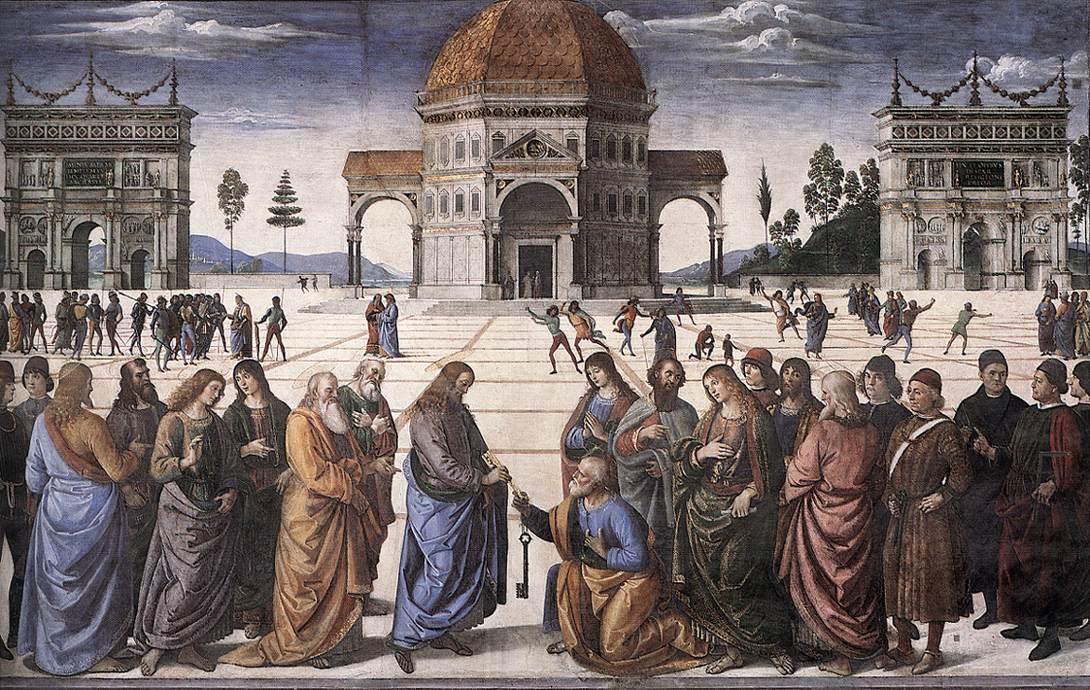
Perugino · Christ Giving the Keys to Saint Peter
Karol Wojtyła was born in Poland. As a young man he loved the theater and poetry and thought for a while about becoming an actor. When the Nazis occupied Poland during the Second World War and closed the universities, he was sent to work in a quarry and then a chemical factory. At the same time he studied for the priesthood in a secret seminary, at great risk, since the Nazis were hunting down Polish priests. After the war he went on to study philosophy, and later became a bishop and then a cardinal in Kraków.
The First in 455 Years
In 1978, after John Paul I died just thirty-three days into his papacy, Wojtyła was elected pope, to everyone’s surprise, the first non-Italian pope since 1522. He took the name John Paul II in honor of his predecessor. His papacy turned out to be one of the longest and most influential of the twentieth century. He visited 129 countries, which earned him the name "the Pilgrim Pope."
Shot, and Forgiving
In 1981 he was seriously wounded in St. Peter’s Square by a Turkish gunman, Mehmet Ali Ağca. Two years later, in 1983, after a long recovery, he went to see Ağca in prison and told him he forgave him, and the picture of that meeting went around the world. He is widely believed to have played a quiet but powerful part in the fall of communism in Eastern Europe, especially in Poland. His first visit home as pope, in 1979, sparked a spiritual awakening that prepared the ground for the Solidarity movement.
He worked hard to put the teaching of the Second Vatican Council into practice, started World Youth Day to reach young people directly, and built dialogue with other religions. In his last years he lived with Parkinson’s disease in full public view, without hiding it, and many saw in that a silent witness to the dignity of suffering. He died in 2005, at eighty-four, and millions came to his funeral. Pope Francis canonized him in 2014. His feast day is October 22.