Glossary of Catholic Terms
877 words of the faith, from Abba to Zucchetto, with the Catechism paragraphs that teach them
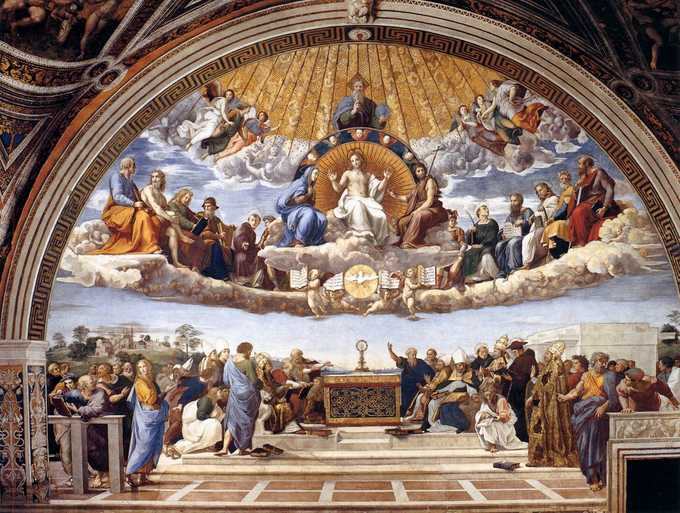
Raphael · The Disputation of the Holy Sacrament
A92 terms
- Abba
An Aramaic word for "Father," expressing a child's intimate trust, used by Jesus in addressing God. Through the Holy Spirit, the baptized share His filial relationship and may also cry out, "Abba! Father!" (Mark 14:36, Romans 8:15, Galatians 4:6).
- Abbess
The superior of an autonomous community of nuns (an abbey), usually elected by the community according to its rule and constitutions. She receives a liturgical blessing from the bishop, which is not ordination, and governs her community in spiritual and temporal matters.
CCC 1672
- Abbot
A priest who exercises ecclesiastical jurisdiction over a monastery or religious community of monks, similar in leadership to a bishop over a diocese.
- Abortion
Deliberate termination of pregnancy by killing the unborn child. Direct abortion, willed either as an end or a means, is gravely contrary to the moral law, and the Church attaches the canonical penalty of excommunication to this crime against human life.
CCC 2271-2272
- Abraham
The Old Testament patriarch with whom God established a covenant, promising land and countless descendants. Abraham served as the father in faith for Israel and for all Christians, preparing the way for Christ, in whom all nations are blessed.
- Absolution
The act by which an ordained priest, acting in the person of Christ (in persona Christi) and by authority granted to the Church, grants divine forgiveness of sins to a repentant penitent in the Sacrament of Reconciliation.
- Abstinence
Refraining from eating meat or specified foods on designated penitential days (such as Ash Wednesday and Fridays during Lent) as a spiritual discipline and act of interior penance.
- Acedia
A state of spiritual sloth, apathy, or listlessness regarding divine love and heavenly goods; one of the seven capital sins.
- Acolyte
A liturgical minister instituted to assist the priest and deacon at the altar during Mass and other liturgical rites. While formally instituted acolytes are traditionally candidates for Holy Orders or installed laymen, altar servers also fulfill this role.
- Act of Contrition
A prayer in which the penitent expresses sorrow for sin, above all for having offended God who is all good, and firmly resolves with His grace to sin no more and to avoid the occasions of sin. It is said in the Sacrament of Penance before absolution and is fitting in daily prayer.
CCC 1451-1453
- Actual Grace
A temporary, supernatural help from God that enlightens the mind and strengthens the human will to perform a good action, resist temptation, or avoid sin.
- Actual Sin
Any willful thought, word, deed, desire, or omission forbidden by the law of God, committed by a person with the use of reason (contrasted with Original Sin).
- Ad Limina Visit
From the Latin ad limina Apostolorum, "to the thresholds of the Apostles"; the visit that diocesan bishops are obliged to make to Rome, ordinarily every five years, to venerate the tombs of Saints Peter and Paul, meet the Pope, and report on the state of their dioceses.
- Adam
According to Genesis, the first human being, created in original holiness and justice. Through Adam's disobedience ("original sin"), humanity lost this original grace. Christ is called the "New Adam" because He restores humanity through His perfect obedience.
- Adoration
The highest worship and praise due to God alone (latria), acknowledging Him as Creator, Savior, and Lord. Eucharistic Adoration specifically refers to the practice of praying directly before Jesus Christ, truly present in the Holy Eucharist.
- Adultery
Marital infidelity, or sexual relations between two individuals where at least one is married to someone else; forbidden absolutely by the Sixth Commandment.
- Advent
The four-week liturgical season of prayerful preparation preceding Christmas, beginning after the Feast of Christ the King. It possesses a twofold character: preparing for the Second Coming of Christ in glory and celebrating His first coming at the Incarnation.
CCC 524
- Advocate
One who pleads or intercedes on behalf of another; a title applied to Jesus Christ, our heavenly Intercessor, and to the Holy Spirit (Paraclete).
- Agape
The self-giving, unconditional divine love that seeks the supreme good of others, reflecting God's own nature and inner life (1 John 4:8).
CCC 218-221
- Agility
One of the four traditional qualities of a glorified body following the final resurrection, enabling it to move effortlessly according to the soul's desire.
- Agnus Dei
(pronounced AH-nyoos DEH-ee) Latin for "Lamb of God"; a title applied to Jesus Christ (John 1:29). Refers both to the liturgical invocation sung before Holy Communion during Mass and to a blessed wax emblem bearing the image of a lamb.
CCC 608
- Alb
A long, white linen garment worn by priests, deacons, and liturgical ministers, recalling the white robe received at Baptism and symbolizing purity of soul.
CCC 1269
- All Saints' Day
A Holy Day of Obligation celebrated on November 1st to honor all the saints in Heaven, both known and unknown.
CCC 954-959
- All Souls' Day
Commemorated on November 2nd as a day of solemn prayer and Mass offerings for all the faithful departed undergoing purification in Purgatory.
CCC 1032
- Alleluia Acclamation
A joyful Hebrew acclamation meaning "Praise the Lord," sung or proclaimed before the Reading of the Gospel during Mass (omitted during Lent).
- Almighty (Omnipotence)
Possessing infinite power, wisdom, and authority; an essential attribute belonging to God alone.
CCC 268-274
- Almsgiving
Money, food, or resources given to the poor as an act of fraternal charity, justice, and interior penance.
- Alpha and Omega (ΑΩ)
The first and last letters of the Greek alphabet, applied to Jesus Christ to signify that He is the beginning, center, and ultimate fulfillment of all creation (Revelation 1:8).
CCC 668
- Altar
The sacred table in the sanctuary upon which the Sacrifice of the Mass is offered. It represents both the altar of Christ's sacrifice on the cross and the table of the Eucharistic banquet.
- Ambo
An elevated lectern, podium, or pulpit in the sanctuary from which Sacred Scripture is proclaimed, the homily is delivered, and announcements or intercessions are made during Mass.
CCC 1184
- Ambry
A secure niche or cabinet in a church where the three holy oils blessed by the bishop at the Chrism Mass (Oil of the Sick, Oil of Catechumens, and Sacred Chrism) are kept.
- Amen
A Hebrew word meaning "truly," "so be it," or "it is true." Used at the end of prayers, creeds, and Eucharistic acclamations to signify personal assent and faith.
- Amice
A square white linen cloth worn around the neck and shoulders by clergy beneath the alb, historically symbolizing the "helmet of salvation."
- Anagogical Sense
The spiritual sense of Sacred Scripture that interprets biblical events in light of their eternal significance, leading believers toward Heaven.
CCC 117
- Analogy of Faith
The inner harmony and coherence that exists among all the truths of divine revelation defined by the Church.
CCC 114
- Anamnesis
The liturgical commemoration and "remembrance" of God's saving acts in salvation history, particularly Christ's Passion, Resurrection, and Ascension made present in the Mass.
- Anaphora
The Eucharistic Prayer, the central prayer of thanksgiving and consecration during the Mass.
CCC 1352
- Anathema
A formal condemnation or excommunication issued by the Church regarding opinions or teachings directly opposed to Catholic dogma.
- Angel
A purely spiritual, personal, and immortal creature endowed with intelligence and free will, serving as a messenger and servant of God.
CCC 328-336
- Angelus
A traditional Catholic prayer commemorating the Incarnation of Christ, recited three times daily (6 a.m., 12 p.m., 6 p.m.) accompanied by the ringing of church bells.
- Anger (Wrath)
An uncontrolled passion or desire for revenge; when unchecked by reason, it becomes one of the seven capital sins.
- Annulment (Decree of Nullity)
An official declaration by a Catholic ecclesiastical tribunal that a marriage was invalid from its inception due to a lack of essential conditions, freedom, or canonical form.
CCC 1629
- Annunciation
The visit of the Archangel Gabriel to the Virgin Mary on March 25th (nine months before Christmas) to obtain her consent to God's plan that she become the Mother of the Savior Jesus Christ through the Holy Spirit (Luke 1:26-38).
- Anointed (Anoint)
To anoint is to pour or rub oil on a person as a sign of consecration, healing, or strength. In Israel kings, priests, and sometimes prophets were anointed; Jesus is the Anointed One (Messiah, Christ) of the Holy Spirit, and Christians share His anointing in Baptism, Confirmation, and Holy Orders.
- Anointing
The liturgical application of consecrated oil on a person or sacred object, symbolizing the gift of the Holy Spirit, healing, or dedication to sacred service.
- Anointing of the Sick
One of the Seven Sacraments of Healing, administered by a priest to a baptized Christian facing serious illness, major surgery, or old age, conferring spiritual comfort, peace, physical healing, and the forgiveness of sins.
CCC 1499-1532
- Antichrist
An ultimate false messianic movement or figure mentioned in Sacred Scripture that exalts human achievement over God, preceding Christ's Second Coming.
CCC 675-677
- Antiphon
A short sentence, verse, or refrain chanted or sung before and after a psalm or canticle during liturgical worship.
- Apocalypse
A genre of biblical literature revealing hidden divine truths through vivid imagery; specifically refers to the Book of Revelation.
CCC 677
- Apocrypha
Books or writings of uncertain authorship or lacking canonical authority. In Protestant usage, refers to books Catholics call Deuterocanonical; in Catholic usage, refers to non-inspired ancient writings omitted from the biblical canon.
- Apologetics
The branch of Christian theology dedicated to explaining, defending, and giving a reasoned justification (apologia) for the Catholic faith.
CCC 156
- Apophatic Theology (Negative Theology)
A way of approaching God by articulating what He is not, acknowledging that the divine essence infinitely transcends human language and concepts.
CCC 230
- Apostasy
The total rejection and repudiation of the Christian faith by a baptized person.
CCC 2089
- Apostle
One of the twelve men chosen directly by Jesus Christ to be His primary witnesses, sent forth to preach the Gospel and lay the foundation of the Church.
CCC 857-860
- Apostles' Creed
An ancient summary of Christian belief developed from the early baptismal liturgy of the Church in Rome.
CCC 194
- Apostolate
The activity and organization of the Christian directed toward serving, spreading the Gospel, and extending Christ's kingdom across the world.
CCC 863
- Apostolic
Pertaining to the Apostles, their authority, teachings, or succession maintained by the Church.
CCC 857
- Apostolic Administrator
A prelate, usually a bishop, appointed by the Holy See to govern a particular church in the Pope's name, either temporarily (when a diocese is vacant or its bishop is impeded) or stably, in a territory called an apostolic administration that has not yet been erected as a diocese.
- Apostolic Blessing
A special blessing imparted by the Pope, or by a bishop or priest with papal delegation, often granted at the hour of death accompanied by a plenary indulgence.
- Apostolic Exhortation
A pastoral message issued by a Pope or Bishop offering encouragement and clear direction on a specific issue or aspect of Christian living.
- Apostolic Fathers
The Christian writers of the late first and early second centuries who knew the Apostles or their immediate disciples, such as Saint Clement of Rome, Saint Ignatius of Antioch, and Saint Polycarp of Smyrna. Their writings, together with works like the Didache, are precious witnesses to the faith, worship, and order of the early Church.
- Apostolic Letter
A formal papal document issued by the Pope addressing specific doctrinal, administrative, or pastoral matters.
- Apostolic Nunciature
The official diplomatic embassy of the Holy See in a specific nation.
- Apostolic Nuncio (Papal Nuncio)
A diplomat, usually with the rank of archbishop, who represents the Pope both to the government of a country and to the Catholic Church there. He strengthens the bonds between the Holy See and the local bishops and assists in the process of selecting candidates for the episcopate.
- Apostolic Prefecture (Prefect Apostolic)
A portion of the People of God, usually in mission territory, not yet established as a diocese, and entrusted to a prefect apostolic, often a priest rather than a bishop, who governs it in the name of the Pope. It is ordinarily an early stage toward a vicariate or diocese.
- Apostolic Succession
The unbroken line of sacred preaching and authority handed down from the Apostles to Catholic bishops through the laying on of hands in Holy Orders.
- Apostolic Tradition
The living transmission of the Gospel that the Apostles received from Christ and the Holy Spirit and handed on by their preaching, example, and institutions; the bishops, their successors, preserve it. Together with Sacred Scripture it forms the one deposit of faith, and it is distinct from local customs and lesser traditions.
- Apostolic Vicariate / Vicar Apostolic
A portion of the People of God, usually in mission territory, not yet established as a diocese and entrusted to a vicar apostolic, ordinarily a titular bishop, who governs it in the name of the Pope. Many vicariates later become dioceses as the local Church matures.
- Apparition
A supernatural manifestation of Christ, the Virgin Mary, an angel, or a saint to individuals on earth.
CCC 67
- Apse
The semicircular or polygonal recess, often vaulted, at the end of a church behind or around the altar, traditionally at the east end. In ancient basilicas the bishop's chair stood in the apse with a bench for the presbyters, and the apse is often adorned with mosaics or paintings of Christ.
- Archangel
A high-ranking angel entrusted with solemn, pivotal messages in salvation history (e.g., Saints Michael, Gabriel, and Raphael).
CCC 335
- Archbishop
A bishop who governs an archdiocese, often serving as the Metropolitan of an ecclesiastical province overseeing neighboring dioceses.
- Archdiocese
A diocese given the rank of archdiocese and governed by an archbishop. Most archdioceses are metropolitan sees, heading an ecclesiastical province of neighboring dioceses, though some are not; the title gives honor and certain duties but no authority over the internal government of other dioceses.
- Archeparchy
In the Eastern Catholic Churches, an eparchy whose bishop holds the title of archbishop (archeparch). It is often the metropolitan see of an ecclesiastical province, corresponding to an archdiocese in the Latin Church.
- Archives
A private repository maintained by a diocese or religious community to preserve church history, administrative documents, and sacramental registers.
- Archpriest
A title of precedence among priests. In the Latin Church it may designate a dean (vicar forane) who coordinates a group of parishes, and the cardinals who head the major papal basilicas bear the title; in Eastern Churches it is an honorary rank conferred on senior priests.
- Ark of the Covenant
The gold-covered chest of acacia wood made at God's command in the desert, holding the tablets of the Law and topped by the mercy seat with two cherubim; it was the sign of God's presence among Israel. Christian tradition sees in Mary the Ark of the New Covenant, in whom the Lord dwelt (Exodus 25:10-22).
- Ascension
The entry of Jesus' humanity into divine glory in Heaven forty days (six weeks) after His Resurrection.
CCC 659-667
- Ascesis / Asceticism
The practice of self-denial, spiritual discipline, mortification, and fasting undertaken to grow in holiness and overcome sinful inclinations.
CCC 2015
- Aseity (Aseitas)
The divine attribute of God existing in and of Himself, dependent on no other cause or creator.
CCC 213
- Ash Wednesday
The first day of the penitential season of Lent, marked by fasting, abstinence, and the imposition of ashes on the forehead as a public sign of repentance and human mortality.
CCC 1438
- Asperges / Aspergillium
The rite of sprinkling holy water upon the congregation or sacred objects, using a perforated vessel or brush called an aspergillium.
- Aspiration (Ejaculation)
A brief, fervent prayer uttered mentally or aloud throughout the day to elevate the heart to God.
CCC 2688
- Assembly
The gathered congregation of the faithful participating in a liturgical service.
CCC 1140
- Associate Pastor (Parochial Vicar)
A priest assigned to assist the pastor in the care and administration of a parish.
- Assumption of Mary
The Catholic dogma declared in 1950 recognizing Mary's singular participation in her Son's Resurrection, by which she was taken up body and soul into heavenly glory on August 15th.
CCC 966
- Atheism
The denial or rejection of the existence of God; a violation of the First Commandment.
CCC 2124-2126
- Atonement
The reconciliation of God and humanity accomplished through the sacrificial death and resurrection of Jesus Christ.
CCC 613-618
- Attribute (Divine)
An essential quality or perfection belonging to God's infinite nature, such as eternal existence, omnipotence, omniscience, and unchangeability.
- Attrition (Imperfect Contrition)
Sorrow for sin motivated primarily by fear of God's punishment or the ugliness of sin, rather than pure love for God.
CCC 1453
- Auxiliary Bishop
One or more additional bishops assigned to a diocese by the Pope to assist the diocesan bishop in governing and pastoring the local Church.
- Ave Maria (Hail Mary)
The principal Marian prayer, joining the greetings of the angel Gabriel and of Elizabeth to a petition for Mary's intercession: "Holy Mary, Mother of God, pray for us sinners, now and at the hour of our death." It forms the heart of the Rosary and the Angelus (Luke 1:28, 42).
CCC 2676-2677
B35 terms
- Balsam (Balm)
A sweet-smelling resin derived from aromatic plants, mixed with olive oil by the bishop to create Sacred Chrism.
- Banns of Marriage
Public announcements made in a parish church prior to a wedding to ensure there are no canonical impediments to the union.
- Baptism
The foundational Sacrament of Initiation that cleanses original and personal sin, incorporates a person into the Body of Christ, and welcomes them into the Church.
CCC 1213-1274
- Baptism of Blood
The grace of Baptism received by an unbaptized person who suffers martyrdom for the Christian faith.
CCC 1258
- Baptism of Desire
The grace of Baptism conferred on an unbaptized person who possesses explicit or implicit sorrow for sin, perfect charity, and the desire to fulfill God's will when sacramental Baptism is impossible.
CCC 1259
- Baptism of the Lord
The feast commemorating Jesus' baptism by John in the Jordan, when the Holy Spirit descended upon Him like a dove and the Father proclaimed Him His beloved Son. In the Roman Rite it closes the Christmas season; in the Eastern Churches it is celebrated as the Theophany on January 6 (Matthew 3:13-17).
- Baptismal Font
A permanent vessel or basin in a church containing the water used for celebrating the Sacrament of Baptism.
CCC 1185
- Baptismal Promises (Baptismal Vows)
The renunciation of sin and Satan and the profession of faith made at Baptism, by the candidate or, for an infant, by parents and godparents. The faithful renew them each year at Easter, and confirmands renew them in the celebration of Confirmation.
- Base Communities
Small communities of Catholics, especially widespread in Latin America, Africa, and Asia, who gather regularly for prayer, the reading of Scripture, mutual support, and service of their neighbors. The Church commends them as a hope for evangelization when they remain united with their parish, their bishop, and the universal Church.
- Basilica
A designation of honor granted by the Pope to specific church buildings due to exceptional historical, architectural, or liturgical significance.
- Beatific Vision
The direct, face-to-face contemplation and ultimate enjoyment of God in Heaven experienced by the saints and angels.
- Beatification
A formal papal declaration permitting local veneration of a deceased faithful person, bestowing the title "Blessed," the final step before canonization.
- Beatitudes
The teachings of Jesus in the Sermon on the Mount (Matthew 5:3-12) outlining the spiritual conditions and moral attitudes that bring true eternal happiness in God's kingdom.
CCC 1716-1724
- Bema
In the Byzantine tradition, the raised sanctuary behind the iconostasis where the altar stands. In the Syriac tradition, the word designates a raised platform in the middle of the nave from which the Liturgy of the Word is celebrated; the term also names the reading platform of a synagogue.
- Benediction of the Blessed Sacrament
A liturgical devotional service in which the priest blesses the assembled congregation with the exposed Eucharist displayed in a monstrance.
CCC 1378
- Benediction Veil (Humeral Veil)
A long vestment draped over the shoulders and hands of a priest or deacon when holding the monstrance during Eucharistic Benediction.
- Bethlehem
The historic town in Judea where Jesus Christ was born in a stable, fulfilling messianic prophecy.
CCC 525
- Bible
The inspired collection of 73 canonical books (46 Old Testament, 27 New Testament) that record God's salvation history and divine revelation for humanity.
CCC 101-133
- Bible Translations (Versions)
Renderings of Sacred Scripture from the original Hebrew, Aramaic, and Greek into other languages, such as the Greek Septuagint and Saint Jerome's Latin Vulgate. Catholic editions contain all seventy-three books and require approval by Church authority; translations for liturgical use are approved by the bishops and confirmed by the Holy See.
- Bishop
(From Greek episkopos, "overseer") A successor to the Apostles appointed by the Pope who possesses the fullness of Holy Orders and serves as the chief shepherd, teacher, and governor of a diocese.
- Bishop Emeritus
The title of a diocesan or auxiliary bishop whose resignation from office has been accepted by the Pope. Diocesan bishops are asked to submit their resignation at age seventy-five, or earlier for illness or another grave reason; a bishop emeritus remains a bishop and a member of the College of Bishops.
- Bishops' Conference (Episcopal Conference)
The permanent assembly of the bishops of a nation or territory, who jointly exercise certain pastoral functions for the faithful there, such as approving liturgical translations. Its general decrees bind only in cases set by law or by mandate of the Holy See, and after review by it.
CCC 887
- Blasphemy
Uttering words of hatred, reproach, defiance, or disrespect against God, the Church, or sacred things.
CCC 2148
- Blessed Sacrament
A title given to the Holy Eucharist reserved in the tabernacle for adoration or distribution to the sick, containing the true Body, Blood, Soul, and Divinity of Jesus Christ.
- Blessed (Title)
The official title bestowed upon a deceased member of the faithful who has been beatified by the Pope, permitting public veneration on the pathway to canonization.
- Blessing
A divine and life-giving action whose source is the Father; in response, man blesses God in adoration and thanksgiving. As a sacramental, a blessing praises God and asks His gifts for persons, meals, objects, or places, usually with the Sign of the Cross; some are reserved to the ordained.
- Book of the Gospels
The liturgical book containing the Gospel readings proclaimed by a deacon or priest during Mass.
- Brazier / Thurible
A metallic vessel used to hold burning charcoal for burning incense during liturgical services.
- Bread and Wine
The physical elements of unleavened wheat bread and pure grape wine transformed during Mass into the Body and Blood of Christ.
CCC 1333-1336
- Breaking of the Bread
The liturgical action performed by the priest before Communion, recalling Christ's actions at the Last Supper and symbolizing unity among believers.
- Breviary
From the Latin breviarium, "summary"; the book containing the texts of the Liturgy of the Hours, including psalms, canticles, hymns, readings, and prayers for each day and hour. It is used by clergy and religious obliged to pray the Office and by many lay faithful.
- Brilliancy (Clarity)
One of the four qualities of a glorified body following the resurrection, causing it to shine with heavenly splendor and light.
CCC 999
- Brother (Religious)
A man who belongs to a religious institute and has professed the evangelical counsels of poverty, chastity, and obedience, but is not ordained and is not preparing for the priesthood. Brothers serve through prayer, community life, and works such as teaching, nursing, and care of the poor; some institutes consist entirely of brothers.
- Bull (Papal)
An official, formal decree or document issued by the Pope, traditionally sealed with a lead stamp (bulla).
C129 terms
- Calumny (Slander)
The sin of harming another person's reputation by spreading false statements or lies.
- Calvary (Golgotha)
The hill outside the walls of Jerusalem where Jesus Christ was crucified for the salvation of the world.
CCC 616
- Candidate (OCIA / RCIA)
In Christian initiation, a person who is already validly baptized in another Christian denomination (or an uncatechized Catholic) who is preparing for full reception into communion with the Catholic Church through a profession of faith, Confirmation, and Holy Eucharist.
- Candlemas (Presentation of the Lord)
The feast on February 2, forty days after Christmas, commemorating Mary and Joseph's presentation of the infant Jesus in the Temple, where Simeon hailed Him as "a light for revelation to the Gentiles." Candles are blessed and carried in procession; the Byzantine tradition calls the feast the Meeting (Luke 2:22-38).
CCC 529
- Candles
Lights used in the liturgy and in devotion as signs of Christ, the Light of the world, and of faith, prayer, and joy. Candles are placed on or near the altar at Mass, carried in processions, and given at Baptism, lit from the Paschal candle to signify that Christ has enlightened the newly baptized.
- Canon
A rule, standard, or official list. Refers to the official collection of inspired books of the Bible (Canon of Scripture), the body of Church law, or the principal Eucharistic prayer of the Mass.
CCC 120
- Canon Law
The body of ecclesiastical laws and norms governing good order and discipline in the visible society of the Catholic Church.
- Canon of Scripture
The complete list of the books that the Church, guided by apostolic Tradition, recognizes as divinely inspired Sacred Scripture: forty-six books of the Old Testament and twenty-seven of the New. It was taught by early councils and solemnly defined by the Council of Trent.
- Canon of the Mass (Roman Canon)
The ancient Eucharistic Prayer of the Roman Rite, for centuries its only Eucharistic Prayer and now Eucharistic Prayer I of the Roman Missal. "Canon" means "rule," referring to its fixed text, which commemorates the Virgin Mary, the Apostles, and many early martyrs.
CCC 1352-1354
- Canonization
The solemn declaration by the Pope that a deceased member of the faithful lived a life of heroic virtue or suffered martyrdom, is in Heaven, and is proposed as an intercessor and model of holiness for universal veneration.
CCC 828
- Canticle
A song of praise found in Sacred Scripture outside the Book of Psalms, such as the Canticle of Moses, the Canticle of Daniel, or the Magnificat. In the Liturgy of the Hours, the Benedictus is sung at Morning Prayer, the Magnificat at Evening Prayer, and the Nunc Dimittis at Night Prayer.
- Cantor
A lay or ordained minister who leads the congregation in singing scripture, hymns, and responses during the liturgy.
- Capital Sins (Seven Deadly Sins)
The seven primary moral vices that engender other sins: pride, covetousness (greed), lust, anger (wrath), gluttony, envy, and sloth (acedia).
CCC 1866
- Cardinal
A high-ranking prelate appointed by the Pope to serve in the College of Cardinals, advising the Holy See and electing new Popes during a Conclave.
- Cardinal Vicar
The cardinal who, in the name of the Pope as Bishop of Rome, exercises the ordinary pastoral governance of the Diocese of Rome, assisted by auxiliary bishops. Vatican City has its own vicar general, distinct from the Cardinal Vicar.
- Cardinal Virtues
The four principal moral virtues upon which all other human virtues hinge: prudence, justice, fortitude, and temperance.
CCC 1805-1809
- Carnival (Mardi Gras)
The days of festivity before Lent, culminating on Shrove Tuesday, called Mardi Gras ("Fat Tuesday"), the day before Ash Wednesday. Rooted in the custom of using up rich foods before the Lenten fast, it is a popular tradition rather than a liturgical observance.
- Cassock
A full-length ankle-level robe worn as ecclesiastical dress by clergy and altar servers (black for priests, violet for bishops, red for cardinals, white for the Pope).
- Casuistry
In moral theology, the method of resolving particular cases of conscience by applying general moral principles to concrete circumstances. Rightly used, it helps confessors and the faithful form prudent judgments; when it loses sight of the virtues and the call to holiness, it can become legalistic or lax.
- Catacombs
Underground burial galleries, chiefly outside the walls of ancient Rome, where early Christians buried their dead and honored the martyrs, especially on the anniversaries of their deaths. Their inscriptions and paintings are among the earliest witnesses to Christian faith and art.
- Catechesis
Systematic religious instruction and spiritual formation (from the Greek for "teaching") oriented toward introducing believers into the fullness of Christian life and making them disciples of Jesus Christ.
CCC 4-10
- Catechetical / Catechetics
Relating to the methods, theories, and practice of religious teaching and instruction.
CCC 4-6
- Catechetical Age
The age of reason (traditionally around seven years old) at which a child is considered capable of moral responsibility, personal faith discernment, and receiving the Sacraments of Initiation.
- Catechism
A compendium or comprehensive summary of Catholic doctrine regarding faith, morals, sacraments, and prayer intended for popular use and catechesis.
CCC 11-12
- Catechism of the Catholic Church (CCC)
The official compendium of Catholic doctrine promulgated by Pope John Paul II in 1992 as an authoritative reference for faith and morals.
- Catechist
A member of the faithful, most often a layperson, who teaches the faith in the name of the Church, preparing children, youth, and adults for the sacraments and accompanying their growth in Christian life. In 2021 Pope Francis instituted the lay ministry of catechist for the universal Church.
- Catechumen
An unbaptized person preparing for entry into the Catholic Church through the Sacraments of Initiation (Baptism, Confirmation, Eucharist).
CCC 1247-1249
- Catechumenate
The second extended period in the Order of Christian Initiation of Adults (OCIA) involving intense formation through God's Word, worship, community life, and apostolic service.
- Cathedra
The official chair of the bishop located in his cathedral, symbolizing his pastoral authority and teaching office within the diocese.
CCC 1558
- Cathedral
The principal church of a diocese, housing the bishop's official cathedra.
- Catholic
Derived from Greek katholikos, meaning "universal" or "comprehensive." One of the four marks of the Church in the Nicene Creed, used since at least the early 2nd century (St. Ignatius of Antioch) to designate the universal Church founded by Christ.
CCC 830-835
- Catholic Action
The active participation and apostolic work of lay Catholics under the guidance and leadership of their bishops.
- Catholic Church (Roman Catholic Church, Catholicism)
The one Church founded by Christ, which subsists in the Church governed by the successor of Peter and the bishops in communion with him. She is "catholic," meaning universal, because Christ is fully present in her and she is sent to all peoples; she comprises the Latin Church and the Eastern Catholic Churches.
- Catholic Epistles
The seven New Testament letters of James, 1 and 2 Peter, 1, 2, and 3 John, and Jude. They are called "catholic," meaning universal, because most of them are addressed to the Church at large rather than to one local community or person.
- CCCB (Canadian Conference of Catholic Bishops)
The national assembly of Catholic bishops in Canada responsible for publishing ritual texts, liturgical translations, and pastoral directives.
- Celebrant
The bishop or priest who presides over a liturgical assembly and consecrates the Eucharist.
CCC 1348
- Celebrant's Chair
The seat in the sanctuary occupied by the presiding priest, representing his role of leading prayer and presiding over the worshiping assembly.
CCC 1184
- Celibacy
The voluntary state of remaining unmarried for the sake of the Kingdom of Heaven, embraced by bishops, priests in the Latin Rite, and religious to dedicate themselves entirely to God.
- Chalice
The sacred cup made of durable, precious material used to hold the wine that becomes the Precious Blood of Christ during Mass.
- Chancellor
The diocesan official or curia employee responsible for gathering, safeguarding, and maintaining official archdiocesan archives, records, and sacramental registers, serving as the official notary on diocesan documents.
- Chancery
The administrative offices and executive headquarters of a diocese where the bishop and his curia oversee church administration.
- Chaplain of His Holiness
A papal honor granted to a priest at the request of his bishop, carrying the title "Monsignor." Since 2014 it is the only such honor granted to diocesan priests, ordinarily to those who have reached sixty-five years of age.
- Chaplet
A form of prayer, shorter than the Rosary, prayed on a string of beads with a set sequence of prayers, such as the Chaplet of Divine Mercy or the Chaplet of Saint Michael. The word, meaning "little crown," was formerly used also for a Rosary of five decades.
- Character (Sacramental)
An indelible spiritual mark imprinted on the soul by the Sacraments of Baptism, Confirmation, and Holy Orders that can never be removed or repeated.
- Charism
A specific gift or grace granted by the Holy Spirit to an individual or community directly or indirectly benefiting the Church and humanity.
- Charismatic Renewal
A movement in the Catholic Church that began in 1967 and emphasizes a personal renewal in the Holy Spirit, openness to His charisms, praise, and prayer in groups. The Holy See promotes its unity and service through the body known as CHARIS.
- Charity
The theological virtue by which we love God above all things for His own sake, and love our neighbor as ourselves for the love of God.
CCC 1822-1829
- Chastity
The moral virtue that aligns human sexuality with reason and God's design, disposing a person to purity of heart, mind, and body according to their state of life.
CCC 2337-2350
- Chasuble
The outer, sleeveless vestment worn over the alb and stole by a priest or bishop when celebrating Mass, with colors corresponding to the liturgical season or feast.
- Chi-Rho
An ancient Christian symbol (monogram) formed by overlapping the Greek letters Chi (X) and Rho (P), representing the first two letters of Christ's name in Greek (ΧΡΙΣΤΟΣ).
- Choir
A group of singers who lead and enrich the sung parts of the liturgy, exercising a genuine liturgical function. The word also designates the part of a church, between the nave and the sanctuary or around the altar, where clergy or religious gather to sing the Divine Office.
CCC 1143
- Chrism (Holy Chrism)
Perfumed olive oil consecrated by the bishop at the Chrism Mass, used in Baptism, Confirmation, Holy Orders, and the dedication of altars and churches.
- Chrism Mass
The annual Mass celebrated during Holy Week by the bishop alongside his clergy, during which priests renew their ordination promises and holy oils are consecrated.
CCC 1297
- Chrismation
The name used in the Eastern Churches for the Sacrament of Confirmation, conferred immediately after Baptism, even of infants, normally by the priest who baptizes, using myron consecrated by the bishop. Several parts of the body are anointed with the words, "The seal of the gift of the Holy Spirit".
- Christ
The title applied to Jesus, from the Greek translation of the Hebrew Messiah, meaning "Anointed One".
CCC 436-440
- Christ the King
The Solemnity of Our Lord Jesus Christ, King of the Universe, instituted by Pope Pius XI in 1925 and celebrated in the Roman Rite on the last Sunday of Ordinary Time, closing the liturgical year. It honors Christ as Lord of the cosmos and of history, who reigns by serving and by His Cross.
- Christian
A disciple and follower of Jesus Christ, incorporated into Christ through Baptism.
- Christianity
The religion of those who believe in Jesus Christ, the eternal Son of God made man, who died and rose for the salvation of the world, and in the one God, Father, Son, and Holy Spirit. It is not a "religion of the book" but of the Word incarnate and living.
CCC 108
- Christmas
The solemn feast celebrated on December 25th commemorating the birth and Incarnation of Jesus Christ.
CCC 525-526
- Christogram
A monogram or abbreviation of the name of Jesus or Christ, used in Christian art, on vestments, and on sacred objects. Examples include IHS, from the first letters of "Jesus" in Greek, the Chi-Rho, and the Byzantine IC XC.
- Church
The universal assembly of believers throughout the world, local communities (dioceses/parishes), and the physical building dedicated to public worship.
CCC 751-752
- Church Fathers
Early Christian writers, teachers, and bishops of the first several centuries (e.g., St. Ignatius, St. Justin Martyr, St. Athanasius, St. Augustine) whose teachings bear witness to Sacred Tradition.
- Churching
A traditional blessing given to a mother after childbirth in thanksgiving for safe delivery and the blessing of new life.
- Ciborium
A covered vessel, similar to a chalice or bowl, used to hold consecrated Hosts for Communion or for reservation in the tabernacle.
- Cincture
A cord or belt worn around the waist over the alb by priests, deacons, and altar servers.
- Circumcision
The cutting away of the foreskin, given to Abraham as the sign of God's covenant. Jesus was circumcised on the eighth day, and this sign prefigures Baptism, the "circumcision of Christ." The Apostles taught that Gentile converts need not be circumcised (Genesis 17:10-12, Luke 2:21, Colossians 2:11-12).
CCC 527
- Clergy / Cleric
Ordained ministers of the Catholic Church (deacons, priests, and bishops) who have received the Sacrament of Holy Orders.
- Cloister
An enclosed section of a monastery or convent reserved exclusively for religious monks or nuns devoted to prayer and contemplative life.
- Coadjutor Bishop
A bishop appointed by the Pope to assist a diocesan bishop in governing his diocese, with special faculties and the right of succession. He serves as vicar general and automatically becomes the diocesan bishop when the see becomes vacant.
- Code of Canon Law (1917, 1983)
The book of universal law for the Latin Church. The first Code was promulgated by Pope Benedict XV in 1917; it was replaced by the Code promulgated by Pope Saint John Paul II in 1983. The Eastern Catholic Churches follow the Code of Canons of the Eastern Churches (1990).
- College of Bishops
The collective body of all validly ordained bishops in union with the Pope, possessing supreme teaching and governing authority over the universal Church.
CCC 880-887
- College of Cardinals
The body of all the cardinals of the Church, who assist the Pope collegially in consistories and individually in their offices. Those under eighty years of age elect the Pope in conclave; the college is presided over by its dean and comprises three orders: bishops, priests, and deacons.
- College of Consultors
A required advisory committee composed of priests chosen from the presbyteral council to advise the diocesan bishop on significant financial and administrative decisions.
- Collegiality
The principle that the bishops, as successors of the Apostles, form together with the Pope as their head a single college that holds supreme authority over the universal Church. It is exercised most solemnly in an ecumenical council and expressed in the shared concern of all the bishops for the whole Church.
- Commandment
A divine norm or moral obligation promulgated by God (e.g., the Ten Commandments) or by the Church (Precepts of the Church).
CCC 2052
- Common Good
"The sum total of social conditions which allow people, either as groups or as individuals, to reach their fulfillment more fully and more easily." It requires respect for the person, social well-being and development, and peace, and all, especially those in authority, must work to promote it.
CCC 1905-1912
- Communion (Holy)
Our fellowship and union with Jesus Christ and other baptized believers through the reception of the Eucharist, which forms the source and summit of Christian life.
CCC 1382-1390
- Communion of Saints
The unity in Christ of all the redeemed: those on earth (Church Militant), those undergoing purification in Purgatory (Church Suffering), and those glorified in Heaven (Church Triumphant).
CCC 946-959
- Communion Rite
The part of Mass following the Eucharistic Prayer, comprising the Lord's Prayer, the Rite of Peace, the Breaking of the Bread with the Lamb of God, the invitation to Communion, the reception of Holy Communion, and the Prayer after Communion.
CCC 1355
- Communion Service
A liturgical service led by a deacon or trained lay minister in the absence of a priest, featuring the Liturgy of the Word and distribution of previously consecrated Hosts reserved in the tabernacle.
- Communion Song
The chant or hymn sung while Holy Communion is distributed, beginning as the priest receives. It expresses the spiritual union of the communicants through the unity of their voices and the joy of their hearts; when there is no singing, the Communion antiphon may be recited.
- Communion under Both Kinds
The reception of Holy Communion under both species of bread and wine. Since Christ is wholly present under each species, Communion under the form of bread alone is complete, and it is the most common form in the Latin Church, but the sign of the Eucharistic meal is fuller under both kinds; Eastern Churches ordinarily give both.
CCC 1390
- Complementarity
The truth that man and woman, equal in dignity as persons, are made for each other in their difference as masculine and feminine. Their physical, moral, and spiritual differences are ordered to communion, to the goods of marriage, and to the flourishing of family life and society (Genesis 2:18-24).
- Concelebration (Concelebrants)
The celebration of one Mass by several priests or bishops together, who all consecrate the same offerings under one principal celebrant. It manifests the unity of the priesthood, of the sacrifice, and of the People of God; long practiced in the East, it was widely restored in the Latin Church after the Second Vatican Council.
- Conclave
The closed assembly of the cardinal electors, those under eighty years of age, gathered in the Sistine Chapel to elect a new Pope when the See of Rome is vacant. The name comes from the Latin cum clave, "with a key"; election requires a two-thirds majority.
- Concluding Rites
The final part of Mass, comprising any brief announcements, the priest's greeting and blessing, the dismissal by the deacon or priest, and the veneration of the altar. The dismissal sends the faithful forth to do good works, praising and blessing God in their daily lives.
CCC 1332
- Concordat
A formal treaty or agreement between the Holy See and a sovereign government regarding Church rights and religious freedom.
- Concupiscence
The human inclination toward sin resulting from Original Sin, affecting human desires and passions.
- Confession
The verbal disclosure of one's sins to a priest in the Sacrament of Penance and Reconciliation.
CCC 1455-1458
- Confessional (Reconciliation Room)
The place in a church set apart for the Sacrament of Penance. Church law requires that a confessional with a fixed grille between penitent and confessor always be available for those who wish to use it, while many churches also allow face-to-face confession.
CCC 1185
- Confessor
A priest who hears confessions and grants absolution, having the faculty to do so. He is the servant, not the master, of God's forgiveness and is bound absolutely by the sacramental seal. In the liturgical tradition, "confessor" is also a title of saints who witnessed to the faith but were not martyrs.
CCC 1466-1467
- Confirmand
A person preparing to receive, or receiving, the Sacrament of Confirmation. One who has reached the age of reason must profess the faith, be in the state of grace, intend to receive the sacrament, and be ready to serve as a disciple and witness to Christ.
- Confirmation
The Sacrament of Initiation that completes baptismal grace, imprinting an indelible spiritual mark and sealing the recipient with the gifts of the Holy Spirit.
CCC 1285-1314
- Congregation (Religious; Roman)
A religious congregation is an institute of consecrated life whose members historically professed simple rather than solemn vows. A Roman Congregation was one of the chief departments of the Roman Curia, now called dicasteries. The word also names the faithful assembled for worship.
- Conscience
The interior judgment of practical reason helping an individual recognize the moral quality of an action, urging them at the appropriate moment to do good and avoid evil.
CCC 1776-1802
- Conscientious Objection
The refusal, for reasons of upright conscience, to obey civil laws or commands contrary to the moral order, such as taking part in abortion or euthanasia. Public authorities should make equitable provision for those who refuse to bear arms, who remain obliged to serve the community in other ways.
- Consecrated Life
A permanent state of life in the Church entered freely in response to Christ's call to perfection, characterized by the profession of the evangelical counsels of poverty, chastity, and obedience.
CCC 914-933
- Consecrated Virgins
Women who resolve to live in perpetual virginity for the sake of the Kingdom and are consecrated to God by the diocesan bishop through a solemn liturgical rite. Mystically betrothed to Christ and dedicated to the service of the Church, they may live in the world or as nuns.
CCC 922-924
- Consecration
The dedication of a person or thing to divine service. Specifically refers to the central Eucharistic Prayer at Mass when the Lord's words of institution transform bread and wine into Christ's Body and Blood.
- Consistory
An assembly of the cardinals convoked by the Pope and held under his presidency. An ordinary consistory consults on grave matters or celebrates solemn acts, such as approving canonizations and creating new cardinals; an extraordinary consistory gathers all the cardinals for special needs of the Church.
- Consubstantial
Expressing the fundamental truth defined at the Council of Nicaea that God the Son is of the same identical divine substance/nature as God the Father (Greek: homoousios).
- Consubstantiation
The heretical doctrine asserting that the Body and Blood of Christ coexist alongside the ongoing substance of bread and wine in the Eucharist (condemned by Fourth Lateran Council and Council of Trent; contrasted with Transubstantiation).
CCC 1376
- Contemplation (Contemplative Prayer)
A gaze of faith fixed on Jesus, a silent love in which the soul, beyond many words, rests in God's presence. A gift of grace, it is one of the three major expressions of prayer, with vocal prayer and meditation; Saint Teresa called it "a close sharing between friends".
- Contemplative Life
A state of consecrated life characterized by prayer, silence, solitude, and meditation on God.
CCC 2687
- Contraception
Any action which, in anticipation of, during, or after the conjugal act, intends to render procreation impossible. The Church teaches it is intrinsically evil because each marriage act must remain open to life; periodic continence, which uses the natural infertile periods for just reasons, is morally legitimate.
- Contrition
True interior sorrow and hatred for sin committed, accompanied by the firm intention not to sin again.
CCC 1451-1454
- Convent
The residence where a community of religious sisters or nuns lives together under a common rule.
- Conversion
A ongoing movement of the heart toward God; a radical reorientation of one's whole life away from sin and toward Jesus Christ.
CCC 1427-1433
- Convert
A term historically applied to someone entering the Church; modern Catholic usage emphasizes that all believers are called to ongoing conversion as a lifelong journey rather than a single destination.
CCC 1427-1428
- Convocation
A formal gathering of clergy or Church leaders assembled for a specific spiritual, educational, or administrative purpose.
- Cope
A long, cape-like liturgical vestment fastened across the chest, worn by priests or deacons during Benediction, processions, and liturgical rites outside of Mass.
- Corporal
A square piece of blessed white linen laid on the altar upon which the Host and Chalice are placed during Mass.
- Corpus Christi
The Solemnity of the Most Holy Body and Blood of Christ, celebrating the mystery and institution of the Holy Eucharist.
- Council (Ecumenical)
An official, solemn assembly of Catholic bishops from throughout the world, convened under the authority of the Pope to clarify doctrine or regulate Church discipline.
CCC 884
- Council of the Church
An assembly of bishops gathered to deliberate and decide on questions of faith, morals, worship, and discipline. An ecumenical council gathers the whole College of Bishops with the Pope, who convokes and confirms it; particular councils, such as plenary or provincial councils, serve the Church of a region.
- Counter-Reformation
The renewal of the Catholic Church in the sixteenth and seventeenth centuries, in response to the Protestant Reformation, also called the Catholic Reformation. It included the Council of Trent, the founding of seminaries, the Roman Catechism, new orders such as the Jesuits, and saints like Charles Borromeo and Teresa of Avila.
- Covenant
A solemn, binding sacred agreement between God and His people (e.g., with Noah, Abraham, Moses, David), fulfilled and perfected in the New Covenant in Jesus Christ.
CCC 56-73
- Covetousness (Covet)
The disordered desire for what belongs to another, whether goods or spouse, forbidden by the ninth and tenth commandments. Covetousness of goods is the root of theft, robbery, and fraud, and is overcome by poverty of heart and trust in God (Exodus 20:17).
- Cradle Catholic
An informal term for a Catholic who was baptized as an infant and raised within the Catholic faith from childhood.
- Creation (Creator)
God's free act by which, out of nothing and according to His wisdom and love, He gave existence to all things visible and invisible. Creation is the common work of the Father, Son, and Holy Spirit, and God alone is Creator, who sustains and governs all that He has made (Genesis 1:1).
- Credence Table
A small table placed in the sanctuary, usually at the side, on which the chalice, paten, cruets, corporal, purificator, and other items needed for Mass are kept before and after their use at the altar.
- Creed
A formal, structured statement of essential Christian beliefs, such as the Nicene Creed or Apostles' Creed.
CCC 185-197
- Crosier
The pastoral staff carried by a bishop or abbot during liturgical functions, shaped like a shepherd's crook to symbolize his role as shepherd of Christ's flock.
- Cross / Crucifix
The cross is the instrument of Christ's death, which became the sign of salvation and of Christian faith. A crucifix is a cross bearing the figure (corpus) of Christ crucified; a cross with the figure of Christ must be on or near the altar at Mass.
- Cross-Bearer (Crucifer)
The minister, often an altar server, who carries the processional cross at the head of a liturgical procession, such as the entrance procession at Mass, and places it near the altar.
- Cruets (Decanter, Flagon)
Small vessels of glass or metal holding the wine and water brought to the altar for the celebration of Mass. When Holy Communion is given under both kinds, a larger flagon or decanter holds the wine, which is poured into the chalices before the consecration.
- Crusades
Military expeditions from 1095 to the late Middle Ages, undertaken with papal sanction chiefly to recover the Holy Land and protect pilgrims and Eastern Christians. Many joined in sincere faith and penance, yet grave wrongs were also committed, such as massacres of Jews and the sack of Constantinople in 1204, which the Church has acknowledged with sorrow.
- Curia
The administrative body of clergy and laity assisting a bishop in the pastoral and administrative governance of a diocese (or assisting the Pope in the Holy See).
CCC 873
- Cycles (Liturgical Reading Cycles A, B, C)
The three-year arrangement of Sunday Gospel readings used in Mass: Year A focuses on Matthew, Year B on Mark, and Year C on Luke (John is woven across all three years).
D38 terms
- Dalmatic
The sleeved outer vestment worn by a deacon during liturgical celebrations, matching the color of the liturgical season.
- Deacon
(From Greek diakonos, "servant") An ordained minister belonging to the third degree of Holy Orders (below bishop and priest), ordained not unto priesthood but unto service in Liturgy, Word, and Charity.
CCC 1569-1571
- Deanery
An administrative grouping of neighboring parishes within a diocese, placed under the fraternal leadership of a Dean or Vicar Forane.
- Decalogue
The Ten Commandments given by God to Moses on Mount Sinai, providing the fundamental moral law for humanity.
CCC 2056-2074
- Definition, Dogmatic
A solemn and infallible act by which the Pope speaking ex cathedra, or an ecumenical council in union with him, proposes a truth of faith or morals as divinely revealed and to be held by all the faithful, such as the dogmas of the Immaculate Conception (1854) and the Assumption (1950).
- Delict
In canon law, an external violation of a law or precept, gravely imputable to the person by malice or culpable negligence, to which a canonical penalty is attached, such as procuring an abortion. Penalties aim at the repentance of the offender, the restoration of justice, and the repair of scandal.
- Denomination
A term used, especially in English, for a distinct organized body of Christians, such as Lutherans, Methodists, or Baptists. Catholic teaching speaks of Churches and ecclesial communities not in full communion, whose baptized members are brothers and sisters in Christ, and in which many elements of sanctification and truth are found.
- Deposit of Faith
The divine truth and revelation contained in both Sacred Scripture and Sacred Tradition, entrusted by Christ to the Church to preserve and proclaim.
- Descent into Hell
The article of the Apostles' Creed professing that after His death Christ, in His soul united to His divine Person, went down to the realm of the dead (Sheol or Hades), not the hell of the damned, to free the just who had gone before Him (1 Peter 3:18-19).
CCC 631-635
- Despair
The deliberate abandonment of hope for salvation and forgiveness, considering one's sins beyond God's mercy; a sin against the theological virtue of Hope.
CCC 2091
- Detraction
The sin of revealing another person's real but hidden faults or sins to someone who has no legitimate reason to know, damaging their good name.
- Deuterocanonical Books
The seven books of the Old Testament (Tobit, Judith, 1 & 2 Maccabees, Wisdom, Sirach, Baruch, plus additions to Esther and Daniel) recognized as inspired Sacred Scripture by the Catholic Church, but excluded from the Protestant canon.
CCC 120
- Development of Doctrine
The growth, under the guidance of the Holy Spirit, in the Church's understanding of revealed truth, through the contemplation and study of believers, their spiritual experience, and the preaching of the bishops. Revelation itself is complete; doctrine develops in clarity and expression without change in its meaning.
- Devotion
A pious religious practice, prayer, or traditional custom (such as the Rosary or Novenas) that fosters love of God, honor to Mary, and veneration of the saints.
CCC 1674-1675
- Dicastery
The name for each principal department of the Roman Curia, such as the Dicastery for the Doctrine of the Faith. Under the apostolic constitution Praedicate Evangelium (2022), the former congregations and pontifical councils became dicasteries, juridically equal, assisting the Pope in his ministry.
- Diocesan Administrator
The priest or bishop elected by the college of consultors, within eight days of a diocese becoming vacant, to govern it temporarily until the new bishop takes possession. He must be at least thirty-five years old, and nothing may be innovated while the see is vacant.
- Diocesan Bishop
A bishop entrusted with the pastoral care of a diocese, which he governs in Christ's name with power that is proper, ordinary, and immediate, as its teacher, priest, and shepherd. He is the visible source of unity in his particular Church and is not a mere vicar of the Pope.
- Diocesan Priest / Religious Priest (Secular and Regular Clergy)
A diocesan (secular) priest is incardinated in a diocese and serves under its bishop, usually in parishes. A religious (regular) priest belongs to a religious institute, professes vows, lives under its rule (regula), and serves where his superiors assign him, with faculties from the local bishop.
- Diocese (Episcopal See)
A particular church or defined geographical territory containing parishes under the pastoral care and authority of a bishop ordained in apostolic succession.
CCC 833
- Diriment Impediment
A circumstance or condition established by divine or ecclesiastical law that renders a marriage invalid from its beginning.
CCC 1625-1632
- Discalced (Discalceation)
From the Latin for "unshod"; describes religious orders or branches whose members go barefoot or wear only sandals as a sign of poverty and penance, such as the Discalced Carmelites, reformed by Saint Teresa of Avila and Saint John of the Cross.
- Discernment
The prayerful process of discovering God's divine will in a particular decision, vocation, or state of life.
CCC 2690
- Disciple
A follower and student of Jesus Christ who accepts His teachings and strives to conform their life to His example.
- Disordered
In Catholic moral theology, an orientation, desire, or action that deviates from its natural, God-given end or moral purpose.
- Dispensation
The relaxation of a merely ecclesiastical law in a particular case, granted by competent authority for a just and reasonable cause, such as a dispensation from the impediment of disparity of cult for marriage. No one can dispense from divine law or natural law.
CCC 1635
- Dispositions
The spiritual readiness, interior faith, and state of soul necessary to receive the grace of a Sacrament fruitfully.
- Distraction
Wandering attention during prayer or divine worship, drawing the mind away from God.
CCC 2729
- Divine Accommodation
The condescension and pedagogical strategy of God revealing Himself to humanity using human language, concepts, and historical contexts suited to human understanding.
CCC 101
- Divine Mercy
God's loving-kindness, infinite compassion, and willingness to forgive sinners and heal human misery, celebrated especially on Divine Mercy Sunday.
- Divine Office (Liturgy of the Hours)
The official daily prayer of the Church, consisting of psalms, scripture readings, and hymns recited at specific canonical hours.
CCC 1174-1178
- Divine Revelation
God's voluntary self-disclosure to humanity, revealing His divine nature and saving plan across history, culminating in Jesus Christ.
CCC 50-67
- Divorce
The claim to dissolve a valid marriage. A ratified and consummated marriage between baptized persons cannot be dissolved by any human power or for any reason other than death; divorce is a grave offense against the natural law, though civil divorce may be tolerated to secure certain legal rights (Mark 10:9-12).
- Doctor of the Church
A saint recognized by the Pope for exceptional theological insight, holiness of life, and significant contributions to Church doctrine.
- Doctrine
The knowledge, principles, and official body of teachings imparted by the Church regarding faith and morals.
CCC 88-90
- Dogma
A truth of faith explicitly revealed by God, handed down from the Apostles, and defined by the Magisterium as divinely revealed and binding on all believers.
CCC 88-90
- Domestic Church
An ancient name, used by the Second Vatican Council, for the Christian family (Ecclesia domestica). It is a community of faith, hope, and charity, where parents are the first heralds of the faith and all members exercise the baptismal priesthood through prayer, sacraments, and love.
- Doxology
A solemn formula or hymn of praise offered to the Holy Trinity (e.g., the "Glory Be" or the Eucharistic ending "Through Him, with Him, in Him...").
- DRE (Director of Religious Education)
A lay or religious minister appointed to direct parish religious education, catechism classes, and sacramental preparation programs.
E53 terms
- Easter
The greatest solemnity of the liturgical year, celebrating the bodily Resurrection of Jesus Christ from the dead.
CCC 1168-1169
- Easter Season
The 50-day period of liturgical joy beginning on Easter Sunday and culminating on the Feast of Pentecost.
- Easter Triduum
The three sacred days spanning Holy Thursday evening (Mass of the Lord's Supper) to Easter Sunday evening prayer, commemorating Christ's Passion, Death, and Resurrection.
CCC 1168
- Easter Vigil
The celebration of the Lord's Resurrection held after nightfall on Holy Saturday, the greatest of all vigils. It comprises the Service of Light with the Paschal candle and the Exsultet, the Liturgy of the Word, the Baptismal Liturgy with the renewal of baptismal promises, and the Liturgy of the Eucharist.
- Eastern Catholic Churches (Eastern-rite Churches)
The Churches sui iuris in full communion with the Pope that follow the liturgical, theological, and canonical traditions of the East, such as the Byzantine, Syriac, Coptic, Armenian, Maronite, and Chaldean traditions. They are equal in dignity to the Latin Church and follow the Code of Canons of the Eastern Churches.
- Ecclesial
Pertaining to or characteristic of the Church.
- Ecclesiastical
Belonging to, associated with, or relating to the Church structure, governance, or clergy.
- Ecclesiology
The theological study of the origin, nature, structure, mission, and sacraments of the Church.
- Economy of Salvation (Divine Economy)
God's overarching plan and works across history by which He reveals Himself and redeems humanity.
- Ecumenism
The initiative and ongoing efforts to foster dialogue, understanding, and visible unity among all Christian churches and denominations.
CCC 820-822
- Elect
In the Order of Christian Initiation of Adults (OCIA), catechumens who celebrate the Rite of Election on the First Sunday of Lent, affirming their selection by God for the Easter sacraments.
- Ember Days
Twelve specific days of prayer, fasting, and abstinence distributed across the four seasons of the year to offer thanks for harvest and pray for holy vocations.
- Eminence (His Eminence)
The title of honor reserved to the cardinals of the Holy Roman Church since 1630, used in address ("Your Eminence") and in reference ("His Eminence").
- Emmanuel
A Hebrew name meaning "God is with us," foretold by Isaiah and applied to Jesus Christ in the Gospel of Matthew (Matthew 1:23).
CCC 712
- Enclosure
The part of a religious house reserved to its members, which outsiders may not enter except as the law allows, and which members leave only for legitimate reasons. Contemplative nuns observe a stricter papal enclosure as a sign of their total dedication to God.
- Encyclical
An official pastoral letter written by the Pope addressed to the bishops and faithful of the global Church regarding important doctrinal, social, or moral issues.
- Entrance Procession (Entrance Song)
The procession of the priest and ministers to the altar at the beginning of Mass, accompanied by the Entrance Chant. The chant opens the celebration, fosters the unity of the assembly, and introduces the mystery of the season or feast; without singing, the entrance antiphon is recited.
- Envy
A capital sin: sadness at the sight of another's goods and the immoderate desire to acquire them for oneself, even unjustly. It is mortal when it wishes grave harm to a neighbor; it is overcome by good will, humility, and rejoicing in a brother's progress.
- Eparchy
In the Eastern Churches, a particular church corresponding to a diocese in the Latin Church, governed by a bishop called an eparch.
CCC 833
- Epiclesis
The invocation of the Holy Spirit during the Mass (and other sacraments), asking God to send down His Spirit to transform the bread and wine into Christ's Body and Blood.
- Epiphany
The solemn feast (Jan. 6th or adjacent Sunday) celebrating Christ's manifestation as Savior to the Gentiles (Magi), His baptism in the Jordan, and His first miracle at Cana.
CCC 528
- Episcopal Vicar
A priest or auxiliary bishop appointed by the diocesan bishop with the same ordinary executive power as a vicar general, but limited to a certain part of the diocese, a certain type of affairs, or the faithful of a particular rite or group.
- Episcopate / Episcopal College
The collective body of all validly ordained bishops throughout the universal Church in union with the Pope.
CCC 880-887
- Epistle
A letter of the New Testament written by an Apostle or his companion to a community or person, such as the letters of Saint Paul and the Catholic Epistles. In the liturgy, "Epistle" traditionally names the reading from these letters before the Gospel, now usually the Second Reading on Sundays.
- Eremitical Life (Hermit)
A form of consecrated life in which a hermit devotes his or her life to the praise of God and the salvation of the world through stricter separation from the world, the silence of solitude, prayer, and penance. Church law recognizes a hermit who publicly professes the evangelical counsels before the diocesan bishop.
CCC 920-921
- Eschatology / Eschatological
The branch of theology concerning the "last things": death, judgment, Heaven, Hell, Purgatory, and the final resurrection at Christ's Second Coming.
CCC 1020-1050
- Eternal Life (Life Everlasting)
The unending life of communion with God that Christ offers to all who believe in Him, begun already through grace and brought to fulfillment in the vision of God in heaven. It is the final article of the Creed (John 17:3).
- Eternity
Existence without beginning or end; a divine attribute belonging to God alone, as well as the unending duration of human souls after death.
CCC 220
- Eucharist
(From Greek eucharistia, "thanksgiving") The central sacrament and Holy Sacrifice of the Mass in which Jesus Christ is truly, really, and substantially present under the species of bread and wine.
CCC 1322-1419
- Eucharistic Adoration (Adoration of the Blessed Sacrament)
Prayer and worship offered to Jesus Christ, truly present in the consecrated Host, outside of Mass, whether before the tabernacle or before the Blessed Sacrament exposed. It extends the adoration given during the Eucharistic celebration.
- Eucharistic Congress
A gathering of clergy, religious, and laity, held at the international, national, or local level, to deepen faith in and devotion to the Holy Eucharist through the celebration of Mass, adoration, processions, and teaching. International Eucharistic Congresses have been held since 1881.
- Eucharistic Prayer
The central prayer of thanksgiving and consecration recited by the priest during Mass (Anaphora).
CCC 1352-1354
- Euthanasia
An act or omission which, of itself or by intention, causes the death of handicapped, sick, or dying persons in order to eliminate suffering. It is murder and gravely wrong; refusing burdensome or disproportionate treatment and using painkillers that may shorten life are not euthanasia.
CCC 2277-2279
- Evangelical Counsels
The vows of Poverty, Chastity, and Obedience embraced by individuals in consecrated religious life as recommended by Jesus for spiritual perfection.
CCC 914-933
- Evangelist
A proclaimer of the Gospel message; specifically applied to the four human authors of the Gospels (Matthew, Mark, Luke, and John).
CCC 125
- Evangelization
(From Greek euangelion, "good news") The proclamation of Jesus Christ and His Gospel in word and deed to invite souls into faith and salvation.
- Eve
The first woman, wife of Adam and "mother of all the living," created in original holiness and justice. Though she disobeyed God, she received the promise of a victorious offspring, and the Fathers call Mary the "New Eve" whose obedience undid Eve's disobedience (Genesis 3:20).
- Evil
The absence or privation of a good that ought to be present. Physical evil comes with a creation still on its way to perfection, while moral evil (sin) comes from the free choice of angels and men; God permits evil only to draw a greater good from it.
- Ex Cathedra
A Latin phrase meaning "from the chair." Refers to when the Pope speaks with supreme apostolic authority to define a doctrine concerning faith or morals, exercising papal infallibility.
CCC 891
- Ex Nihilo
Latin for "out of nothing." The truth of faith that God created the universe freely, without any pre-existent matter or help, and without creation being an emanation from His own substance (2 Maccabees 7:28).
CCC 296-298
- Examination of Conscience (Examen)
Prayerful reflection on one's thoughts, words, deeds, and omissions in the light of God's word and law, especially in preparation for the Sacrament of Penance. The daily Examen is a form of this practice commended by St. Ignatius of Loyola.
- Exarch / Exarchy
In the Eastern Catholic Churches, an exarchy is a portion of the faithful not yet erected as an eparchy (diocese) and entrusted to an exarch, who governs it in the name of the pope or a patriarch. In Orthodox usage the title can also denote certain senior bishops.
- Excardination
The canonical act by which a cleric is released from the diocese or institute to which he belongs, so that he may be incardinated into another. A cleric may not be excardinated without being incardinated elsewhere, so that no cleric is left without a superior.
- Exclaustration
Permission granted to a member of a religious institute with perpetual vows to live outside the religious house for a time (up to three years by grant of the supreme moderator, longer only by higher authority), while remaining a religious bound by the vows. It may also be imposed by the Holy See for grave cause.
- Excommunication
A severe canonical penalty excluding a person from participating in the sacraments, Eucharistic reception, or church governance due to grave offenses.
CCC 1463
- Exegesis
The critical explanation and interpretation of Sacred Scripture to uncover the original historical context, literary meaning, and divine intent of the text.
CCC 109-114
- Exemption
The privilege by which certain religious institutes are removed from the jurisdiction of the local bishop and placed directly under the pope or another ecclesiastical authority, for the good of the whole Church. Exempt religious still collaborate with the diocesan bishop in his pastoral work.
CCC 927
- Exodus
The liberation of Israel from slavery in Egypt under Moses, culminating in the covenant at Mount Sinai; also the second book of the Bible, which recounts it. The Church sees the Exodus and the Passover as prefiguring Christ's saving Passover and Baptism.
- Exorcism
A prayer and liturgical rite of the Church invoking authority in Jesus' name to protect or deliver a person, place, or object from demonic influence or possession.
CCC 1673
- Expiation
The act of making satisfaction or reparation for sin and guilt through sacrifice or penance.
- Exposition of the Blessed Sacrament
The placing of the consecrated Host, usually in a monstrance on the altar, for the adoration of the faithful. It may conclude with Benediction, in which the priest or deacon blesses the people with the Blessed Sacrament.
CCC 1378
- Extraordinary Form (Traditional Latin Mass)
The celebration of the Mass according to the liturgical books used prior to the Second Vatican Council, characterized by the use of Latin, ad orientem posture, and traditional chants.
- Extraordinary Minister of Holy Communion (Eucharistic Minister)
A layperson, religious, or instituted acolyte who assists in distributing Holy Communion when ordinary ministers (bishops, priests, and deacons) are lacking or insufficient for the number of communicants. The correct term is "extraordinary," since only the ordained are ordinary ministers.
CCC 903
F23 terms
- Faculty
An authorization, granted by Church law or by competent authority, to perform certain acts validly or lawfully, such as hearing confessions, administering Confirmation, preaching, or assisting at marriages. For example, a priest needs the faculty of absolving to forgive sins in the Sacrament of Penance.
- Faith
The theological virtue by which we believe and trust in God and in all that He has revealed through the Church.
- Fall of Man (The Fall)
The first sin of Adam and Eve, who, tempted by the devil, disobeyed God's command and lost the original holiness and justice they had received for themselves and all humanity. The Genesis account uses figurative language but affirms a real event at the beginning of human history (Genesis 3:1-24).
- Fasting
Restricting food and drink as an act of interior penance and spiritual self-mastery in imitation of Christ's 40 days in the desert. Church law prescribes one full meal and two smaller meals on Ash Wednesday and Good Friday.
- Fear of the Lord
One of the seven gifts of the Holy Spirit, instilling reverential awe and respect for God's majesty and a desire to avoid offending Him.
CCC 1831
- Feast Day
A liturgical celebration on the Church calendar honoring a mystery of salvation, the Virgin Mary, or a specific saint, offering models of Christian virtue.
CCC 1173
- Fiat
Latin for "let it be done." Refers specifically to Mary's free, obedient consent to the Archangel Gabriel at the Annunciation ("Let it be done to me according to your word").
- Filioque
Latin for "and the Son"; a phrase added to the Nicene Creed in the Western Church expressing that the Holy Spirit eternally proceeds from the Father and the Son.
CCC 246-248
- Final Doxology
The solemn hymn of praise concluding the Eucharistic Prayer ("Through him, and with him, and in him..."), sung or said by the priest while elevating the Body and Blood of Christ and answered by the Great Amen. The term also names the acclamation "For the kingdom, the power and the glory are yours".
CCC 2855
- First Communion
A baptized person's first reception of the Holy Eucharist. In the Latin Church, children receive it after reaching the age of reason and suitable preparation, including first Confession; in the Eastern Churches, infants receive Communion at Baptism together with Chrismation.
CCC 1244
- First Friday
The devotion of attending Mass and receiving Holy Communion in reparation on the first Friday of each month, in honor of the Sacred Heart of Jesus, especially for nine consecutive months, according to the promises made known through St. Margaret Mary Alacoque.
- Five Ways (Quinque Viae)
The five arguments of St. Thomas Aquinas for the existence of God, reasoning from motion, efficient causality, contingency, degrees of perfection, and the order of nature. They are converging arguments of reason, not proofs in the sense of the natural sciences.
CCC 31-32
- Form (of a Sacrament)
The essential words or prayer spoken by the minister during a Sacrament that confer its specific sacramental effect and give meaning to the physical matter (e.g., "I baptize you...").
- Fornication
Sexual union between an unmarried man and an unmarried woman. It is gravely contrary to the dignity of persons and of human sexuality, which is ordered to the good of spouses and to the procreation and education of children.
CCC 2353
- Fortitude
The cardinal virtue that ensures firmness in difficulties and constancy in the pursuit of the good, strengthening resolve to resist temptation and overcome fear.
CCC 1808
- Forty Hours' Devotion
A period of about forty hours of continuous prayer before the Blessed Sacrament exposed, recalling the time Christ's body lay in the tomb. It was spread in the sixteenth century by St. Philip Neri and others and is often held annually in parishes.
- Four Pillars of the Catechumenate
The four essential areas of Christian formation in OCIA: Word (catechesis), Worship (liturgy/prayer), Community (fellowship), and Service (apostolic work).
- Free Will
The God-given human capacity rooted in reason to choose freely between good and evil, making human beings morally responsible for their voluntary actions.
CCC 1730-1738
- Friar
A member of a mendicant religious order (such as the Franciscans, Dominicans, or Augustinians) who combines monastic communal prayer with active ministry among the public.
- Friday Penance
The obligation to do penance on every Friday of the year in memory of the Lord's death, by abstaining from meat or, where the conference of bishops permits, by another act of penance, charity, or piety. Solemnities falling on a Friday are excepted.
- Fruits of the Holy Spirit
The twelve spiritual virtues or qualities produced in the soul through life in the Spirit (charity, joy, peace, patience, kindness, goodness, generosity, gentleness, faithfulness, modesty, self-control, chastity).
CCC 1832
- Full Communion
The complete unity with the Catholic Church of the baptized who are joined to her visible structure by the bonds of the profession of faith, the sacraments, and ecclesiastical governance under the pope and bishops. Other Christians are in real but imperfect communion with her.
- Funeral Mass (Requiem)
The Mass celebrated for a deceased person as the central rite of the Church's funeral liturgy, which also includes the vigil and the committal at the grave. It commends the dead to God and expresses the Paschal hope of resurrection.
CCC 1684-1686
G20 terms
- Gehenna
A biblical term used by Jesus referring to the place of eternal punishment and separation from God (Hell).
CCC 1034
- General Absolution
Absolution given at once to several penitents without prior individual confession, permitted only in grave necessity such as imminent danger of death. Those absolved must intend to confess their grave sins individually in due time.
CCC 1483
- General Instruction of the Roman Missal (GIRM)
The official document containing the guidelines, rules, and theological explanations for celebrating the Mass according to the Roman Rite.
- General Intercessions (Universal Prayer / Prayer of the Faithful)
The prayers offered during Mass following the Creed, asking God's blessing upon the Church, government leaders, the sick, local needs, and the deceased.
CCC 1349
- Genesis
The first book of the Bible, which recounts the creation of the world and of humanity, the fall, the flood, and the history of the patriarchs Abraham, Isaac, Jacob, and Joseph. Its first three chapters have a unique place in the Church's teaching on creation.
- Genuflection
Touching one's right knee to the ground as a solemn sign of adoration and reverence when passing before the Blessed Sacrament reserved in the tabernacle.
CCC 1378
- Gifts of the Holy Spirit
The seven spiritual gifts bestowed upon believers at Baptism and strengthened in Confirmation: wisdom, understanding, counsel, fortitude, knowledge, piety, and fear of the Lord.
CCC 1830-1831
- Gloria
The ancient hymn "Glory to God in the highest," which opens with the song of the angels at Christ's birth and praises the Father and the Lamb. It is sung or said at Mass on Sundays outside Advent and Lent, on solemnities and feasts, and at solemn celebrations (Luke 2:14).
- Gluttony
An inordinate, uncontrolled desire for or indulgence in food or drink; one of the seven capital sins.
CCC 1866
- God
The one, infinite, eternal Creator of all things, who has revealed Himself as "He who is," as love, and as Father, Son, and Holy Spirit. Three distinct Persons, God is one in being, each Person being God whole and entire.
- God the Father
The First Person of the Holy Trinity, Creator of all and origin of the Son, whom He eternally begets, and of the Holy Spirit. Jesus revealed that God is Father in a new sense, eternally Father of the Son and, through Him, of all the adopted children of God.
CCC 238-240
- Godparent
A sponsor who accompanies a baptismal candidate, making a solemn commitment to guide and support them in living a faithful Christian life.
CCC 1255
- Good Friday
The Friday of Holy Week, commemorating the Passion and death of Christ on the cross. No Mass is celebrated; the Roman Rite holds the Celebration of the Lord's Passion, with readings, solemn intercessions, adoration of the Cross, and Holy Communion. It is a day of fasting and abstinence.
- Good Shepherd
A title of Christ, who lays down His life for His sheep and knows them by name. Bishops and priests are to model their ministry on the Good Shepherd, especially in seeking out sinners in the Sacrament of Penance (John 10:11).
- Gospel
The "Good News" of salvation in Jesus Christ; specifically refers to the four canonical Gospels (Matthew, Mark, Luke, John).
CCC 124-127
- Grace
God's free, unmerited favor and divine life communicated to human souls, sanctifying us and empowering us to respond to our heavenly vocation.
CCC 1996-2005
- Grace at Meals
Prayer of blessing and thanksgiving before and after meals, acknowledging that food is a gift from our heavenly Father. It is one of the daily rhythms of prayer that sustain Christian family life.
- Great Amen
The solemn "Amen" spoken or sung by the congregation at the conclusion of the Eucharistic Prayer, affirming the prayer of consecration.
- Great Commandments
The two commandments in which Jesus summed up the whole Law and the prophets: to love the Lord your God with all your heart, soul, and mind, and to love your neighbor as yourself (Matthew 22:37-40).
- Guardian Angel
An angel assigned by God to protect, guide, and intercede for each individual human soul throughout their earthly journey.
CCC 336
H35 terms
- Habit
The distinct, traditional attire worn by members of religious communities (monks, friars, nuns, and sisters).
- Hallow
To make holy, consecrate, or treat with deep reverence (as in "Hallowed be thy name").
CCC 2813
- Heaven
Eternal life with God; the state of supreme, definitive happiness and perfect communion with the Blessed Trinity, Mary, angels, and saints.
CCC 1023-1029
- Hell
The state of definitive self-exclusion from communion with God and the blessed, reserved for those who refuse by free choice to repent of mortal sin.
CCC 1033-1037
- Heresy
The obstinate post-baptismal denial or doubt of a truth that must be believed with divine and Catholic faith.
CCC 2089
- Hermeneutics
The theory and methodology of interpreting biblical texts, philosophical writings, and Church doctrines.
CCC 109-119
- Hesed
The Hebrew concept of God's enduring covenantal love, mercy, lovingkindness, and steadfast fidelity toward His people.
- Heterodox
Teachings or opinions that deviate from defined Catholic doctrine and orthodoxy.
CCC 2089
- Hierarchy
The sacred governance of the Church established by Christ, comprising the Pope and bishops in communion with him, exercising authority to teach, sanctify, and rule.
CCC 874-896
- Hierarchy of Truths
The principle that the truths of Catholic doctrine, while all to be believed, vary in their relation to the foundation of the Christian faith. The mystery of the Holy Trinity is the central truth from which the others draw their light.
- His Holiness
The formal title of honor given to the pope, as in "His Holiness Pope Leo XIV." It is also used for certain patriarchs of the Eastern Churches, and courteously for some leaders of other religious communities.
- Holy Days of Obligation
Designated feast days on which Catholics are required by Church precept to participate in Mass and refrain from servile work.
- Holy Door
A special door in the papal basilicas of Rome, and in other churches designated for the occasion, which is opened only during a Jubilee Year. Passing through it with faith symbolizes passage to Christ, the door of salvation, and forms part of the Jubilee pilgrimage.
- Holy Hour
An hour spent in prayer, especially before the Blessed Sacrament, in response to Christ's question to His apostles in Gethsemane: "So, could you not watch with me one hour?" It is often kept in reparation and is commended to priests (Matthew 26:40).
- Holy Oils
The three oils used in the sacraments and blessed or consecrated by the bishop, usually at the Chrism Mass: the Oil of Catechumens, the Oil of the Sick, and Sacred Chrism, which is used in Baptism, Confirmation, and Holy Orders.
- Holy Orders
The Sacrament of Service through which men are ordained as deacons, priests, or bishops, receiving the grace and authority to serve the Church.
CCC 1536-1600
- Holy Saturday
The day between Good Friday and Easter, when the Church waits at the Lord's tomb, meditating on His death and descent among the dead. No Mass is celebrated during the day; after nightfall the Easter Vigil begins the celebration of the Resurrection.
- Holy See (Sancta Sedes)
The episcopal see of the Pope as Bishop of Rome and successor of St. Peter, constituting the central seat of worldwide governance for the Catholic Church.
CCC 871-896
- Holy Spirit
The Third Person of the Blessed Trinity, eternally proceeding from the Father and the Son, who sanctifies and guides the Church.
CCC 683-747
- Holy Thursday (Maundy Thursday)
The Thursday of Holy Week. Its evening Mass of the Lord's Supper, which begins the Easter Triduum, recalls Christ's institution of the Eucharist and priesthood and His washing of the disciples' feet; the Chrism Mass is often celebrated that morning. "Maundy" comes from mandatum, "commandment" (John 13:34).
- Holy Water
Water blessed by a priest or deacon and used by the faithful as a sacramental. Signing oneself with holy water, especially on entering a church, recalls Baptism and expresses a desire for purification from sin.
- Holy Water Font (Stoup)
A basin containing holy water, placed near the entrance of a church, from which the faithful bless themselves as a remembrance of their baptismal promises. A smaller font may also be kept in the home.
CCC 1185
- Holy Week
The sacred week from Palm Sunday to Easter Sunday, commemorating Christ's Passion, Death, and Resurrection, incorporating the Easter Triduum.
- Homily
Preaching by an ordained minister at Mass to explain the Scriptures proclaimed in the liturgy and guide the faithful in applying God's Word to daily life.
- Homosexuality
Sexual attraction, exclusive or predominant, toward persons of the same sex. The Church teaches that homosexual acts are contrary to the natural law and cannot be approved, while persons with this inclination must be accepted with respect, compassion, and sensitivity, and are called to chastity.
CCC 2357-2359
- Hope
The theological virtue by which we desire the Kingdom of Heaven and eternal life as our happiness, placing our trust in Christ's promises and relying on the help of the Holy Spirit.
CCC 1817-1821
- Hosanna
A Hebrew acclamation meaning "Save!" or "Give salvation!", with which the crowds greeted Jesus at His entry into Jerusalem. The Church takes it up in the Sanctus of the Mass (Matthew 21:9).
CCC 559
- Host
The thin, round piece of unleavened bread that becomes the Body of Christ upon consecration at Mass.
- Human Dignity
The inherent worth of every human being, rooted in creation in the image and likeness of God and fulfilled in the call to divine beatitude. Every person is "someone," not "something," and must never be treated merely as a means.
- Human Rights
The rights that flow from the dignity of the human person as a creature of God, beginning with the right to life. They are prior to society, which must recognize them, and they are the basis of the moral legitimacy of every authority.
- Humility
The moral virtue that enables a person to recognize their total dependence on God and refrain from excessive pride or self-exaltation.
CCC 2559
- Hymn
A song of praise to God, sung in the liturgy or in private devotion. Sacred song forms an integral part of the solemn liturgy, and hymns have a fixed place in the Liturgy of the Hours.
CCC 1156-1158
- Hyperdulia / Dulia
Theological terms for the honor given to creatures, distinct from the worship of adoration (latria) due to God alone. Dulia is the veneration given to the saints and angels; hyperdulia is the special veneration given to the Blessed Virgin Mary.
- Hypostasis
A Greek word meaning "person" or "subsistence." The Church uses it to designate the Father, Son, and Holy Spirit in their real distinction, and teaches that in Christ there is one hypostasis, the divine Person of the Word, in two natures.
I39 terms
- Icon
A sacred image, especially in the Eastern tradition, representing Christ, the Mother of God, the angels, or the saints. Made possible by the Incarnation, icons proclaim the Gospel in images, and the honor paid to them passes to the person portrayed.
- Iconoclasm
The rejection and destruction of sacred images, especially the movement in the eighth and ninth centuries in the Byzantine Empire. The Second Council of Nicaea (787) defended the veneration of icons on the basis of the Incarnation.
CCC 2131
- Idolatry
The sin of worshipping or divinizing a creature, object, or concept in place of the one true God; forbidden by the First Commandment.
CCC 2112-2114
- Ignorance, Invincible
Lack of knowledge for which a person is not responsible because it cannot be overcome by reasonable effort. It removes the guilt of an evil act, though the act remains disordered; ignorance that could and should be overcome (vincible) does not excuse.
- IHS
A traditional sacred monogram representing the name of Jesus, derived from the first three letters of His name in Greek (ΙΗΣΟΥΣ).
- Illicit
Canonical terminology describing an action that is unlawful or performed contrary to Church regulations, though not necessarily invalid.
- Immaculate Conception
The Catholic dogma defined in 1854 declaring that Mary was preserved immune from all stain of Original Sin from the first moment of her conception.
CCC 490-493
- Immanence
The presence of God within His creation. Though infinitely greater than all His works (transcendent), God as Creator and first cause is present to every creature's inmost being, upholding it in existence.
CCC 300
- Immortality
The condition of not being subject to death. The human soul, created immediately by God, is immortal and does not perish when it separates from the body at death; it will be reunited with the body at the resurrection.
- Immutability
The divine attribute of God being unchanging and unchangeable in His divine nature and perfection.
CCC 212
- Impassibility
One of the four traditional qualities of a glorified body after the resurrection, rendering it free from physical suffering, disease, and death.
- Impediments to Marriage
Circumstances defined by divine or Church law that make a person incapable of contracting marriage validly, such as a prior bond, close blood relationship, Holy Orders, or a public perpetual vow of chastity. Some impediments of Church law can be dispensed.
CCC 1625
- Imprimatur
A Latin phrase meaning "let it be printed," representing the official ecclesiastical permission granted by a bishop to publish a Catholic book or text.
- Imputability
The degree to which a person can be held morally responsible for an act. It can be diminished or even removed by ignorance, inadvertence, duress, fear, habit, inordinate attachments, and other psychological or social factors.
- Incardination
The official canonical status placing an ordained priest or deacon under the jurisdiction and service of a specific bishop or religious superior.
- Incarnation
The foundational mystery of faith wherein the eternal Son of God assumed human nature and became man in Jesus Christ.
CCC 461-463
- Incense
A fragrant resin burned on hot charcoal during liturgical rites, producing smoke that symbolizes prayers rising to God.
CCC 2581
- Incipit
Latin for "it begins." The opening words of a text, by which it is customarily named, such as papal documents (for example, Lumen Gentium), prayers (the Gloria), and hymns.
- Incredulity
The neglect of revealed truth or the willful refusal to assent to it; a sin against faith forbidden by the First Commandment.
CCC 2089
- Indefectibility
The divine guarantee that the Church, established by Christ, will endure until the end of time remaining faithful to her apostolic origin and truth.
CCC 889
- Indissolubility
The property of marriage by which the bond, once validly established, cannot be dissolved by the spouses or by any human power. A ratified and consummated marriage between baptized persons can be dissolved only by death (Mark 10:9).
- Indulgence
The remission before God of the temporal punishment due to sins that have already been forgiven in Sacramental Confession.
CCC 1471-1479
- Ineffable
Beyond human expression; incapable of being fully described or grasped in words, especially regarding the mystery of God.
CCC 230
- Inerrancy
The truth that Sacred Scripture, inspired by the Holy Spirit, teaches firmly, faithfully, and without error the truth that God wished to be recorded for the sake of our salvation.
CCC 107
- Infallibility
The gift of the Holy Spirit to the Church enabling the Pope (and bishops in union with him) to definitively proclaim a doctrine of faith or morals without error.
CCC 891
- Infant of Prague
A sixteenth-century statue of the Child Jesus in royal robes, kept in the Church of Our Lady of Victory in Prague, and the devotion to the Holy Childhood of Jesus associated with it. Replicas are venerated throughout the world.
- Inquirer (Inquiry Period)
An individual taking part in the initial period of Christian initiation (pre-catechumenate), exploring the Catholic faith and Gospel message.
- Inquisition
Church tribunals established from the thirteenth century to investigate and judge heresy, including the medieval, Spanish, and Roman Inquisitions. Their methods sometimes involved grave abuses, for which the Church has asked forgiveness; the Roman Inquisition's work passed to the present Dicastery for the Doctrine of the Faith.
- INRI
The Latin acronym for Iesus Nazarenus, Rex Iudaeorum ("Jesus of Nazareth, King of the Jews"), placed above Christ on the Cross.
- Inspiration (Biblical)
The divine influence of the Holy Spirit on the human authors of Sacred Scripture, ensuring that their writings express God's truth without error.
CCC 105-108
- Institute of Consecrated Life (Religious Institute)
A community, canonically erected by the Church, whose members profess the evangelical counsels of chastity, poverty, and obedience. Religious institutes add public vows and common life; secular institutes are those whose members live in the world.
- Institution Narrative
The words of consecration spoken by Christ at the Last Supper ("This is my Body... This is my Blood") repeated by the priest at Mass.
CCC 1353
- Intercession
A prayer of petition offered to God on behalf of someone else, modeled on Christ's heavenly intercession and the prayers of Mary and the Saints.
CCC 2634-2636
- Intercommunion
The sharing of the Eucharist between Christians not in full communion. The Catholic Church does not generally permit it, as Eucharistic communion expresses full ecclesial unity, but allows certain exceptions under strict conditions, especially with the Eastern Churches.
CCC 1399-1401
- Intinction
The liturgical practice of dipping the consecrated Host into the Precious Blood prior to Holy Communion, performed validly by an ordained or extraordinary minister.
- Introductory Rites
The opening part of the Mass, before the Liturgy of the Word: the entrance, greeting, Penitential Act, Kyrie, Gloria, and Collect. They gather the faithful into a community and prepare them to hear God's word and celebrate the Eucharist worthily.
- Invocation
A prayer calling upon God, or upon the saints for their intercession, often by name or title. The invocation of the holy name of Jesus is the simplest way of praying always, as in the Jesus Prayer of the Eastern tradition.
CCC 2665-2668
- Irreligion
The vice contrary by defect to the virtue of religion. Its chief sins, forbidden by the First Commandment, are tempting God, sacrilege, and simony.
- Israel (Israelites)
The name given by God to the patriarch Jacob, and the people descended from him, chosen by God and bound to Him by the covenant of Sinai. Israel was called to prepare for the coming of the Messiah and the gathering of all nations into the Church (Genesis 32:28).
J13 terms
- Jerusalem
The holy city of David and site of the Temple, where Jesus suffered, died, and rose again, and where the Church was born at Pentecost. Scripture also speaks of the "heavenly Jerusalem," the image of the Church and of God's dwelling with mankind at the end of time.
- Jesse Tree
An Advent devotion and image tracing the ancestry of Christ from Jesse, father of King David, with symbols of the people and events of salvation history added day by day. It takes its name from Isaiah's prophecy of a shoot from the stump of Jesse (Isaiah 11:1).
- Jesus Christ
The Son of God, the Word made flesh, second Person of the Holy Trinity, and Savior of the world whose Passion, Death, and Resurrection redeemed humanity from sin.
CCC 430-455
- John the Baptist
The son of Zechariah and Elizabeth, the last and greatest of the prophets and the immediate forerunner of Christ, who preached repentance, baptized Jesus in the Jordan, and pointed Him out as the Lamb of God. He died a martyr.
- Joseph, Saint
The husband of the Virgin Mary and the legal father of Jesus, a just man of the house of David who protected and provided for the Holy Family. He is patron of the universal Church and of a happy death (Matthew 1:18-25).
- Jubilee Year (Holy Year)
A year of special grace, usually every twenty-five years, proclaimed by the pope, in which the faithful are invited to pilgrimage, conversion, and reconciliation, and may gain a Jubilee indulgence. It is rooted in the jubilee year of the Old Testament (Leviticus 25:10).
- Judaism
The religion of the Jewish people, the first to hear the Word of God and to whom belong the covenants, the Law, and the promises. The Church recognizes her unique spiritual bond with the Jewish people, whose faith is a response to God's revelation in the Old Covenant.
CCC 839-840
- Judgment (Particular vs. General)
Particular Judgment occurs immediately at death, where the soul is judged by Christ based on faith and works. General (Final) Judgment occurs at the end of time at Christ's Second Coming when all dead will be resurrected.
- Judicial Vicar
A qualified canon lawyer appointed by the bishop to preside over the diocesan ecclesiastical tribunal and judicial affairs.
- Just War
The moral teaching setting strict conditions under which a nation may use military force in legitimate defense: the aggressor's damage must be lasting, grave, and certain; other means must be ineffective; there must be serious prospects of success; and the use of arms must not produce greater evils.
CCC 2308-2309
- Justice
The cardinal virtue that consists in the constant and firm will to give God and neighbor their due.
CCC 1807
- Justification
The gracious act of God through which a sinner is cleansed from sin, sanctified, and renewed through faith in Jesus Christ and the grace of Baptism.
CCC 1987-1995
- Justification by Faith
The teaching that sinners are justified by God's grace received through faith in Christ, not by works of the law. Catholic teaching holds that faith is the beginning and root of justification, which is conferred in Baptism and brings inner renewal, faith working through love (Romans 3:28).
K5 terms
- Kenosis
The "self-emptying" of Christ described in Philippians 2:7, wherein the eternal Son of God humbled Himself to take on human nature and die on the Cross.
- Kerygma
The core, foundational proclamation of the Gospel: "Jesus Christ loves you; he gave his life to save you; and now he is living at your side every day to enlighten, strengthen, and free you".
CCC 425
- Keys of the Kingdom (Power of the Keys)
The authority Christ entrusted to Peter to govern the house of God, including the power to bind and loose, to forgive sins, and to make doctrinal judgments and disciplinary decisions. It is exercised by the pope and the bishops in communion with him (Matthew 16:19).
- Kingdom of God
The reign and rule of God established through Jesus Christ, present now in the Church and awaiting ultimate fulfillment at the end of time.
CCC 541-550
- Kyrie Eleison
Greek for "Lord, have mercy." An ancient invocation sung or said at Mass, with "Christe eleison" ("Christ, have mercy"), after the Penitential Act or as part of it. It also echoes the humble prayer of the tax collector.
CCC 2613
L32 terms
- Laicization
The official canonical process by which an ordained cleric is relieved of clerical duties and obligations, returning to the lay state.
CCC 1583
- Laity (Layperson)
All baptized Catholics who are not ordained ministers or living in a formally recognized state of consecrated religious life.
CCC 897-913
- Lamb of God (Agnus Dei)
A title given to Jesus Christ as the sacrificial Lamb who takes away the sin of the world (John 1:29).
CCC 608
- Lapsed Catholic
A baptized Catholic who has ceased to practice the faith, especially by no longer attending Mass or receiving the sacraments. In the early Church, the lapsi were Christians who had denied the faith under persecution.
- Last Rites
The sacraments given to a dying Christian: Penance, the Anointing of the Sick, and the Eucharist as Viaticum, which together prepare the faithful for their passage to eternal life.
CCC 1525
- Last Supper
The final meal celebrated by Jesus with His Apostles on Holy Thursday evening, during which He instituted the Eucharist and Holy Orders.
- Latin Church (Latin Rite)
The Church of the West, headed by the pope as Bishop of Rome, and the largest of the sui iuris Churches of the Catholic Church. Its principal liturgical rite is the Roman Rite, alongside others such as the Ambrosian Rite.
CCC 1202-1203
- Lay Apostolate
The participation of the laity in the saving mission of the Church, to which they are commissioned by Baptism and Confirmation. Laypeople carry it out individually or in associations, especially by bringing the Gospel into the ordinary circumstances of the world.
- Laying on of Hands
An ancient gesture of blessing, healing, and conferring the Holy Spirit. It belongs to the essential rite of Holy Orders and is also used in Confirmation and the Anointing of the Sick.
- Lectio Divina
An ancient practice of scriptural reading, meditation, prayer, and contemplation (lectio, meditatio, oratio, contemplatio) to foster intimacy with God.
- Lectionary
The official book containing the Scripture readings assigned for proclamation during the Mass and liturgical celebrations.
- Lector (Reader)
A layperson who proclaims the readings from Sacred Scripture, other than the Gospel, in the liturgy. The ministry of lector can be conferred permanently by institution, and other suitable laypeople may serve as readers when needed.
- Legitimate Defense
The right, and for those responsible for others the duty, to protect oneself or others from an unjust aggressor, even with force when necessary. Using no more force than necessary, the defender intends to preserve life, not to kill.
CCC 2263-2265
- Lent
The 40-day penitential season extending from Ash Wednesday to sundown on Holy Thursday, dedicated to prayer, fasting, and almsgiving in preparation for Easter.
- Liberation Theology
A theological movement that arose in Latin America in the 1960s, emphasizing God's preferential love for the poor and freedom from oppression. The Congregation for the Doctrine of the Faith (1984, 1986) affirmed its concern for the poor while rejecting the use of Marxist analysis and a purely political view of salvation.
- Ligamen
The canonical impediment of a prior bond, by which a person still bound by a valid marriage cannot validly contract another, even if the first marriage was not consummated. It ceases only with the death of the spouse or a declaration of nullity.
- Limbo
A traditional theological hypothesis (not a defined dogma) regarding the state of souls who die in Original Sin without personal fault, such as unbaptized infants.
CCC 1261
- Litany
A form of prayer consisting of a series of petitions or invocations recited by a leader, followed by repetitive responses from the congregation.
- Literal Sense
The meaning conveyed by the words of Scripture and discovered by sound exegesis. It is the foundation of the spiritual senses (allegorical, moral, and anagogical).
CCC 115-116
- Liturgical Colors
The colors of vestments that express the character of the mysteries celebrated: white for Easter, Christmas, and feasts of the Lord, Mary, and non-martyr saints; red for Pentecost, the Passion, and martyrs; green for Ordinary Time; violet for Advent and Lent. Black and rose are also permitted.
- Liturgical Year
The annual arrangement of seasons (Advent, Christmas, Ordinary Time, Lent, Easter Triduum, Easter) and feast days leading believers through the mysteries of salvation.
CCC 1163-1173
- Liturgist
An expert in liturgy, its history, theology, and practice; also a person, such as a parish liturgy coordinator, responsible for preparing and overseeing liturgical celebrations in accordance with the Church's liturgical books.
- Liturgy
The official, public, communal worship offered by the Church, encompassing the Mass, the Sacraments, and the Liturgy of the Hours.
CCC 1066-1075
- Liturgy of the Eucharist
The second main part of the Mass, encompassing the Offertory, Eucharistic Prayer (Consecration), and reception of Holy Communion.
CCC 1350-1355
- Liturgy of the Hours (Divine Office)
The daily public prayer of the Church, consisting of psalms, hymns, scriptures, and prayers recited at specific canonical hours throughout the day.
CCC 1174-1178
- Liturgy of the Word
The first main part of the Mass, consisting of Scripture readings, the homily, the Creed, and the Prayer of the Faithful.
CCC 1349
- Local Ordinary
The diocesan bishop and those equivalent to him in law, together with the vicars general and episcopal vicars of a particular Church. Unlike "ordinary," the term excludes major superiors of religious institutes, who are ordinaries only for their own members.
- Logos
A Greek term meaning "Word," applied to the Second Person of the Blessed Trinity, Jesus Christ, who is the eternal Word made flesh (John 1:1).
- Lord
The title by which the Greek Old Testament renders God's revealed name, YHWH. Applied to Jesus, it confesses His divinity and His sovereignty over the world and history, and it runs through Christian prayer (Philippians 2:11).
CCC 446-451
- Lord of Hosts
A biblical title of God (Hebrew YHWH Sabaoth), proclaiming Him the sovereign of the armies of heaven and of all creation. It is echoed in the Sanctus at Mass, where the Roman Missal renders it "Lord God of hosts" (Isaiah 6:3).
- Lord's Prayer (Our Father)
The prayer Jesus taught His disciples, consisting of an address to the Father and seven petitions. It is "the summary of the whole Gospel" and the fundamental Christian prayer, prayed at every Mass and in the Liturgy of the Hours (Matthew 6:9-13).
M51 terms
- Magi
The wise men from the East who followed a star to Bethlehem to worship the newborn King of the Jews, offering gold, frankincense, and myrrh. They represent the nations coming to Christ, celebrated at the Epiphany (Matthew 2:1-12).
CCC 528
- Magisterium
The official, authoritative teaching authority of the Catholic Church, exercised by the Pope and the bishops in communion with him.
- Magnificat
The canticle of the Virgin Mary, "My soul proclaims the greatness of the Lord," sung at her visit to Elizabeth. It is the song both of the Mother of God and of the Church, and is prayed daily at Evening Prayer (Luke 1:46-55).
CCC 2619
- Manna
The bread from heaven by which God fed the Israelites in the desert during the Exodus. Jesus revealed that it prefigured the Eucharist, the true bread from heaven that gives eternal life (John 6:31-35).
- Mariology
The branch of theology that studies the Blessed Virgin Mary, her role in the mystery of Christ and of the Church, and the doctrines concerning her. What the Church believes about Mary is based on, and illumines, her faith in Christ.
- Marks of the Church
The four essential attributes defining the true Church of Christ as proclaimed in the Creed: One, Holy, Catholic, and Apostolic.
CCC 811-870
- Martyr / Martyrdom
A witness who bears supreme testimony to the truth of the Christian faith by undergoing death for Christ.
CCC 2473-2474
- Mary
The Mother of Jesus Christ, Mother of God (Theotokos), and Mother of the Church, venerated above all saints (hyperdulia).
- Mass
The central liturgical action of the Catholic Church, making present the unique sacrifice of Christ on Calvary and offering Holy Communion.
CCC 1322-1419
- Mass Intentions
Specific prayers and intentions offered by the priest during Mass for individuals, living or deceased, requested by the faithful.
- Master of Ceremonies
The minister, ordained or lay, who plans and directs a liturgical celebration so that it is carried out with dignity, order, and fidelity to the liturgical books, especially at solemn and episcopal liturgies, guiding the other ministers.
- Matrimony
The Sacrament that establishes a lifelong, exclusive, and indissoluble covenant between a baptized man and woman for their mutual good and the procreation and education of children.
CCC 1601-1666
- Matter (of a Sacrament)
The physical element or sensible action required for the valid administration of a Sacrament (e.g., water in Baptism, bread and wine in the Eucharist).
- May Devotions
Prayers and practices honoring the Blessed Virgin Mary during May, traditionally called the month of Mary. They include the daily Rosary, Marian hymns and litanies, and the crowning of a statue of Our Lady with flowers (often called a May Crowning).
CCC 971
- Mediator
One who links or reconciles separate parties. Jesus Christ is the sole Mediator between God and humanity (1 Timothy 2:5).
- Mediatrix
A title given to the Blessed Virgin Mary, together with Advocate, Helper, and Benefactress, expressing her maternal intercession for us. Her role is wholly subordinate to the one mediation of Christ, from which it draws all its power and which it never obscures or diminishes.
CCC 969-970
- Meditation
A form of mental prayer in which the mind, imagination, emotions, and desire reflect on the Word of God and the mysteries of Christ, in order to deepen faith, convert the heart, and strengthen the will to follow Him, as in lectio divina or the Rosary.
CCC 2705-2708
- Mercy
The loving compassion and willingness to forgive shown by God toward sinners, as well as the duty of Christians to show compassion to others.
- Merit
The reward offered by God for good works performed under the influence of grace and charity.
CCC 2006-2011
- Messiah
From the Hebrew for "anointed one" (in Greek, Christos), the Savior promised by God to Israel. Jesus is the Messiah, anointed by the Holy Spirit as priest, prophet, and king, who fulfilled His messianic mission through His Passion as the suffering Servant (John 4:25-26).
CCC 436-440
- Metanoia
A deep, profound transformation of mind and heart; true interior repentance and turning toward God.
CCC 1427-1433
- Metropolitan
An archbishop who presides over an archdiocese and exercises leadership over an ecclesiastical province comprising neighboring dioceses.
- Military Ordinariate
An ecclesiastical jurisdiction, juridically comparable to a diocese, that provides pastoral care for Catholics serving in a nation's armed forces and their families. It is headed by a military ordinary, usually a bishop, and served by priests acting as military chaplains.
- Ministry
Service rendered to God and His people in the name of Christ, who is the source of all ministry in the Church. It includes the ordained ministry of bishops, priests, and deacons, conferred by Holy Orders, and the instituted and other ministries exercised by lay faithful, such as lector and acolyte.
- Minor Rites
Prayers, blessings, anointings, and exorcisms celebrated during the catechumenate period to strengthen candidates on their faith journey.
- Miracle
A supernatural sign or work performed by God, often through the intercession of Mary or the saints, that surpasses natural laws to display divine power or truth.
CCC 547-550
- Missal (Roman Missal)
The official liturgical book containing the prayers, responses, and rubrics required for the priest to celebrate Mass.
- Mission
The Church’s sending by Christ to proclaim the Gospel to all nations, rooted in the eternal love of the Holy Trinity and in the missions of the Son and the Holy Spirit. The Church is missionary by her very nature; the term also denotes a territory or post where she is newly being planted (Matthew 28:19-20).
CCC 849-852
- Missionary (Missioner)
A person sent by the Church to proclaim the Gospel, especially among peoples or in places where Christ is not yet known or the Church is not yet firmly established. Every baptized Christian shares in the Church’s missionary duty, but some dedicate their lives to it in a special way.
- Mitre
The tall, pointed two-peaked liturgical hat worn by bishops and abbots during sacred functions, featuring two hanging streamers (lappets) in the back.
- Moderator of the Curia
A priest or delegate appointed by the bishop to coordinate administrative activities and oversee the daily operations of the diocesan curia.
- Modernism
A movement of the late nineteenth and early twentieth centuries that treated dogma as the evolving expression of religious experience rather than revealed truth, and subjected faith to the assumptions of secular philosophy and criticism. Pope St. Pius X condemned it in 1907 in the encyclical Pascendi Dominici Gregis, calling it "the synthesis of all heresies."
- Modesty
The virtue that inspires discretion, decency, and reserve regarding body dress, speech, and behavior, protecting the mystery of persons.
CCC 2521-2524
- Monastery
The dwelling of a community of monks or nuns living under a monastic rule, separated from the world for a life of prayer, work, and common life. A monastery is often governed by an abbot or abbess; its communities help the faithful share in the Liturgy of the Hours and in solitary prayer.
CCC 2691
- Monastic Life (Monasticism)
A form of consecrated life, born in the East in the early centuries, in which monks or nuns withdraw from the world to seek God through prayer, work, asceticism, and life in common under a rule, such as that of St. Benedict or St. Basil.
- Monk
A man who has professed vows in a monastic community, living under a rule in stability, prayer, and work, and devoted above all to the praise of God and intercession for His people. In the Eastern Churches, the monastic tradition has a central place in the Church’s spiritual life.
CCC 2687
- Monotheism
Belief in and worship of only one God. Revealed to Israel ("Hear, O Israel: the LORD our God is one LORD") and confessed by Christians, it is fully compatible with faith in the Holy Trinity, the one God in three divine Persons (Deuteronomy 6:4).
CCC 200-202
- Monsignor
An honorific title granted by the Pope to certain priests for distinguished service, in ranks such as Chaplain of His Holiness, Prelate of Honor, and Protonotary Apostolic. In many countries the title is also used when addressing bishops; it confers no additional power of orders or jurisdiction.
- Monstrance
An ornate, golden vessel (from Latin monstrare, "to show") used to hold and display the consecrated Host for Eucharistic Adoration and Benediction.
- Moral Law
The divine directives established by God instructing humanity on the path to goodness and ultimate beatitude.
CCC 1950-1974
- Morality
The goodness or evil of human acts, judged by their conformity to reason and the law of God. The morality of a human act depends on the object chosen, the end or intention in view, and the circumstances of the action.
CCC 1749-1751
- Mortal Sin
A grave violation of God's law committed with full knowledge and deliberate consent, destroying sanctifying grace in the soul and separating the soul from God.
CCC 1854-1861
- Mortification
Voluntary acts of self-denial, penance, and discipline performed to master selfish desires and grow in holiness.
CCC 2015
- Moses
The great prophet and lawgiver of Israel, called by God from the burning bush, who led the people out of slavery in Egypt, received the Law on Mount Sinai, and interceded for them as a friend of God. He prefigures Christ, the one Mediator (Exodus 3:1-14).
- Mother Church
A traditional title for the Church, who gives birth to her children to new life through Baptism, nourishes them with the Word and the sacraments, and teaches them the faith. The term also designates a cathedral or the original church from which other churches were founded.
- Mount Sinai (Horeb)
The mountain in the wilderness where God revealed Himself to Moses, established His covenant with Israel, and gave the Ten Commandments. It is also called Horeb, especially in Deuteronomy; there the prophet Elijah also encountered God in a still small voice (Exodus 19:16-20, 1 Kings 19:8-12).
- Mystagogy / Mystagogical Reflection
The post-baptismal period in Christian initiation (from Easter to Pentecost) dedicated to reflecting on the sacraments received and integrating into full parish life.
CCC 1075
- Mysterium Fidei
"The Mystery of Faith": the acclamation proclaimed by the priest and faithful immediately following the consecration during Mass.
- Mystery
A truth revealed by God that transcends human reason's full comprehension, though not contrary to reason.
- Mystic / Mysticism
Mysticism is the intimate union of the soul with God, called "mystical" because it shares in the mystery of Christ through the sacraments and, in Him, in the mystery of the Trinity. All are called to this union; a mystic is one who receives it to a high degree, sometimes with extraordinary graces.
CCC 2014
- Mystical Body of Christ
The spiritual reality of the Church, in which Christ is the Head and all baptized believers are united as members.
CCC 787-795
N18 terms
- Narthex
The vestibule or enclosed entryway located directly inside the main entrance of a church building leading into the nave.
- National Parish
A personal parish established not for a territory but for Catholics of a particular nationality or language, so that they may receive pastoral care, the liturgy, and preaching in their own tongue and culture. Canon law provides for such personal parishes alongside territorial ones.
- Natural Law
The universal moral principles inscribed by God upon the human heart and accessible through human reason.
CCC 1954-1960
- Natural Revelation
The knowledge of God that human beings can attain with certainty by the natural light of reason from the created world and the human person. Because of sin this knowledge is difficult, so humanity needs God’s supernatural Revelation, which completes and surpasses it (Romans 1:19-20).
- Nazareth
The town in Galilee where the Annunciation took place and where Jesus lived the greater part of His life with Mary and Joseph, obedient to them and working with His hands. The hidden life at Nazareth sanctifies ordinary daily life and work (Luke 1:26-27, 2:51).
CCC 531-534
- Neophyte
(From Greek for "new plant/sprout") A newly baptized person during their first year of full communion in the Catholic Church.
CCC 1248
- New Covenant
The definitive covenant established by Jesus Christ through His blood on the Cross, fulfilling and perfecting the Old Covenant.
- New Law (Law of the Gospel)
The perfection on earth of the divine law, natural and revealed, given by Christ and expressed especially in the Sermon on the Mount. It is above all the grace of the Holy Spirit, an interior law of charity, which uses the sacraments to give us the strength to live it.
CCC 1965-1966
- New Testament
The twenty-seven inspired books of Sacred Scripture written after Christ: the four Gospels, Acts, the apostolic Letters, and Revelation. Their central object is Jesus Christ, and the Gospels form the heart of all the Scriptures.
- Nicene Creed
The solemn profession of faith formulated at the Councils of Nicaea (A.D. 325) and Constantinople (A.D. 381), recited at Mass on Sundays and Solemnities.
CCC 195
- Nihil Obstat
A formal declaration by an official Church censor stating that a book or publication contains nothing contrary to Catholic faith or morals.
- Novena
Nine consecutive days of prayer offered for a specific intention or spiritual grace, modeled after the nine days the Apostles prayed before Pentecost.
CCC 2688
- Novice
A person admitted to the novitiate of a religious institute, who begins the life of the institute under a director of novices in order to discern the vocation and be formed in its spirit. A novice is not yet bound by religious vows and may freely leave.
- Novitiate
A formal period of spiritual discernment, study, and training undertaken before a candidate takes vows in a religious order.
- Novus Ordo
An informal name (Latin, "new order") for the Order of Mass of the Roman Missal promulgated by Pope St. Paul VI in 1969 after the Second Vatican Council. It is the ordinary form of celebrating Mass in the Roman Rite today.
- Nun
A woman who has taken solemn, perpetual vows in a cloistered religious order, dedicating her life to contemplative prayer.
CCC 918
- Nuptial Mass (Nuptial Blessing)
A Ritual Mass within which the Sacrament of Matrimony is celebrated, normally the case for a marriage between two Catholics in the Latin Church. Its Nuptial Blessing, given after the Lord’s Prayer, invokes God’s grace and the Holy Spirit upon the new couple, especially the bride.
O20 terms
- Obedience
The moral virtue and evangelical counsel that disposes a person to submit their will to legitimate authority and ultimately to God's directives.
- Oblate (Oblation)
An oblation is an offering to God. An oblate is a person who offers himself to God in association with a religious community, such as a lay or secular oblate attached to a Benedictine monastery. The term also forms the name of several congregations, such as the Oblates of Mary Immaculate.
- OCIA / RCIA (Order / Rite of Christian Initiation of Adults)
The official process through which unbaptized adults (catechumens) and baptized non-Catholics (candidates) are formed and received into full communion with the Catholic Church.
- Offertory
The portion of the Mass in which the bread, wine, and gifts of the faithful are presented at the altar.
CCC 1350-1351
- Offertory Song
The chant or hymn sung during the Preparation of the Gifts at Mass, while the bread and wine (and gifts for the poor) are brought in procession to the altar and placed upon it. It continues at least until the gifts are placed on the altar.
- Oil of Catechumens
Holy olive oil blessed by the bishop, used to anoint candidates before Baptism to strengthen them against temptation.
CCC 1237
- Oil of the Sick
Holy olive oil blessed by the bishop, used in the Sacrament of the Anointing of the Sick.
CCC 1513
- Old Covenant
The covenant made by God with the people of Israel through Abraham, Moses, and the prophets, preparing for the Coming of Christ.
CCC 54-64
- Old Law (Mosaic Law)
The Law given by God to Israel through Moses, the first stage of revealed law, whose moral precepts are summed up in the Ten Commandments. Holy and good yet imperfect, it prepared for the Gospel and is fulfilled in Christ.
CCC 1961-1964
- Old Testament
The forty-six inspired books of Sacred Scripture written before the coming of Christ, from Genesis to Malachi. Christians venerate them as the true Word of God, for they prepare for and announce Christ, and the Old Covenant has never been revoked.
CCC 120-123
- Omnipresence
The divine attribute by which God is present everywhere, not as one thing among others, but as Creator sustaining all things in being and present to His creatures’ inmost being, while remaining infinitely greater than all His works (Psalm 139:7-10, Acts 17:28).
CCC 300
- Opening Prayer (Collect)
The prayer said by the priest at the end of the Introductory Rites of Mass. After the invitation "Let us pray" and a moment of silence, he gathers (collects) the prayers of the people into one, expressing the character of the day’s celebration; the people respond "Amen."
- Order of Mass
The fixed structure and texts of the Mass as given in the Roman Missal (Ordo Missae): the Introductory Rites, the Liturgy of the Word, the Liturgy of the Eucharist, and the Concluding Rites. Its two principal parts form one single act of worship.
CCC 1346-1347
- Ordinary
A bishop or religious superior exercising territorial or jurisdictional authority within the Church.
- Ordinary Time
The weeks of the liturgical year outside the major seasons of Advent, Christmas, Lent, and Easter, providing opportunity to reflect on Christ's public ministry and daily Christian living.
CCC 1163
- Ordination
The liturgical rite of Holy Orders by which a man is consecrated as a deacon, priest, or bishop.
CCC 1538
- Original Justice / Holiness
The initial state of harmony, grace, and innocence enjoyed by Adam and Eve prior to Original Sin.
CCC 374-379
- Original Sin
The fallen state of human nature inherited by all descendants of Adam and Eve, depriving humanity of original holiness and cleansed through Baptism.
CCC 396-409
- Orthodox Churches
The Eastern Churches not in full communion with the See of Rome, chiefly those separated since the eleventh century, together with the ancient Oriental Orthodox Churches. They possess true sacraments, above all the priesthood and the Eucharist by apostolic succession, and are joined to the Catholic Church in a profound, though imperfect, communion.
- Orthodoxy
Sound, correct belief adhering to the defined doctrines and sacred tradition of the Church (contrasted with heterodoxy/heresy).
P97 terms
- Pagan
Historically, a person who worships many gods or follows a religion other than Judaism, Christianity, or Islam; from the Latin paganus, "country dweller." The Church calls all people to the knowledge of the one true God while respecting whatever is true and holy in their traditions.
- Pall
A stiffened white linen square used to cover the chalice during Mass; also the large white cloth draped over a casket during a Catholic funeral.
- Pallium
A narrow band of white lamb’s wool marked with black crosses, worn over the chasuble around the shoulders by the Pope and by metropolitan archbishops. It signifies the metropolitan’s authority and communion with the Successor of Peter, and is given by the Pope, usually on the Solemnity of Sts. Peter and Paul.
- Palm Sunday
The Sunday before Easter celebrating Jesus' triumphant entrance into Jerusalem, marking the beginning of Holy Week.
CCC 559
- Papacy
The supreme office, jurisdiction, and ministry of the Pope as the Successor of St. Peter and earthly head of the Catholic Church.
CCC 880-882
- Parable
A short story or allegory drawn from everyday life used by Jesus to illustrate spiritual truths and the mysteries of the Kingdom of God.
CCC 546
- Paraclete
A title for the Holy Spirit derived from Greek, meaning "Advocate," "Helper," "Comforter," or "Counselor" (John 14:16).
CCC 692
- Paradise
A biblical name for Heaven and the original state of innocence in the Garden of Eden.
- Parish
A distinct community of Catholic faithful established within a diocese under the pastoral care of a pastor appointed by the bishop.
CCC 2179
- Parish Council (Pastoral Council)
A consultative body of clergy, religious, and lay faithful in a parish who, under the presidency of the pastor, help promote pastoral activity. The diocesan bishop decides whether to establish such councils; they are distinct from the parish finance council, which every parish must have.
CCC 911
- Parish Mission
A period of several days of special preaching, prayer, and opportunities for Confession, often given by a visiting priest or religious, to renew the faith and Christian life of a parish and call back those who have drifted from the practice of the faith.
- Parish Priest
The priest to whom a parish is entrusted as its proper shepherd under the authority of the diocesan bishop (in Latin, parochus; usually called the pastor in the United States). The term is also used broadly of any priest serving in a parish.
CCC 2179
- Parousia
The glorious Second Coming of Jesus Christ at the end of time to judge the living and the dead.
- Particular Church
A diocese (or eparchy in the Eastern Churches), or a community equivalent to it, of the Christian faithful in communion of faith and sacraments with their bishop ordained in apostolic succession. In it the one, holy, catholic, and apostolic Church is truly present.
CCC 833-835
- Paschal Lamb
The unblemished lamb sacrificed and eaten by Israel at the Passover, whose blood marked the doors and spared the people. It prefigured Jesus Christ, the true Lamb of God, sacrificed for the sins of the world and given as food in the Eucharist (Exodus 12:1-13, 1 Corinthians 5:7).
- Paschal Mystery
The passion, death, resurrection, and ascension of Jesus Christ, by which He redeemed humanity.
- Passion of Christ
The suffering underwent by Jesus during His agony in the garden, trial, flagellation, and crucifixion.
CCC 599-618
- Passion Sunday
The Sunday before Easter, now officially called Palm Sunday of the Passion of the Lord, which opens Holy Week with the commemoration of Christ’s entry into Jerusalem and the reading of the Passion. Before the liturgical reform of 1969, the name designated the Fifth Sunday of Lent.
CCC 560
- Passions (Moral)
Emotions or movements of the sensitive appetite, such as love, desire, joy, fear, and anger, which incline us to act or not to act toward something perceived as good or evil. In themselves neither good nor evil, they become morally good or evil as they engage reason and will.
CCC 1763-1767
- Passover
The annual Jewish feast commemorating Israel's liberation from Egyptian slavery, serving as the prefiguration of Christ's Paschal sacrifice.
- Pastor
A priest (from Latin pastor, "shepherd") delegated by the bishop to exercise direct pastoral, spiritual, and administrative care over a parish community.
CCC 2179
- Pastoral Care
The care of souls (cura animarum) by which pastors, in the name of Christ the Good Shepherd, teach, sanctify, and guide the faithful entrusted to them. The term also covers the works of service by which priests, deacons, religious, and lay faithful accompany people, especially the sick, the poor, and the grieving.
- Pastoral Letter
A letter addressed by a bishop to the faithful of his diocese, or by a conference of bishops to the faithful of its territory, to teach, exhort, or give guidance on matters of faith, morals, and Christian life.
- Paten
A small plate, usually of precious metal, used at Mass to hold the bread that becomes the Body of Christ. With the chalice, it is a sacred vessel reserved for the celebration of the Eucharist.
- Patriarch
An Old Testament father of faith (e.g., Abraham, Isaac, Jacob); also a high-ranking bishop presiding over an Eastern Catholic Patriarchate.
CCC 59-61
- Patron Saint
A saint chosen as a special intercessor and advocate for a person, profession, parish, or nation.
CCC 2156
- Pectoral Cross
A cross worn on a chain or cord over the breast by the Pope, cardinals, bishops, and abbots as a sign of their office. In some Eastern Churches, priests also wear a pectoral cross.
- Pelagianism
A 5th-century heresy denying Original Sin and asserting that human beings can achieve salvation through free will without divine grace.
CCC 406
- Penance
Interior repentance expressed through prayer, fasting, almsgiving, and physical or spiritual works assigned by a priest in Confession to make amends for sin.
- Penitential Act (Penitential Rite)
The part of the Introductory Rites of Mass in which the community, after a brief silence, acknowledges its sinfulness, using the Confiteor or another form with the Kyrie, and the priest prays for God’s mercy. It does not have the effect of sacramental absolution.
- Pentateuch
The first five books of the Old Testament: Genesis, Exodus, Leviticus, Numbers, and Deuteronomy. Called the Torah ("Law") in Jewish tradition and traditionally attributed to Moses, they recount creation, the patriarchs, the Exodus, and the giving of the Law.
- Pentecost
The solemn feast celebrated fifty days after Easter, commemorating the outpouring of the Holy Spirit upon Mary and the Apostles.
CCC 731-741
- People of God
A scriptural title for the Church, emphasizing that all baptized believers constitute a chosen, priestly people (1 Peter 2:9).
CCC 781-786
- Pericope
A passage or section of Sacred Scripture taken as a unit, especially one appointed to be read in the liturgy. From the Greek for "a cutting around," the term is used for the readings arranged in the Lectionary.
- Perjury
The sin of making a promise under oath with no intention of keeping it, or of failing to keep a promise made on oath, and also of stating a falsehood under oath. It gravely dishonors God, the Lord of all speech, and compromises justice.
- Permanent Deacon
A man ordained to the diaconate as a lasting rank of the hierarchy, not as a step toward the priesthood. Restored in the Latin Church by the Second Vatican Council and always kept in the Eastern Churches, the permanent diaconate can be conferred on married men.
CCC 1571
- Perpetual Adoration
The continuous, uninterrupted exposition and adoration of the Blessed Sacrament 24 hours a day in a dedicated chapel or church.
CCC 1378-1379
- Perpetual Virginity (Ever-Virgin)
The doctrine that Mary remained a virgin before, during, and after the birth of Jesus throughout her life. The "brothers and sisters of Jesus" mentioned in Scripture are understood as close relatives, not other children of Mary.
- Person (Human)
Each human being, created in the image of God, a unity of body and spiritual soul, who is not just something but someone. The person is capable of self-knowledge, self-possession, and free self-giving, and is called by grace to a covenant with God.
- Personal Ordinariate
A jurisdiction, juridically comparable to a diocese, established under Pope Benedict XVI’s apostolic constitution Anglicanorum Coetibus (2009) for groups of former Anglicans entering full communion with the Catholic Church. It allows them to preserve elements of their Anglican liturgical and spiritual patrimony.
- Personal Prelature
A canonical structure erected by the Apostolic See, composed of secular priests and deacons under a prelate, to carry out particular pastoral or missionary works; lay people may cooperate in its works by agreement. Opus Dei is the only personal prelature established to date.
- Petition
The form of prayer in which we ask God for what we need, expressing our awareness that we are creatures dependent on Him. It begins with asking forgiveness and seeks first the Kingdom, then whatever is necessary to welcome it (Matthew 6:33).
CCC 2629-2633
- Pew
A fixed bench, usually with a back and often a kneeler, on which the faithful sit and kneel in the nave of a church.
- Pharisees
A Jewish religious movement of Jesus’ time, devoted to the faithful observance of the Law of Moses in letter and spirit and to the oral traditions of the elders. Jesus rebuked hypocrisy among some of them, yet shared their belief in the resurrection; St. Paul was a Pharisee (Philippians 3:5).
- Piety
One of the seven gifts of the Holy Spirit, which disposes us to honor God as our Father with filial love and to respect others as His children. The word also describes devotional practices, such as popular piety, that extend the liturgy without replacing it.
- Pilgrimage
A journey made for religious motives to a holy place, such as a shrine, the Holy Land, or the tombs of the Apostles and saints. Pilgrimages evoke our earthly journey toward heaven and are special occasions for prayer and conversion.
- Polygamy
The practice of having more than one spouse at the same time. It is contrary to the moral law and to conjugal love, which is undivided and exclusive, and denies the equal personal dignity of husband and wife.
- Polytheism
The belief in or worship of multiple gods; forbidden by the First Commandment.
CCC 2112
- Pontiff
A title derived from Latin (pontifex), referring to a bishop, and specifically to the Supreme Pontiff (the Pope).
CCC 882
- Pope
The Bishop of Rome, Vicar of Christ, Successor of Saint Peter, and chief Pastor of the universal Catholic Church elected by the College of Cardinals.
CCC 880-882
- Postulant
A candidate in the first stage of formation for religious life (the postulancy), living with the community to test the vocation and prepare for admission to the novitiate.
- Postulator
The person appointed to promote a cause of beatification or canonization, who gathers documents and witnesses on the life, virtues or martyrdom, and miracles of a Servant of God and guides the cause through the diocesan inquiry and the Holy See.
- Poverty
Detachment from riches for the sake of Christ and the Kingdom, to which all the faithful are called as poverty of spirit, and which consecrated persons embrace by vow as an evangelical counsel. The term also denotes material want, which calls forth the Church’s love for the poor (Matthew 5:3).
- Praise
The form of prayer which most directly recognizes that God is God, glorifying Him for His own sake, beyond what He does, simply because He is. It reaches its fullness in the Eucharist, the "sacrifice of praise".
CCC 2639-2643
- Prayer
The raising of one’s mind and heart to God, or the requesting of good things from God. It is a gift of grace, a covenant relationship, and a living communion with the Holy Trinity, expressed in blessing, petition, intercession, thanksgiving, and praise.
- Prayer after Communion
The prayer said by the priest after the period of silence or song following Holy Communion, in which he asks that the mystery celebrated may bear fruit in the lives of the faithful. It concludes the Communion Rite; the people respond "Amen."
- Prayer over the Offerings (Gifts)
The prayer said by the priest at the end of the Preparation of the Gifts, after the invitation "Pray, brethren," asking God to accept the gifts placed on the altar. It leads into the Eucharistic Prayer; the people respond "Amen."
- Preaching (Sermon)
The proclamation of the Word of God, especially by bishops, priests, and deacons, to call people to faith and conversion and to build up the faithful. In the liturgy it takes the form of the homily, which explains the Scriptures and exhorts the faithful to put them into practice.
- Pre-catechumenate
The initial period of Christian initiation (Period of Inquiry) characterized by initial evangelization, faith sharing, and welcoming.
- Precepts of the Church
Positive laws of the Church that guarantee the faithful the indispensable minimum of prayer and moral effort, such as attending Mass on Sundays and holy days of obligation, confessing one’s sins at least once a year, receiving Holy Communion at least during the Easter season, fasting and abstaining on prescribed days, and supporting the Church.
CCC 2041-2043
- Predestination
God’s eternal plan of salvation, in which He calls and destines the elect to share the image of His Son, while including in it each person’s free response to His grace. God predestines no one to hell, which requires a willful turning away from Him until the end (Romans 8:29-30).
- Preface (Preface Dialogue)
The opening part of the Eucharistic Prayer, in which the priest, after the dialogue with the people ("The Lord be with you... Lift up your hearts... Let us give thanks to the Lord our God"), gives thanks to the Father for His works of creation, redemption, and sanctification. It concludes with the Sanctus.
CCC 1352
- Preferential Option for the Poor
The Church’s special love and concern for the poor, the oppressed, and the suffering, which she has never ceased to work to relieve, defend, and liberate. Drawn from Christ’s own compassion, it shapes Christian social teaching and the choices of every disciple.
CCC 2443-2448
- Prelate (Honorary Prelate)
A cleric, usually a bishop, who exercises ordinary power of governance over a portion of the faithful, such as a diocese, territorial prelature, or personal prelature. An honorary prelate (Prelate of Honor of His Holiness) is a priest given this title by the Pope, with the style of Monsignor.
- Preparation of the Gifts
The rite beginning the Liturgy of the Eucharist, in which the bread and wine, sometimes brought in procession together with gifts for the poor, are placed on the altar. The priest offers them in Christ’s name, for they will become His Body and Blood.
CCC 1350-1351
- Presbyter / Presbyterium
A priest; "presbyterium" refers collectively to the body of priests serving within a diocese under their bishop.
- Presbyteral Council (Council of Priests)
A body of priests representing the presbyterate of a diocese, which canon law requires in every diocese, to act as the bishop’s senate and to aid him in governing the diocese for the pastoral good of the faithful. Its role is ordinarily consultative.
- Presbytery
The area of the sanctuary surrounding the altar, reserved for the clergy and ministers. In some English-speaking countries, the term also denotes the residence of the parish priests (a rectory), and it is sometimes used for the body of priests of a diocese (the presbyterium).
- Presentations
Ritual actions during the Period of Purification in OCIA wherein the Elect are presented with the Creed and the Lord's Prayer.
- Presumption
A sin against Hope wherein a person expects salvation without personal conversion or assumes God will forgive sin without repentance.
CCC 2092
- Pride
An inordinate self-esteem or self-exaltation that rejects dependence on God; the root of all capital sins.
CCC 1866
- Priest
A man ordained through Holy Orders who is granted care of souls, empowered to celebrate the Sacraments, and offer the Sacrifice of the Mass in persona Christi under his bishop.
CCC 1562-1568
- Priesthood of Christ
The unique, eternal priesthood of Jesus Christ, the one Mediator and high priest of the New Covenant after the order of Melchizedek, who offered Himself once for all on the Cross. All other Christian priesthood shares in it and makes it present without diminishing it (Hebrews 7:24-27).
- Priesthood of the Faithful (Common Priesthood)
The share in the priesthood of Christ that all the baptized receive, by which they offer their lives, prayers, and work as spiritual sacrifices. It differs in essence, not only in degree, from the ministerial priesthood, which serves it (1 Peter 2:5, 9).
- Primacy (Papal)
The full, supreme, and universal power of the Pope over the whole Church, received from Christ, who made Peter the rock and shepherd of the Church. As Bishop of Rome and Successor of Peter, the Pope is the perpetual and visible source and foundation of unity (Matthew 16:18-19).
CCC 881-882
- Prior
The superior of certain religious communities. In monastic orders a prior is either the deputy of an abbot or the head of a priory; in orders such as the Dominicans, Carmelites, and Augustinians, he is the superior of a local house or, as prior provincial or general, of a larger body.
- Private Revelation
A revelation given to an individual after the close of public Revelation, such as an approved apparition. Private revelations do not belong to the deposit of faith and cannot improve or complete Christ’s definitive Revelation, but may help the faithful live it more fully in a given age.
CCC 67
- Processional Cross
The cross carried at the head of a liturgical procession.
- Processions
The orderly movement of the faithful or ministers from one place to another as an act of worship, such as the entrance, Gospel, and Communion processions at Mass, or those of Palm Sunday and Corpus Christi. They express the pilgrim Church journeying toward God.
CCC 1674
- Profession of Faith
The public proclamation or recitation of Christian beliefs (such as the Creed).
CCC 185-197
- Profession (Religious)
The public act by which a member of a religious institute takes vows of chastity, poverty, and obedience, consecrating himself or herself to God. Temporary profession follows the novitiate and precedes perpetual (or solemn) profession.
- Promulgation
The official publication and legal enactment of a decree, law, or document by Church authority.
- Prophet
One called by God to speak in His name, proclaim His truth, and call people to repentance and fidelity.
- Propitiation
The atoning sacrifice of Christ, by which He offered Himself for our sins and reconciled us with God. Scripture calls Him the expiation (or propitiation) for our sins, whose blood fulfills the sprinkling of the mercy seat; the Mass, which makes this sacrifice present, is truly propitiatory (1 John 2:2).
- Prostration
Lying face down on the ground as a sign of deep humility, supplication, and adoration. In the Roman Rite it is done by candidates for ordination during the Litany of the Saints and by the priest and deacon at the beginning of the Good Friday liturgy; many Eastern Christians make frequent prostrations in prayer.
- Protestant
A member of one of the Christian ecclesial communities that arose from the sixteenth-century Reformation, such as Lutherans, Reformed, and Anglicans, and of the communities descended from them. Those baptized and justified by faith are incorporated into Christ and rightly called brothers and sisters in the Lord.
- Protoevangelium
Genesis 3:15 ("the First Gospel"), the first biblical prophecy announcing the eventual victory over Satan through the offspring of the Woman.
CCC 410
- Providence (Divine)
God's loving guidance, care, and governance by which He directs all creation toward its ultimate perfection.
CCC 302-305
- Province (Ecclesiastical)
A grouping of neighboring dioceses, headed by a metropolitan archbishop, whose own archdiocese is joined by the suffragan dioceses. The bishops of a province may meet in provincial councils.
CCC 887
- Prudence
The cardinal virtue that disposes practical reason to discern our true good in every circumstance and choose the right means of achieving it.
CCC 1806
- Psalm (Psalms)
One of the 150 inspired songs and prayers of the Book of Psalms, used in the worship of Israel and by Jesus Himself. Hymns, laments, and thanksgivings, the psalms are a mirror of God’s marvelous deeds and form the core of the Liturgy of the Hours.
- Psalter
The Book of Psalms, called the masterwork of prayer in the Old Testament, in which the Word of God becomes man’s prayer. The term also designates the arrangement of the psalms for liturgical prayer, as in the four-week psalter of the Liturgy of the Hours.
- Punishment, Eternal
The everlasting punishment of hell, whose chief pain is eternal separation from God, incurred by those who die in a state of mortal sin. Grave sin deprives us of communion with God and so of eternal life; its privation is called the eternal punishment of sin (Matthew 25:46).
- Purgatory
The state of final purification after death for those who die in God's grace but still require cleansing from the temporal effects of sin before entering Heaven.
CCC 1030-1032
- Purification and Enlightenment
The Lenten period of spiritual preparation preceding Easter in OCIA, marked by prayerful reflection and the Scrutinies.
- Purificator
A small rectangular white linen cloth used at Mass to wipe the chalice after the distribution of the Precious Blood and at the purification of the sacred vessels, and to dry the priest’s fingers and lips.
- Pyx
A small, sacred metal container used to carry the Blessed Sacrament to the sick, elderly, or homebound.
Q2 terms
- Queen of Heaven
A title of the Blessed Virgin Mary, who, assumed body and soul into heavenly glory, was exalted by the Lord as Queen over all things, sharing in the kingship of her Son. The Church celebrates her Queenship on August 22 and sings the Regina Caeli in Eastertide.
CCC 966
- Quietism
A 17th-century spiritual error asserting that spiritual perfection consists in total passivity and annihilation of human effort, neglecting active virtue.
R37 terms
- Racism
Any belief, attitude, or practice that holds some races superior to others or that discriminates against persons because of race, color, or ethnic origin. It is a sin against the equal dignity of every human being created in God’s image and is incompatible with God’s design.
CCC 1934-1935
- Ratum sed Non Consummatum
Latin for "ratified but not consummated," a valid marriage between baptized persons that has not been consummated by the conjugal act. Unlike a consummated sacramental marriage, which no human power can dissolve, it may be dissolved by the Roman Pontiff for a just cause.
CCC 1640
- Real Presence
The unique, true, and substantial presence of Jesus Christ (Body, Blood, Soul, and Divinity) under the Eucharistic species of bread and wine.
CCC 1373-1381
- Reason
The natural power of the human mind, by which a person, made in the image of God, knows truth, understands the order of creation, and can come to know God with certainty. Faith is above reason but never contrary to it, since both come from God.
- Reconciliation (Confession / Penance)
The Sacrament of Healing through which sins committed after Baptism are confessed to a priest and forgiven by God.
CCC 1422-1484
- Rector
A priest entrusted with the direction of a church that is not a parish church, such as a shrine, or of an institution such as a seminary, Catholic college, or university. In some places the title is also used for the pastor of a cathedral or parish.
- Redemption
The salvation and liberation of humanity from sin and death accomplished through the ransom paid by Christ's sacrificial death.
- Redemptive Suffering
Suffering accepted in faith and united to the Passion of Christ, which by grace shares in his saving work for oneself and for others. St. Paul could rejoice that in his flesh he completed "what is lacking in Christ's afflictions for the sake of his body, that is, the church" (Colossians 1:24).
- Reformation
The sixteenth-century movement, begun by Martin Luther in 1517 and carried on by others such as Zwingli and Calvin, that sought to reform the Church and led to the separation of the Protestant communities from full communion with Rome. Catholics regard Christians of these communities with respect and affection as brothers and sisters in the Lord.
CCC 817-819
- Regina Caeli
The Marian antiphon "Queen of Heaven, rejoice, alleluia," which rejoices with Mary in the Resurrection of her Son. During the Easter season it replaces the Angelus at morning, noon, and evening, and it is sung as the final Marian antiphon of Night Prayer in the Liturgy of the Hours.
- Relic
Physical remains or personal belongings of a saint (First-Class: body/remains; Second-Class: clothing/belongings; Third-Class: object touched to a first-class relic) venerated by the faithful.
CCC 1674
- Religion
The bond between the human person and God, and in particular the moral virtue by which one gives God the worship and service owed to him in justice, above all through adoration, prayer, and sacrifice. The duty of offering God genuine worship binds both individuals and societies.
- Religious Liberty
The natural right of every person to immunity from coercion by individuals, groups, or civil authority in religious matters, so that no one is forced to act against conscience or prevented, within due limits, from acting according to it. Founded on human dignity, it is not a license to adhere to error.
CCC 2104-2109
- Religious Life
The form of consecrated life lived in institutes canonically erected by the Church, distinguished by its liturgical character, the public profession of the evangelical counsels, fraternal life in common, and witness to the union of Christ and the Church. It arose in the East in the first Christian centuries.
CCC 925-927
- Religious Movements
Ecclesial movements and new communities, often born of a founder's charism and including laity, clergy, and consecrated persons, that foster a particular way of living the Gospel through prayer, formation, and mission. The Church recognizes them, often as associations of the faithful, and they remain subject to the discernment of the bishops and the Holy See.
- Religious (Noun)
A member of a religious institute who has professed the evangelical counsels of poverty, chastity, and obedience by public vows and lives a fraternal life in common, such as a monk, nun, friar, religious sister, or religious brother. Religious may be lay persons or clerics.
- Religious Order
An institute of religious life whose members profess public vows and live in common under an approved rule, such as the Benedictines, Franciscans, Dominicans, or Jesuits. Canon law now calls all such bodies religious institutes; "order" refers especially to the older institutes whose members take solemn vows.
CCC 925
- Religious Vows
The public vows of poverty, chastity, and obedience by which a religious, received by a legitimate superior in the name of the Church, is consecrated to God within a religious institute. They are first made for a time and later perpetually, may be simple or solemn, and are fulfilled by the virtue of religion.
- Remission of Sins
The forgiveness of sins by God through Christ, a power the risen Lord entrusted to his Church and which the Creed professes. Baptism is the first and chief sacrament of the remission of sins; those who sin gravely after Baptism are reconciled with God and the Church through the Sacrament of Penance.
CCC 976-980
- Reparation
Making amends for an offense or injury done to God or neighbor through prayer, penance, or justice.
- Repentance
Interior sorrow for sin and a turning of the whole heart back to God, with the resolve to change one's life and trust in his mercy. Jesus began his preaching with the call, "Repent, and believe in the gospel" (Mark 1:15).
- Responsorial Psalm
The psalm or biblical canticle sung or recited after the first reading at Mass, in which the people answer with a refrain the verses proclaimed by a psalmist or cantor. It is an integral part of the Liturgy of the Word and helps the assembly meditate on the Word of God just heard.
- Restitution
The return of stolen or unjustly held goods, or fair compensation for them, to their rightful owner, as commutative justice requires of anyone who has wronged another in his property. Zacchaeus pledged, "If I have defrauded any one of anything, I restore it fourfold" (Luke 19:8).
- Resurrection of Christ
The bodily rising of Jesus Christ from the dead on the third day after His death, the foundational truth of the Christian faith.
CCC 638-658
- Resurrection of the Body
The Catholic belief that at Christ's Second Coming, the bodies of all the dead will be resurrected and reunited with their souls.
CCC 988-1004
- Retreat
A period of withdrawal from ordinary activities, from a day to several weeks, devoted to prayer, silence, reflection, and spiritual renewal, often with conferences or guidance from a director. The Spiritual Exercises of St. Ignatius of Loyola are a classic model, following the example of Christ, who withdrew to lonely places to pray (Mark 1:35).
- Revelation (Divine)
God's communication of Himself and His divine plan of salvation to humanity through historical deeds, words, and supremely through Jesus Christ.
CCC 50-67
- Rite of Acceptance into the Order of Catechumens
The liturgical rite marking the transition from the pre-catechumenate (inquiry) into the formal catechumenate for unbaptized persons.
- Rite of Calling to Lenten Renewal
A liturgical rite celebrated alongside Election for candidates who are already validly baptized.
- Rite of Election
The liturgical rite presided over by the bishop on the First Sunday of Lent marking the entry of catechumens into the final period of preparation (Purification and Enlightenment).
- Rite of Welcome
The liturgical rite marking the transition from inquiry into the catechumenate phase for already baptized candidates.
- Rite (Rites)
A liturgical celebration with its prescribed words and actions, such as the rite of Baptism. The term also names a liturgical, spiritual, and disciplinary tradition of the Church, such as the Roman, Ambrosian, Byzantine, Coptic, Syriac, Armenian, Maronite, or Chaldean rite; the Church holds all lawfully recognized rites to be of equal right and dignity.
CCC 1200-1203
- Roman Martyrology
The official liturgical book of the Roman Rite that lists, for each day of the year, the saints and blessed commemorated by the Church, with brief notices of their lives and deaths. It may be read in choir or in community, and it is revised periodically as new saints are canonized.
- Roman Rite
The liturgical tradition of the Church of Rome, the principal rite of the Latin Church and the most widely celebrated in the world. Its ordinary form is the liturgy as revised after the Second Vatican Council, celebrated in Latin or in approved vernacular translations.
CCC 1203
- Roman Ritual
The liturgical book, or collection of books, of the Roman Rite (Rituale Romanum) containing the rites of sacraments and sacramentals not found in the Missal or the Pontifical, such as Baptism, Penance, Anointing of the Sick, Marriage, funerals, and blessings. Since the Second Vatican Council its parts have been issued as separate books.
- Rosary
A scriptural Catholic prayer devotion focusing on the mysteries of the life, death, and resurrection of Jesus and Mary, counted on a string of beads.
- Ruah
The Hebrew word for "wind," "breath," or "spirit," used in Sacred Scripture to describe the life-giving presence and action of the Holy Spirit.
S79 terms
- Sabbath
The seventh day of the week, which God blessed and made holy, kept by Israel as a day of rest and worship in memory of creation and of the liberation from Egypt, and as a sign of the covenant. For Christians, Sunday, the day of the Resurrection, fulfills the spiritual truth of the Sabbath (Exodus 20:8-11).
- Sacrament
An outward sign instituted by Christ and entrusted to the Church to dispense divine grace to the soul.
CCC 1113-1131
- Sacramental
Sacred signs, objects, or actions (such as holy water, rosaries, crucifixes, or ashes) instituted by the Church to prepare believers to receive grace.
CCC 1667-1673
- Sacramental Character
An indelible spiritual mark imprinted on the soul by Baptism, Confirmation, and Holy Orders that can never be removed.
CCC 1121
- Sacramentary
A liturgical book containing the prayers said by the priest at Mass and other rites, such as the ancient Gelasian and Gregorian Sacramentaries. In some English-speaking countries, the name was also given to the English translation of the Roman Missal used from the 1970s until the new translation of 2011.
- Sacraments at the Service of Communion
Holy Orders and Matrimony, the two sacraments directed toward the salvation of others. They contribute to personal salvation through service to others, confer a particular mission in the Church, and serve to build up the People of God.
CCC 1533-1535
- Sacraments of Healing
Penance (Reconciliation) and the Anointing of the Sick, by which Christ, physician of our souls and bodies, continues through his Church his work of healing and salvation for those whose new life in him has been weakened by sin or burdened by illness.
CCC 1420-1421
- Sacraments of Initiation
The three foundational sacraments (Baptism, Confirmation, and Holy Eucharist) that fully initiate a person into the Catholic Church.
- Sacred Heart of Jesus
A devotion centered on the physical heart of Jesus Christ as the symbol of His divine and human love for humanity.
CCC 478
- Sacred Scripture
The written Word of God, inspired by the Holy Spirit and contained in the canonical books of the Bible.
CCC 101-133
- Sacred Tradition
The living transmission of the Word of God handed down through the practice, preaching, and teaching authority of the Church across generations.
CCC 75-83
- Sacrifice
An offering made to God as an act of adoration, thanksgiving, petition, or atonement. The Sacrifice of the Mass is the same sacrifice as that of Calvary made present.
CCC 1362-1372
- Sacrificial Love
Love that gives itself freely for the good of another at personal cost, perfectly revealed in Christ, who died for us while we were still sinners. The Lord asks us to love as he loves: "Greater love has no man than this, that a man lay down his life for his friends" (John 15:13).
- Sacrilege
Profaning, mistreating, or treating disrespectfully the Sacraments, liturgical actions, persons, or objects consecrated to God.
CCC 2120
- Sacristan
The person, lay or religious, responsible for the care of the sacristy and for preparing the books, vessels, vestments, and other items needed for liturgical celebrations, as well as for the good order and cleanliness of the church.
- Sacristy
The room in or beside a church where vestments, sacred vessels, liturgical books, and other furnishings are kept, and where ministers vest and prepare for celebrations. It often contains a sacrarium, a basin draining directly into the earth for the reverent disposal of water used for sacred purposes.
- Saint
A holy person who lived a life of heroic virtue on earth and is now in Heaven with God in eternal glory.
- Salvation
Deliverance from sin and its consequences, above all eternal death, and the gift of eternal life in communion with God. Salvation comes from God alone through Jesus Christ, whose name means "God saves," and is received through faith and Baptism in the Church.
- Salvation History
The story of God's saving actions across human history to redeem humanity from sin and death.
CCC 54-67
- Sanctification (Sanctify)
The work of God, especially of the Holy Spirit, by which persons and things are made holy and set apart for him. Begun in Baptism together with justification, it grows through grace, the sacraments, prayer, and charity; the Church, sanctified by Christ, in turn becomes sanctifying.
- Sanctifying Grace
The divine, permanent grace received in Baptism that heals human nature, makes us children of God, and grants a share in the divine life.
CCC 1999-2000
- Sanctuary
The elevated, sacred area of a church where the altar, ambo, and celebrant's chair are located.
- Sanctuary Lamp
A red candle kept burning near the tabernacle to signify and honor the Real Presence of Christ in the reserved Eucharist.
- Sanctus (Holy, Holy, Holy)
The acclamation sung by the people with the priest at the end of the Preface of the Eucharistic Prayer, joining the praise of the angels and saints to the thrice-holy God. It unites the song of the seraphim with the cry of the crowds who welcomed Jesus into Jerusalem (Isaiah 6:3, Matthew 21:9).
- Satan
A fallen angel who freely rejected God, the leader of demons and enemy of human salvation.
CCC 391-395
- Satisfaction (for Sin)
The penitent's act of making amends for sin through prayer, works of mercy, self-denial, or other penances, especially those given by the confessor, and by repairing harm done to others. Its value comes from Christ, whose loving sacrifice is the perfect satisfaction for the sins of all.
- Savior
A title of Jesus Christ, whose name means "God saves," for he saves his people from their sins and accomplishes the universal and definitive redemption that only God can bring about. In the Old Testament God himself is the Savior of Israel (Matthew 1:21).
CCC 430-432
- Scandal
An attitude or behavior that leads another person to commit sin or moral harm.
CCC 2284-2287
- Scapular
Originally a long piece of cloth worn over the shoulders as part of the habit of many religious orders. The small scapular, two pieces of cloth joined by cords and worn by the faithful as a sacramental, signifies association with an order and its spirituality; the best known is the brown scapular of Our Lady of Mount Carmel.
- Schism
The refusal of submission to the Supreme Pontiff or of communion with the members of the Church subject to him.
CCC 2089
- Scribes
In the time of Jesus, Jewish scholars and teachers who copied, interpreted, and applied the Law of Moses, many of them associated with the Pharisees. Jesus taught "as one who had authority, and not as their scribes," and called for a righteousness exceeding theirs (Matthew 5:20, Matthew 7:29).
- Scrupulosity
A psychological and spiritual condition characterized by persistent, unfounded anxiety that one's thoughts or actions are sinful when they are not.
- Scrutinies (Scrutiny)
Three solemn rites of exorcism and spiritual healing celebrated for the Elect on the 3rd, 4th, and 5th Sundays of Lent during Mass.
- Seal of Confession
The absolute, unbreakable obligation of a priest never to reveal any sin disclosed to him in Sacramental Confession.
CCC 1467
- Secular Institute
An institute of consecrated life whose members, living in the world rather than in community, profess the evangelical counsels and strive for the perfection of charity, working for the sanctification of the world from within, like leaven. Members may be lay persons or clerics.
CCC 928-929
- Sede Vacante (Vacant See)
The period during which an episcopal see has no bishop, through death, resignation, transfer, or removal. The term is used especially of the Holy See after a Pope dies or resigns, when the College of Cardinals sees to ordinary business, makes no innovations, and prepares the conclave to elect a new Pope.
- See
The seat of a bishop's authority, from the Latin sedes, "seat," and hence the diocese or particular Church he governs. The Holy See is the see of the Bishop of Rome; an archdiocese heading a province is a metropolitan see, and a titular see survives only in name.
- Seminary
An institution for the human, spiritual, intellectual, and pastoral formation of men preparing for ordination to the priesthood, directed by a rector and formators appointed by the Church. Minor seminaries serve younger students, while major seminaries provide the philosophical and theological program required by canon law.
- Senses of Scripture (Spiritual Sense)
The levels of meaning in Sacred Scripture: the literal sense, conveyed by the words themselves, on which all the others rest, and the spiritual sense, by which the realities and events described are themselves signs. The spiritual sense is subdivided into the allegorical, moral, and anagogical senses.
CCC 115-119
- Sensus Fidei
The supernatural appreciation of the faith, aroused and sustained by the Holy Spirit, by which the whole People of God, guided by the Magisterium, adheres unfailingly to the faith, penetrates it more deeply, and applies it more fully in daily life. The whole body of the faithful cannot err in matters of belief.
- Septuagint
The ancient Greek translation of the Hebrew Old Testament produced in the 3rd to 2nd centuries B.C..
CCC 120
- Sepulcher (Holy Sepulchre)
A tomb or burial place, above all the tomb in Jerusalem where the body of Jesus was laid and which was found empty on Easter morning. The Church of the Holy Sepulchre, built over the traditional sites of Calvary and the tomb, is among the holiest shrines of Christianity.
- Shrine
A church or other sacred place to which, with the approval of the local bishop, the faithful make pilgrimage for a particular reason of piety, such as the tomb of a saint or a place of Marian devotion. Shrines are special places for renewal in prayer and for receiving the sacraments.
CCC 2691
- Sign of Peace (Kiss of Peace)
The gesture exchanged at Mass by which the faithful express peace, communion, and mutual charity before receiving the Body of Christ. In the Roman Rite it comes before Communion, its form set by local custom; in the Eastern liturgies and the Ambrosian Rite it precedes the offering of the gifts (Matthew 5:23-24).
- Sign of the Cross
A prayer and gesture tracing the cross on oneself while invoking the Holy Trinity: "In the name of the Father, and of the Son, and of the Holy Spirit." It recalls Baptism and the redemption won on the cross; Latin Catholics usually touch the left shoulder first, Eastern Christians the right.
- Signal Graces
A term from popular devotion, not from the Church's official teaching, for a sign or prompting a person believes God has given in answer to prayer, often in connection with a particular saint. Such signs may be received with gratitude, but the Church urges discernment and warns against demanding signs or treating them superstitiously.
- Simony
The buying or selling of spiritual things, graces, sacraments, or ecclesiastical offices; a grave sin against the First Commandment.
CCC 2121
- Sin
An offense against reason, truth, and right conscience, consisting of a transgression against God's moral law.
CCC 1849-1869
- Sister (Religious)
A woman religious who belongs to an institute of consecrated life. Strictly, "nun" denotes a woman of a contemplative order with solemn vows and papal enclosure, while "sister" denotes one of an active institute with simple vows, though the two words are often used interchangeably.
- Sloth (Acedia)
Spiritual apathy or listlessness regarding divine love and holiness; one of the seven capital sins.
- Social Doctrine / Social Justice
The body of Catholic teachings regarding economic, political, and social order, upholding human dignity and the common good.
CCC 2419-2425
- Social Encyclical
An encyclical letter of a Pope applying the Gospel and the Church's moral teaching to social, economic, and political life, beginning with Leo XIII's Rerum Novarum (1891) on the condition of workers. Later examples include Quadragesimo Anno, Pacem in Terris, Centesimus Annus, and Laudato Si’.
CCC 2421-2422
- Social Sin
An analogous term for social situations, institutions, and "structures of sin" that are contrary to God's goodness and arise as the expression and effect of personal sins. Such structures lead their victims to do evil in turn, yet responsibility always rests ultimately with the persons who commit sin.
CCC 1869
- Societies of Apostolic Life
Communities, alongside the institutes of consecrated life, whose members, without religious vows, pursue the apostolic purpose of their society and live a fraternal life in common under its constitutions; some also embrace the evangelical counsels by other bonds. Examples include the Oratorians and the Daughters of Charity.
CCC 930
- Solemnity
The highest rank of liturgical celebration in the Roman Rite, kept for the principal mysteries of the Lord, of the Blessed Virgin Mary, and of certain saints, such as Easter, Christmas, the Assumption, and Sts. Peter and Paul. A solemnity begins with Evening Prayer I on the previous day and includes the Gloria and Creed at Mass.
- Solidarity
The principle and virtue, also called "friendship" or "social charity," by which people recognize their common origin and dignity and commit themselves to the good of all and of each. It is shown in the just distribution of goods and pay for work, and among individuals, workers, and nations.
CCC 1939-1942
- Son of God
The title of Jesus that expresses his unique and eternal relationship to the Father as the only-begotten Son, true God from true God. In the Old Testament the title signified adoptive sonship, but Peter's confession, "You are the Christ, the Son of the living God," affirms Jesus' divine sonship (Matthew 16:16).
CCC 441-445
- Son of Man
The title Jesus most often used of himself, recalling Daniel's vision of one "like a son of man" coming with the clouds of heaven. It joins his transcendent origin and future glory to his mission to suffer, give his life as a ransom for many, and rise (Daniel 7:13-14, Mark 10:45).
CCC 440
- Soteriology
The branch of theology dedicated to the study of salvation and the redeeming work of Jesus Christ.
- Soul
The spiritual principle in the human person, by which a person is most especially in God's image. Created immediately by God and immortal, the soul is the "form" of the body, so that body and soul make one human nature; at death it separates from the body, to be reunited with it at the resurrection.
CCC 363-366
- Spiritual Director
A priest, religious, or lay person gifted with wisdom, faith, and discernment, who helps another grow in prayer and the Christian life through regular conversation, counsel, and the discernment of God's will. St. John of the Cross urged that a director be learned, discreet, and experienced.
- Spirituality
A particular way of living the Christian life and prayer, often drawn from the charism of a saint or founder or from liturgical and theological currents, such as Benedictine, Franciscan, Carmelite, or Ignatian spirituality. The different schools share in the one living tradition of prayer and are precious guides for the spiritual life.
- Stations of the Cross (Way of the Cross)
A devotion in which the faithful follow Jesus' path from his condemnation to his burial, pausing at fourteen stations, usually images on the church walls, to meditate on his Passion. It grew from pilgrims' practice of retracing his steps in Jerusalem and is prayed especially during Lent.
- Stealing (Theft)
Taking or unjustly keeping another's property against the reasonable will of the owner, forbidden by the seventh commandment, "You shall not steal." There is no theft when, in obvious and urgent necessity, using another's goods is the only way to meet essential needs; one who steals is bound to restitution (Exodus 20:15).
- Stewardship
The responsible care of the gifts God has entrusted to human beings: life, talents, time, possessions, and creation itself. Since the goods of creation are destined for all, owners are stewards of Providence, bound to make their goods fruitful and to share the benefits with others, first of all their families (Matthew 25:14-30).
- Stigmata
Wounds or marks corresponding to the wounds of Christ's Passion that appear on the body of certain persons, such as St. Francis of Assisi and St. Pio of Pietrelcina. The Church examines such phenomena with great caution; holiness is judged by heroic virtue, not by extraordinary signs, and no one is bound to believe in a particular case.
- Stole
A long, narrow band of fabric, the vestment proper to the ordained. A bishop or priest wears it around the neck, hanging down in front, while a deacon wears it over the left shoulder, fastened at the right side. In the Eastern Churches the corresponding vestments are the priest's epitrachelion and the deacon's orarion.
- Subsidiarity
A key principle of Catholic Social Teaching stating that higher social authorities should not usurp the function of lower, local bodies unless necessary for the common good.
- Subtlety
One of the four traditional qualities of a glorified body following the resurrection, allowing it to transcend physical barriers (as Christ passed through locked doors).
- Suicide
The deliberate taking of one's own life, gravely contrary to the just love of self, to love of neighbor, and to the love of the living God, the sovereign Master of life. Grave psychological disturbance or fear can diminish responsibility, and the Church prays for those who have taken their own lives, not despairing of their salvation.
CCC 2280-2283
- Sunday (The Lord's Day)
The first day of the Christian week, commemorating Christ's Resurrection; the foundational feast day and center of the liturgical calendar.
- Superior (Religious)
A member of a religious institute who, by election or appointment according to its constitutions, exercises authority over a community, a province, or the whole institute, such as an abbot, prior, provincial, or superior general. Superiors govern in a spirit of service, and members owe them obedience according to their vows.
- Supernatural
Whatever surpasses the powers and capacities of created nature and comes as a free gift of God, above all grace, the theological virtues, and the vocation to eternal life in the vision of God. The supernatural does not destroy nature but heals and elevates it.
- Superstition
An irrational or improper religious practice attributing magical efficacy to actions, objects, or recitations.
CCC 2111
- Surplice
A loose white liturgical garment with wide sleeves, reaching about to the knees and derived from the alb, worn over the cassock by clergy and other ministers, including servers. It is used for the Liturgy of the Hours, for sacraments celebrated outside Mass, in processions, and in other rites.
- Suspension
A canonical penalty (censure) that affects only clerics, forbidding some or all acts of the power of orders, of the power of governance, or of the rights and functions attached to an office. Like other censures, it aims at the offender's repentance and is to be lifted once he withdraws from his contumacy.
- Symbol
A sign that points beyond itself to a spiritual reality. In the liturgy, words, gestures, and created things such as water, oil, light, bread, and wine become symbols of God's saving action. A summary of the faith is also called a "symbol" (Greek symbolon), as in the Apostles' Creed.
- Synod
An assembly of bishops, or of clergy and faithful with their bishop, gathered to deliberate on the life of the Church, such as the Synod of Bishops, which advises the Pope, a diocesan synod, or a provincial synod. In many Eastern Catholic Churches the synod of bishops also holds legislative and electoral authority.
- Synoptic Gospels
The Gospels of Matthew, Mark, and Luke, so called (from the Greek for "seeing together") because they share much of the same material, order, and wording and can be read side by side. The Gospel of John follows its own plan and style, though all four proclaim the one Gospel of Jesus Christ.
T24 terms
- Tabernacle
A sacred, secure furnishing (meaning "dwelling place") used to house and reserve the Holy Eucharist outside of Mass for adoration or distribution to the sick.
CCC 1379
- Temperance
The cardinal virtue that moderates the attraction of pleasures and provides balance in the use of created goods, ensuring the will's mastery over instincts and keeping desires within honorable limits. Chastity, sobriety, and moderation in food and drink belong to it.
- Temple
The sanctuary in Jerusalem, built by Solomon and later rebuilt, where God dwelt among his people and sacrifice was offered. Jesus loved and honored the Temple, foretold its destruction, and identified it with his own Body; by grace, Christians become temples of the Holy Spirit (John 2:19-21, 1 Corinthians 3:16).
- Temporal Punishment
The temporary consequence or purification remaining due to forgiven sins, satisfied on earth or in Purgatory.
CCC 1471-1473
- Temptation
An attraction or incitement to sin, coming from the world, the flesh, or the devil. Being tempted is not itself a sin; sin lies in consenting. Jesus overcame Satan's temptations in the desert, and in the Lord's Prayer we ask not to be led into temptation, trusting in God's faithful help (1 Corinthians 10:13).
- Ten Commandments
The moral directives given by God to Moses on Mount Sinai (Decalogue), providing the essential framework for human morality.
CCC 2052-2074
- Territorial Prelature
A portion of the People of God within a defined territory which, for special circumstances, is not erected as a diocese but is entrusted to a prelate who governs it as its own pastor, in the manner of a diocesan bishop. Most are found in mission or remote regions.
- Thanksgiving
Prayer that expresses gratitude to God for his gifts, characteristic of the Church's prayer and above all of the Eucharist, whose name means "thanksgiving." Every joy and suffering, every event and need can become matter for thanksgiving: "Give thanks in all circumstances" (1 Thessalonians 5:18).
- Theologate
A major seminary or house of formation, or the stage of priestly formation within it, devoted to the study of theology, usually for four years after the study of philosophy and before ordination to the priesthood. The term is also used of houses of study where members of religious institutes complete their theology.
- Theological Virtues
The three supernatural virtues infused into the soul at Baptism: Faith, Hope, and Charity.
CCC 1812-1829
- Theology
The systematic study of God and divine revelation ("faith seeking understanding").
- Theophany
A visible manifestation or appearance of God to human beings (e.g., God appearing to Moses in the burning bush or on Mount Sinai).
CCC 2058
- Theotokos
A Greek title for the Blessed Virgin Mary meaning "God-bearer" or "Mother of God," solemnly defined at the Council of Ephesus (A.D. 431).
CCC 495
- Titular See
A diocese that no longer exists as a residential see, often in lands of the ancient Church, whose title is given to a bishop who has no diocese of his own, such as an auxiliary bishop, an apostolic nuncio, or an official of the Roman Curia.
- Torah
The Hebrew word for "instruction" or "law," naming the first five books of the Bible (the Pentateuch) and, more broadly, the teaching God revealed to Israel through Moses. The Old Law is the first stage of revealed law, which Christ came not to abolish but to fulfill (Matthew 5:17).
CCC 1961-1962
- Traditional Latin Mass
(see Extraordinary Form) The celebration of the Liturgy according to the Roman Missal promulgated prior to the Second Vatican Council.
- Transcendence
The attribute by which God infinitely surpasses all creatures, the world, and history, so that no human concept can contain or fully express him. Transcendent, God is yet present to his creatures' inmost being, "higher than my highest and more inward than my innermost self".
- Transfiguration
The event on a high mountain when Jesus, before Peter, James, and John, shone with divine glory while Moses and Elijah spoke with him of his coming death, and the Father's voice declared, "This is my beloved Son." It anticipates the Resurrection and is celebrated on August 6 (Matthew 17:1-8).
CCC 554-556
- Transubstantiation
The theological term describing the complete change of the whole substance of bread and wine into the substance of the Body and Blood of Christ during Mass, while the physical appearances remain.
CCC 1376
- Tribunal
A court of the Church that judges cases under canon law, especially petitions for the declaration of nullity of a marriage. Each diocese has a tribunal of first instance under the judicial vicar; appeals go to a higher tribunal, and the Roman Rota and the Apostolic Signatura are tribunals of the Holy See.
- Triduum (Easter Triduum)
The three holy days spanning Holy Thursday evening, Good Friday, Holy Saturday, and Easter Sunday.
CCC 1168
- Trinity
The central mystery of Christian faith: one God existing in three distinct divine Persons: Father, Son, and Holy Spirit.
CCC 232-260
- Trinity Sunday
The Solemnity of the Most Holy Trinity, celebrated in the Roman Rite on the Sunday after Pentecost, honoring the central mystery of the faith: one God in three divine Persons, Father, Son, and Holy Spirit. In the Byzantine tradition, Pentecost itself is celebrated as the feast of the Holy Trinity.
- Typology
The method of biblical interpretation where persons, events, or objects in the Old Testament ("types") prefigure realities fulfilled in the New Testament ("antitypes"), such as Isaac prefiguring Christ.
CCC 128-130
U2 terms
- Universal Call to Holiness
The teaching of the Church that all baptized Christians, regardless of their state of life, are called to the fullness of Christian life and perfection of charity.
CCC 2012-2016
- USCCB (United States Conference of Catholic Bishops)
The official episcopal conference of Catholic bishops in the United States who assemble to promote the Church's pastoral mission, policy guidelines, and public advocacy.
V24 terms
- Validity (Valid / Invalid)
Whether a sacrament or juridical act truly takes effect. A sacrament is valid when the proper minister, matter, and form are present with the intention of doing what the Church does; an invalid act lacks an essential element and has no effect, while an illicit act is valid but unlawful.
- Vatican City
The independent sovereign city-state in Rome that serves as the administrative center and Holy See of the Catholic Church.
- Vatican I (First Vatican Council)
The twentieth ecumenical council, held in Rome from 1869 to 1870 under Pope Pius IX. In Dei Filius it taught on God, revelation, and faith and reason, and in Pastor Aeternus it defined the primacy and infallibility of the Roman Pontiff; it was suspended when Rome was occupied.
- Vatican II (Second Vatican Council)
The 21st ecumenical council of the Catholic Church (1962–1965), convened by Pope St. John XXIII to address the modern presentation of Church doctrine, pastoral renewal, and liturgical reform.
- Venerable
The title given to a deceased candidate for sainthood whose heroic virtue or martyrdom has been officially recognized by the Pope.
- Veneration
Honoring and revering saints (dulia) or Mary (hyperdulia), distinguished from worship due to God alone (latria).
- Veneration of the Altar
The marks of reverence shown to the altar, which is a symbol of Christ himself: the priest and deacon kiss it at the beginning and end of Mass, ministers bow to it, and it may be incensed. The altar is honored as the place of the sacrifice and the table of the Lord.
- Venial Sin
A lesser sin that weakens charity and offends God but does not deprive the soul of sanctifying grace or cause spiritual death.
CCC 1862-1863
- Vespers (Evening Prayer)
The evening hour of the Liturgy of the Hours, one of its two principal hours with Lauds (Morning Prayer), comprising a hymn, psalms and a New Testament canticle, a reading, the Magnificat, intercessions, the Lord's Prayer, and a concluding prayer. Pastors are urged to celebrate it in common on Sundays and feasts.
CCC 1174-1175
- Vestments
The special garments worn by ministers in liturgical celebrations, which signify their office and add dignity and beauty to worship, such as the alb, stole, chasuble, dalmatic, and cope in the Latin Church, with corresponding vestments in the Eastern Churches. Their colors usually follow the liturgical season or feast.
- Viaticum
Holy Communion administered to a dying Christian as spiritual food for their passage from this earthly life to eternity.
CCC 1524-1525
- Vicar for Clergy
A priest delegated by the bishop to oversee the formation, assignment, support, and administrative care of diocesan priests.
- Vicar Forane (Dean)
A priest appointed by the bishop to lead a regional grouping of parishes (deanery) and foster fraternal support among local clergy.
- Vicar General
The principal deputy or delegate of a diocesan bishop empowered with executive administrative authority over the diocese.
- Vicar of Christ
A traditional title for the Pope, highlighting his role as Christ's earthly representative and visible head of the Church.
CCC 882
- Vice
A habit of sin, a perverse inclination formed by repeating the same evil acts, which clouds conscience and corrupts the judgment of good and evil. Vices are opposed to the virtues and are linked to the capital sins: pride, avarice, envy, wrath, lust, gluttony, and sloth.
CCC 1865-1866
- Vigil for the Deceased (Wake)
The prayer service in the Order of Christian Funerals held between death and the funeral liturgy, often in the presence of the body, in the home, a funeral home, or the church. The community gathers to pray for the deceased, console the family, and keep watch in hope of the resurrection.
- Virgin Birth
The doctrine that Jesus was conceived in the womb of the Virgin Mary solely by the power of the Holy Spirit, without a human father, and born of her without loss of her virginity. It manifests God's absolute initiative in the Incarnation: Jesus has only God as Father (Luke 1:34-35).
- Virtue
A habitual and firm disposition to do good, which allows a person not only to perform good acts but to give the best of himself. The human virtues, acquired by effort and grace, order the passions; the theological virtues of faith, hope, and charity are infused by God.
- Vocal Prayer
Prayer expressed in words, spoken or sung, alone or with others, such as the Our Father, which Jesus taught his disciples. It is an essential element of the Christian life, suited to our nature as body and spirit, and becomes true prayer when the heart is present to God.
CCC 2700-2704
- Vocation
A divine call from God to a specific state of life: priesthood, consecrated religious life, holy matrimony, or committed single life.
- Votive Mass
A Mass celebrated, on days when the liturgical norms permit, in honor of a mystery of the Lord, the Blessed Virgin Mary, the angels, or a saint, or for a particular devotion, in place of the Mass of the day; examples include Masses of the Sacred Heart and of the Holy Spirit.
- Vow
A deliberate and free promise made to God concerning a possible and better good (e.g., the vows of poverty, chastity, and obedience).
CCC 2101-2103
- Vulgate
The official Latin translation of the Bible produced primarily by St. Jerome in the late 4th century.
CCC 120
W6 terms
- Washing of Hands (Lavabo)
The rite in which the priest, after the gifts have been prepared at the altar, washes his hands at its side, praying quietly, "Wash me, O Lord, from my iniquity and cleanse me from my sin," as a sign of the desire for interior purification. The name is the first word, in Latin, of the verse "I will wash my hands among the innocent" (Psalm 26:6, Psalm 51:2).
- Witness (Christian)
The living testimony given by Christians through their daily words, actions, fidelity, and good works in accordance with the Gospel.
CCC 2471-2472
- Word of God
God's self-communication in human words, above all in Jesus Christ, the eternal Word made flesh, and in Sacred Scripture and Tradition, which form one sacred deposit. Through all the words of Scripture God speaks one single Word, and the Church venerates the Scriptures as she venerates the Lord's Body (John 1:14).
- Works (Good Works)
Acts done in grace and charity that fulfill God's will, such as the works of mercy, prayer, and faithfulness to one's duties. No one can merit the first grace of justification, a free gift, but living faith bears fruit in works, which by grace merit eternal life (Ephesians 2:8-10, James 2:17).
- Works of Mercy
Charitable actions by which we come to the aid of our neighbor in their spiritual and bodily necessities (Corporal and Spiritual Works of Mercy).
CCC 2447
- Worship (Latria)
The adoration and supreme homage paid to God alone as Creator and Lord of all.
CCC 2096
Y1 term
- Yahweh
The sacred Hebrew name of God revealed to Moses at the burning bush, meaning "I AM WHO I AM" (Exodus 3:14).
CCC 203-213
Z2 terms
- Zeal
Burning love and devotion for God, His truth, and the salvation of souls.
- Zucchetto (Skullcap)
The small, round silk skullcap worn by clergy, colored according to rank: white for the Pope, scarlet for cardinals, and violet for bishops, while priests may wear black. It is removed from the Preface until after Communion and in the presence of the Blessed Sacrament exposed.
No term matches your search. Try a shorter word, or tell us which term you would like to see added.