On this page

Divine Mercy

God’s mercy runs through the whole Bible, from the Psalms (“his mercy endures for ever”, Psalm 136:1) to the father who runs to meet his prodigal son (Luke 15:11-32). In the 1930s Jesus asked a young Polish nun, Saint Faustina Kowalska, to remind the world of it in a simple way: an image, a short prayer on rosary beads, an hour of the day and a feast. Saint John Paul II gave the feast to the whole Church in the year 2000. The heart of it all fits in five words: Jesus, I trust in you.

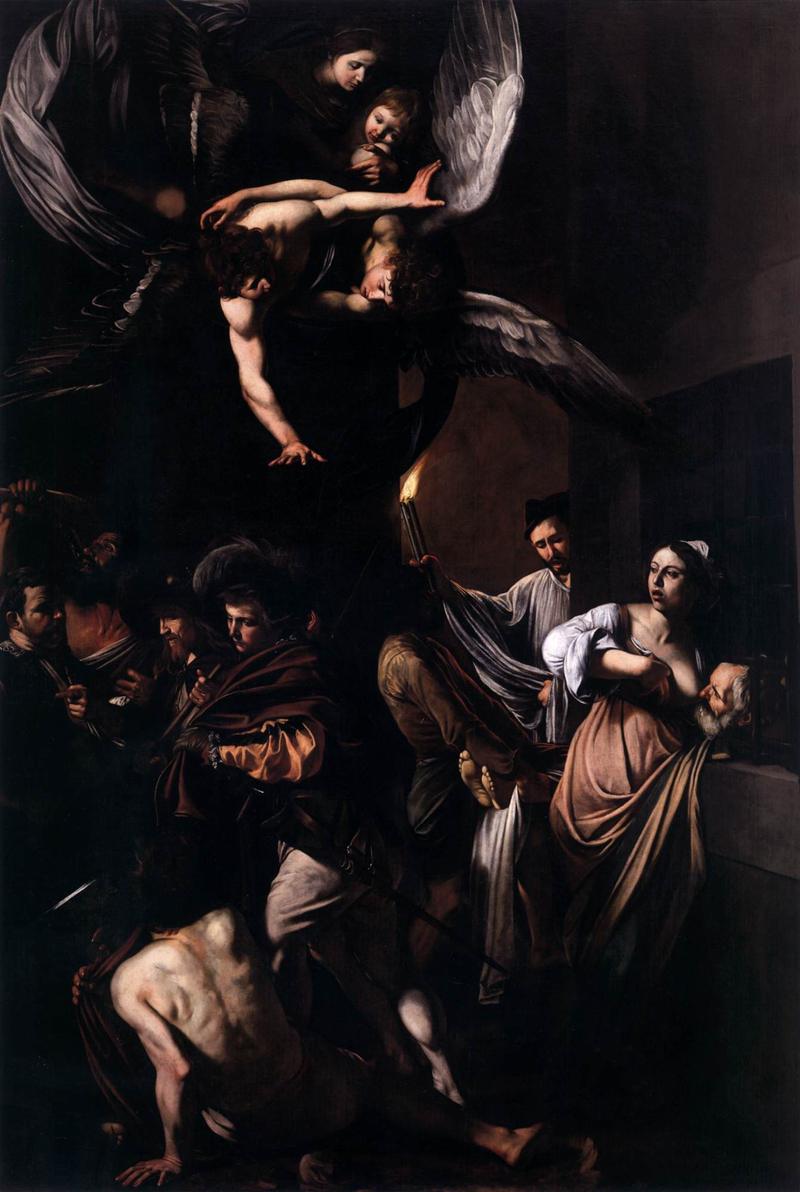
Caravaggio · The Seven Works of Mercy

Pray it today. The Chaplet of Divine Mercy takes about seven minutes on ordinary rosary beads. Many people pray it at three in the afternoon, the hour Jesus died.

Part 1 of 6 · About seven minutes

The Chaplet of Divine Mercy

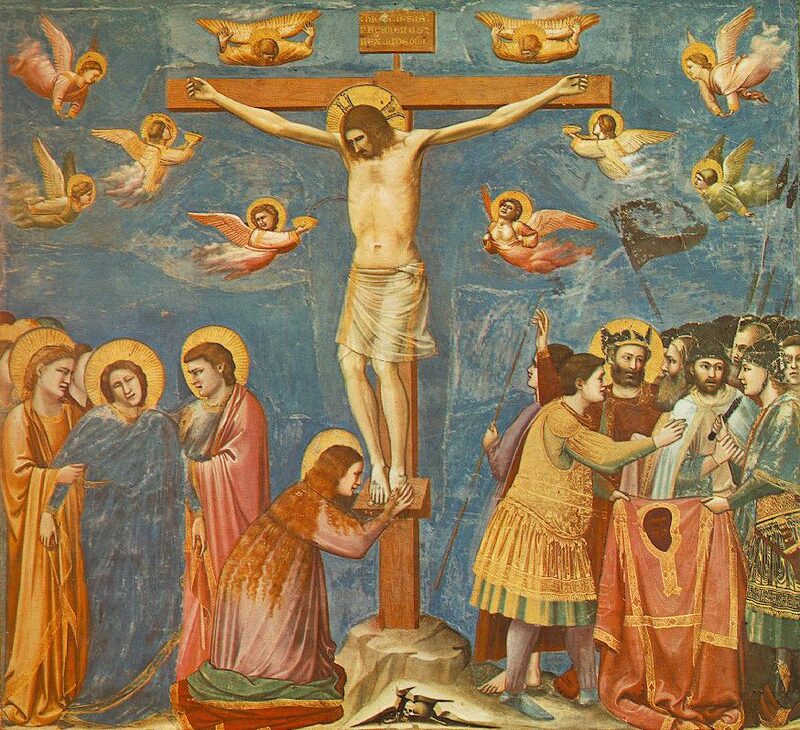
Giotto · The Crucifixion

Jesus taught this prayer to Saint Faustina in Vilnius in September 1935. You pray it on the beads of an ordinary rosary, offering the Father the sacrifice of His Son on the cross and asking mercy for yourself and for the whole world.

  1. 1

    Begin

    Make the Sign of the Cross. You may begin with this prayer, which Saint Faustina wrote in her Diary:

    “You expired, Jesus, but the source of life gushed forth for souls, and the ocean of mercy opened up for the whole world. O Fount of Life, unfathomable Divine Mercy, envelop the whole world and empty yourself out upon us.”

    Then, three times: “O Blood and Water, which gushed forth from the Heart of Jesus as a fount of mercy for us, I trust in you!”

  2. 2

    Our Father, Hail Mary, Creed

    On the first beads of the rosary, pray one Our Father, one Hail Mary and the Apostles’ Creed. The words are in Common Prayers.

  3. 3

    On each large bead

    Before each decade, offer the whole Christ to the Father:

    “Eternal Father, I offer you the Body and Blood, Soul and Divinity of your dearly beloved Son, our Lord Jesus Christ, in atonement for our sins and those of the whole world.”

  4. 4

    On the ten small beads

    On each of the ten beads of the decade:

    “For the sake of his sorrowful Passion, have mercy on us and on the whole world.”

    Then: go on to the next large bead and repeat steps 3 and 4, five decades in all.

  5. 5

    Conclude

    After the fifth decade, pray three times:

    “Holy God, Holy Mighty One, Holy Immortal One, have mercy on us and on the whole world.”

    You may add Saint Faustina’s closing prayer: “Eternal God, in whom mercy is endless and the treasury of compassion inexhaustible, look kindly upon us and increase your mercy in us, that in difficult moments we might not despair nor become despondent, but with great confidence submit ourselves to your holy will, which is Love and Mercy itself.” End with the Sign of the Cross.

The words at a glance

StartSign of the Cross; Our Father, Hail Mary, Apostles’ Creed
Large beadEternal Father, I offer you the Body and Blood, Soul and Divinity of your dearly beloved Son, our Lord Jesus Christ, in atonement for our sins and those of the whole world.
Small beads (×10)For the sake of his sorrowful Passion, have mercy on us and on the whole world.
End (×3)Holy God, Holy Mighty One, Holy Immortal One, have mercy on us and on the whole world.

Alone or together. In a group, one person says the first half of each prayer and everyone answers with the second half, from “in atonement” and “have mercy” on. It is often sung, too.

Part 2 of 6 · Płock, 22 February 1931

The image

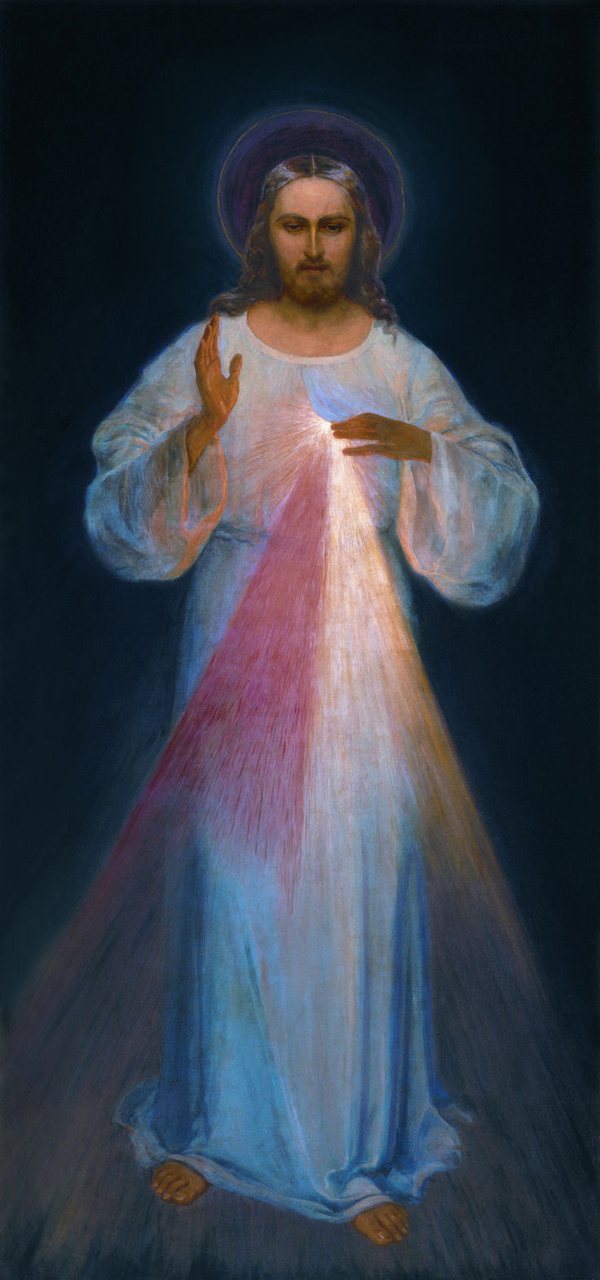
One evening in her convent cell, Saint Faustina saw Jesus dressed in white, His right hand raised in blessing and His left hand touching His garment at the breast. From there two great rays shone out, one pale and one red. He asked her to have the image painted, with the words “Jesus, I trust in you” beneath it.

The pale raystands for the Water that makes souls righteous: baptism and the forgiveness of sins.

The red raystands for the Blood that is the life of souls: the Eucharist.

Both flowed from the side of Jesus when the soldier’s lance opened His heart on the cross: “and at once there came out blood and water” (John 19:34). The Fathers of the Church saw in them the two great sacraments that give birth to the Church.

Jesus in a white garment, his right hand raised in blessing, his left hand at his breast, from where a pale ray and a red ray shine down
Eugeniusz Kazimirowski · Divine Mercy (1934), the first painting of the image

The first painting was made in Vilnius in 1934 by Eugeniusz Kazimirowski, under the eye of Saint Faustina and her confessor, Blessed Michał Sopoćko. The best-known version, by Adolf Hyła, hangs in the Shrine of Divine Mercy at Łagiewniki in Kraków. Catholics do not worship the image. Like any holy picture, it points beyond itself to the one it shows (CCC 2132), and its message is in the words at its foot.

Part 3 of 6 · Every day

The Hour of Mercy

Jesus died at about three in the afternoon (Mark 15:33-37). He asked Saint Faustina to remember that hour every day and to ask for mercy then, above all for sinners.

It does not have to be long. If you can, pray the Chaplet or make the Stations of the Cross, or stop by a church and spend a few minutes before the Blessed Sacrament. If you are at work or on the road, a moment is enough: stop, think of Jesus on the cross, and say “Jesus, I trust in you.”

Part 4 of 6 · The Second Sunday of Easter

Divine Mercy Sunday

Jesus asked Saint Faustina for a feast of mercy on the Sunday after Easter. On 30 April 2000, the day he canonized her, Saint John Paul II gave that Sunday the name Divine Mercy Sunday for the whole Church.

The day fits. Its Gospel is the evening of the Resurrection, when the risen Jesus breathes the Holy Spirit on the apostles and gives them the power to forgive sins, and then shows Thomas His wounds (John 20:19-31). Easter is where mercy comes from: “God, who is rich in mercy, out of the great love with which he loved us” made us alive with Christ (Ephesians 2:4-5).

  1. 1

    The novena: Good Friday to Saturday

    Saint Faustina’s Diary gives a novena of nine days, beginning on Good Friday. Each day brings a different group of people before Jesus, from all mankind and sinners to the souls in purgatory and the lukewarm, and closes with the Chaplet.

  2. 2

    Confession

    Go to confession in the days around the feast. Many parishes add extra times in Easter week.

  3. 3

    Mass and Holy Communion

    On the Sunday itself, receive Communion in a state of grace.

  4. 4

    The indulgence

    A decree of the Apostolic Penitentiary (29 June 2002) grants a plenary indulgence on Divine Mercy Sunday. Besides the usual conditions (confession, Communion, prayer for the Pope’s intentions and a heart free of any attachment to sin), take part in prayers and devotions in honor of Divine Mercy in a church or chapel, or at least pray the Our Father and the Creed before the Blessed Sacrament, adding a prayer to the merciful Lord Jesus such as “Merciful Jesus, I trust in you.” Those who cannot get to church, such as the sick, can still receive it in the ways the decree sets out (CCC 1471).

Part 5 of 6 · 1905-1938

Saint Faustina

Helena Kowalska was born in 1905 in the village of Głogowiec, in central Poland, the third of ten children of a poor farming family. She had less than three years of school.

At twenty she joined the Congregation of the Sisters of Our Lady of Mercy in Warsaw and took the name Sister Maria Faustina of the Most Blessed Sacrament. For thirteen years she worked as a cook, a gardener and a porter in the order’s houses. Few around her guessed that Jesus was speaking to her. At her confessor’s request she wrote down what she heard, in notebooks now published as her Diary, Divine Mercy in My Soul. She died of tuberculosis in Kraków on 5 October 1938, aged thirty-three.

The devotion spread quickly during the Second World War. In 1959 the Holy See halted its spread, because of poor translations of the Diary. After a careful study of the original text, begun in Kraków under its archbishop, Karol Wojtyła, the ban was lifted in 1978. The same man, as Pope John Paul II, beatified Faustina in 1993 and canonized her in 2000, the first saint of the new millennium. He died in 2005 on the eve of Divine Mercy Sunday. Her feast is on 5 October.

Part 6 of 6 · Good to know

What the Church teaches

The revelations to Saint Faustina are private revelations. The Church has judged them worthy of belief, but no Catholic is bound to accept them, and they add nothing to the faith. Their role is to help us live the Gospel more fully in our own time (CCC 67).

What they point to is the Gospel itself. God’s mercy is greater than any sin, and no one is too far gone to come home. Mercy does not ignore sin. It forgives the sinner who turns back, and the first step is to admit the sin (CCC 1846-1848). Saint John Paul II made the same point in his encyclical Rich in Mercy (1980), and Pope Francis opened a Jubilee Year of Mercy in 2015.

Mercy received is also mercy to be passed on. “Blessed are the merciful, for they shall obtain mercy” (Matthew 5:7). Saint Faustina named three ways: by deed, by word and by prayer. The Church lists them as the corporal and spiritual works of mercy (CCC 2447): feeding the hungry, giving drink to the thirsty, clothing the naked, welcoming the stranger, visiting the sick and the imprisoned, burying the dead; and instructing, advising, consoling, comforting, forgiving and bearing wrongs patiently. The painting at the top of this page shows the corporal works in one street in Naples.