St. Leo I
The 45th Pope440 to 461
About
“Leo the Great”: his Tome guided the Council of Chalcedon, and he met Attila in 452.
His gift to the ChurchHe gave the Church the words it still uses to say who Christ is, and showed that the Bishop of Rome could stand firm where emperors had failed.
- Pope
- 29 September 440 to 10 November 461
- Born
- c. 400, Tuscany or Rome
- Died
- 10 November 461
- Secular name
- Leo
- Buried
- St. Peter’s Basilica
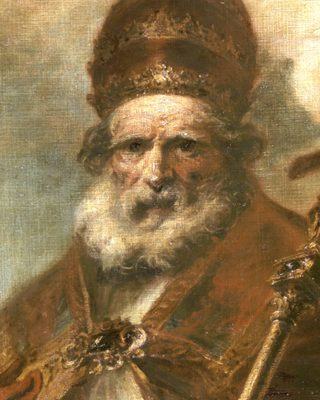
Portrait: Wikimedia Commons, public domain, file page
Life
Leo was a deacon of great influence before his election. His Tome to Flavian (449) set out the faith in one Person of Christ in two natures, divine and human; at the Council of Chalcedon (451) the bishops cried out, “Peter has spoken through Leo!” In 452 he met Attila the Hun near Mantua and persuaded him to withdraw from Italy, and in 455 he obtained from the Vandal king Gaiseric that Rome would not be burned or its people massacred. Nearly a hundred of his sermons and over 140 letters survive; they shaped the Roman liturgy and the theology of the papacy as the office of Peter. He is a Doctor of the Church.
Key moments
- c. 400Born, probably in Tuscany or in Rome
- c. 430As a deacon of Rome, asks John Cassian to write against Nestorius; Cassian’s On the Incarnation is the result
- 440Elected while away in Gaul, making peace between two Roman generals; Rome waits for his return
- 13 June 449Sends his Tome to Flavian, Patriarch of Constantinople, on Christ’s two natures
- 449Rejects the Second Council of Ephesus, which ignored his Tome, calling it a “robber council”
- 451At the Council of Chalcedon the bishops accept his Tome: “Peter has spoken through Leo!”
- 452Meets Attila the Hun near Mantua; the Huns withdraw from Italy
- 455Persuades Gaiseric the Vandal to spare Rome from fire and massacre
- 10 November 461Dies in Rome
- 1754Declared a Doctor of the Church by Benedict XIV
In his words
Christian, recognize your dignity and, now that you share in God’s own nature, do not return by sin to your former base condition.
What was visible in our Savior has passed over into his mysteries.
Did you know?
- Only three popes are called “the Great”: Leo I, Gregory I and Nicholas I. Leo was the first.
- He is the first pope whose sermons survive as a collection: 96 of them, many still read in the Liturgy of the Hours.
- Raphael painted his meeting with Attila in the Vatican, with Saints Peter and Paul in the sky above, and gave Leo the face of the pope of his own day, Leo X.
- Rome had to wait for its new bishop: he was elected while hundreds of miles away in Gaul.
His legacy
- Tome of Leo defined Christ’s two natures; adopted at Chalcedon (451)
- Persuaded Attila to withdraw from Italy (452)
- Doctor of the Church; first pope called “the Great”