St. John Paul II
The 264th Pope1978 to 2005
About
The first Polish pope: philosopher, pilgrim to 129 countries, and witness against Communism.
His gift to the ChurchHe carried the Gospel to every continent, helped bring down Communism without violence, and gave the Church the Catechism and a new hope in God’s mercy.
- Pope
- 16 October 1978 to 2 April 2005
- Born
- 18 May 1920, Wadowice, Poland
- Died
- 2 April 2005
- Secular name
- Karol Józef Wojtyła
- Motto
- Totus tuus (Totally yours)
- Buried
- St. Peter’s Basilica
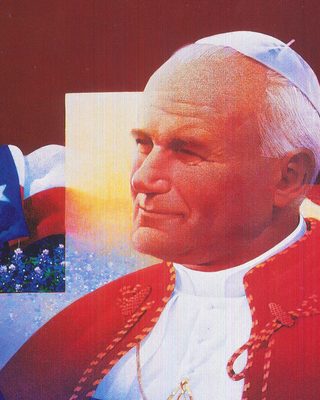
Portrait: Steven Polunsky, CC BY 2.0, via Wikimedia Commons, file page
Life
Karol Wojtyła lost his mother, brother and father by the age of 20. Under Nazi occupation he worked in a quarry and chemical plant, acted in an underground theater and studied for the priesthood in secret. A philosopher and poet, he became Archbishop of Kraków. Elected at 58, the first non-Italian since 1523, he told the world “Be not afraid!” His first visit to Poland (1979) helped give rise to the Solidarity movement and the peaceful fall of Communism in 1989. He survived an assassination attempt in St. Peter’s Square on 13 May 1981 and forgave his attacker in his prison cell. He made 104 foreign journeys to 129 countries, began World Youth Day, and canonized 482 saints. His 14 encyclicals include Redemptor Hominis, Laborem Exercens, Veritatis Splendor, Evangelium Vitae and Fides et Ratio; his Wednesday talks became the Theology of the Body. He promulgated the 1983 Code of Canon Law and the Catechism of the Catholic Church (1992), prayed at the Western Wall and asked forgiveness for the sins of Christians in the Jubilee of 2000, and added the Luminous Mysteries to the Rosary (2002). He endured Parkinson’s disease in public and died on the vigil of Divine Mercy Sunday 2005, a feast he had established. Crowds cried “Santo subito!” He was canonized in 2014.
Key moments
- 18 May 1920Karol Wojtyła is born at Wadowice, Poland
- 1941His father dies; he is left alone at 20, working in a quarry under Nazi occupation
- 1942Begins studying for the priesthood in a secret seminary
- 1 November 1946Ordained a priest
- 1958Auxiliary Bishop of Kraków, at 38
- 1964Archbishop of Kraków; a voice at the Second Vatican Council
- 16 October 1978Elected, the first non-Italian pope since Adrian VI in 1522
- 1979Returns to Poland; the next year the Solidarity movement is born. In November he visits Turkey
- 13 May 1981Shot in St. Peter’s Square by Mehmet Ali Ağca
- 27 December 1983Visits Ağca in prison and forgives him
- 1985Institutes World Youth Day
- 1989Communism falls across Eastern Europe
- 1992Catechism of the Catholic Church
- 2000The Great Jubilee; prays at the Western Wall in Jerusalem; institutes Divine Mercy Sunday
- 2 April 2005Dies on the eve of Divine Mercy Sunday
- 27 April 2014Canonized with John XXIII by Pope Francis
In his words
Do not be afraid! Open wide the doors for Christ!
Faith and reason are like two wings on which the human spirit rises to the contemplation of truth.
Did you know?
- Before he was a priest he was an actor and playwright in an underground theater in occupied Kraków.
- He was shot on 13 May 1981, the feast of Our Lady of Fatima, and said that a mother’s hand guided the bullet. The bullet is now set in the crown of her statue at Fatima.
- He canonized more saints than any pope before him.
- He made 104 journeys abroad, including a visit to Turkey in 1979.
- He kept skiing and hiking in the mountains well into his years as pope.
His legacy
- Helped bring the peaceful end of Communism in Europe
- Catechism of the Catholic Church (1992) and Code of Canon Law (1983)
- 104 pastoral journeys; founded World Youth Day
- Encyclicals including Veritatis Splendor, Evangelium Vitae and Fides et Ratio
- Theology of the Body; Luminous Mysteries; Divine Mercy Sunday
Documents
- Redemptor Hominis
- Sapientia Christiana
- Catechesi Tradendae
- Sanctorum Altrix
- Dives in Misericordia
- Egregiae Virtutis
- Laborem Exercens
- Familiaris Consortio
- Sacrae Disciplinae Leges
- Divinus Perfectionis Magister
- Salvifici Doloris
- Redemptionis Donum
- Redemptionis Anno
- Reconciliatio et Paenitentia
- Dilecti Amici
- Slavorum Apostoli
- Spirituali militum curae
- Dominum et vivificantem
- Redemptoris Mater
- Duodecimum Saeculum
- Sollicitudo Rei Socialis
- Euntes in mundum
- Pastor Bonus
- Ecclesia Dei
- Mulieris Dignitatem
- Vicesimus Quintus Annus
- Christifideles Laici
- Redemptoris Custos
- Ex Corde Ecclesiae
- Redemptoris Missio
- Centesimus Annus
- Pastores Dabo Vobis
- Fidei Depositum
- Veritatis Splendor
- Ordinatio Sacerdotalis
- Tertio Millennio Adveniente
- Evangelium Vitae
- Orientale Lumen
- Ut Unum Sint
- Ecclesia in Africa
- Universi Dominici Gregis
- Vita Consecrata
- Operosam Diem
- A New Hopefor Lebanon
- Laetamur magnopere
- Divini Amoris Scientia
- Ad Tuendam Fidem
- Apostolos Suos
- Dies Domini
- Fides et Ratio
- Incarnationis mysteriumof indiction of the Great Jubilee of the Year 2000
- Ecclesia in America
- Spes AedificandiProclamation of the Co-Patronesses of Europe
- Ecclesia in Asia
- Novo Millennio Ineunte
- Ecclesia in Oceania
- Misericordia Deion certain aspects of the celebration of the Sacrament of Penance
- Rosarium Virginis Mariaeon the Most Holy Rosary
- Ecclesia de Eucharistia
- Ecclesia in Europa
- Pastores gregis
- Spiritus et Sponsaon the 40th anniversary of the Constitution "Sacrosanctum Concilium" on the Sacred Liturgy
- Mane nobiscum Domine